
On this page
Your needs, this model
Does it fit your priorities?
Does this exact two-station package meet your 240 V output and nameplate-energy floor?
Pecron states 7,200 W at 240 V for two E3600LFP stations with the series kit; the two 3,072 Wh nameplates sum to 6,144 Wh.
Explore this need in the finder →How many separate station units must the exact offer contain?
The selected SKU identifies two E3600LFP units; this is an offer count, not a claim that their electrical ratings can be freely added in every mode.
Explore this need in the finder →Do you need four named PV300 panels in the box, and is their combined 1,200 W nameplate enough?
This option names four PV300 panels at 300 W each. The package-specific wiring is unknown, so all-panels-together operation is not confirmed.
Explore this need in the finder →Must a manual transfer switch be in the exact box for your home-backup plan?
The selected option identifies the station pair and 240V Connect Box, not a manual transfer switch.
Explore this need in the finder →Pecron · four-panel 240 V package with a trolley
Pecron dual E3600LFP 240V Connect Box with four PV300 panels and trolley review
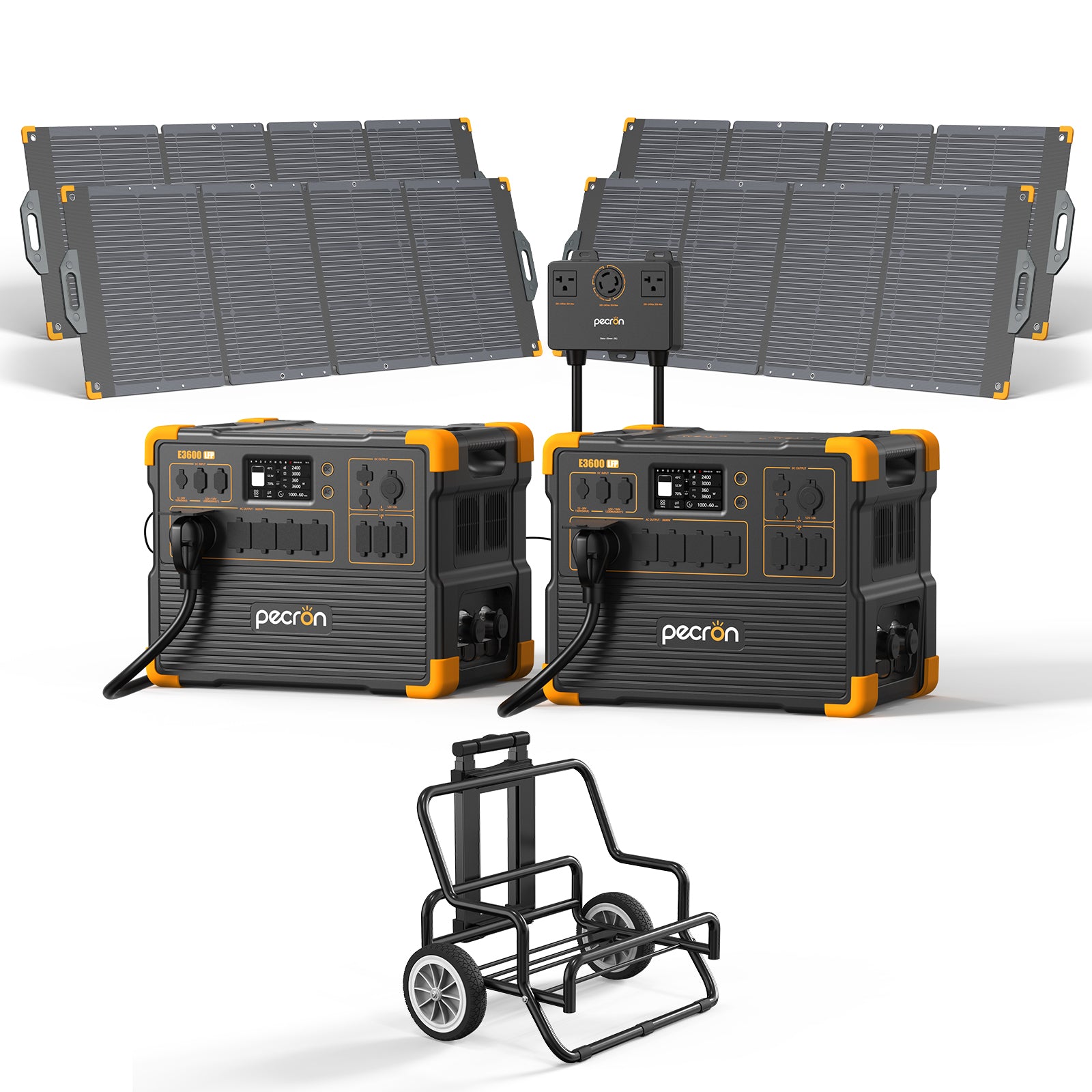
The exact selection is 2*E3600LFP+240V box+4*PV300 / With Trolley, SKU 2*E3600LFP+240V box+4*PV300+CART, variant 44155299758268. It pairs two E3600LFP stations with the Connect Box and the four PV300 panels named in the offer; the selected trolley option adds one cart. Pecron states 7,200 W at 240 V for two E3600LFPs with its series-connection kit. Two 3,072 Wh station nameplates sum to 6,144 Wh. The extra cart is a handling accessory; it does not change the system output or battery capacity. In the archived product JSON, this exact option was marked unavailable, so check the current listing before planning around it.
Choose this only for a verified 240 V plan
A single E3600LFP is rated at 3,600 W and 120 V. The selected package is different because Pecron describes the pair plus its connection kit as a 7,200 W, 240 V arrangement, and the standalone Connect Box page explicitly names a two-E3600LFP pairing. That is a useful published distinction, but it is not a full electrical specification. The retained materials do not identify the 240 V receptacle standard, maximum current at each outlet, surge capability, installation cable path or whether any home transfer equipment is included. Confirm that the exact load and connector are supported before buying; do not treat the bundle as a generic substitute for a professionally designed home-backup system.
For a 120 V-only setup, buying two units and a box may be needless complexity. The bundle makes more sense where the 240 V requirement is explicit and the listed rated output covers it. Its 6,144 Wh is a sum of battery nameplates, not a usable AC-energy rating. The manufacturer has not provided a paired-system runtime guarantee in the reviewed material, so plan with a conservative energy budget rather than dividing nameplate watt-hours by a load and calling that exact runtime.
Panels are bundled; the array plan is not
The option names four PV300 panels, equivalent to 1,200 W of combined panel nameplate if each is the listed 300 W class. But neither the offer text nor the page image documents how those panels should be distributed across the two E3600LFP stations, what cables are supplied, or whether they form one compatible array at published ratings. The manufacturer’s base station materials list two solar inputs and a 2,400 W ceiling for an individual E3600LFP, but that is not a paired-system wiring map. The official-looking render illustrates the package pieces, not the electrical topology. The exact PV300-to-S300/manual bridge remains unresolved; use only model-matched manufacturer connection instructions.
If solar charging is essential, this package at least places four named panels in the selected option. If all panels must operate together at their rated figures, do not count this as a confirmed fit until Pecron supplies that configuration-specific wiring answer. Panel nameplate is not a forecast of daily energy: orientation, shade, weather and the station’s actual input behavior matter. A buyer with an existing array should compare connectors and voltage limits before assuming this package simplifies anything.
The trolley helps once, not everywhere
Pecron lists the E3600LFP at roughly 79 lb per station. The two bare units therefore total about 158 lb before the box, cart, panels, leads and accessories. The exact variant SKU adds “CART,” and the manufacturer image shows one trolley, not two. The page does not state the cart’s maximum load, tire capacity, terrain rating, whether it attaches to the stations, or how the panels travel. Do not infer that one trolley carries the pair together; it may simply help reposition a station across a suitable floor. The additional cart is useful if your site plan includes rolling the equipment, but it does not make this a lightweight travel kit or solve stair access.
Questionnaire tradeoffs and alternatives
Select 240 V and set the output and capacity minimums to the load’s real requirements. This reviewed plan has 7,200 W at 240 V and 6,144 Wh of nameplate capacity. A four-panel requirement at 1,200 W or less can distinguish this offer from the no-panel dual option; a higher minimum should reject it. If all four panels must be confirmed as a single supported array, the unknown wiring must not satisfy that essential condition. A transfer-switch requirement should also exclude the package: the Connect Box is not documented here as a manual or smart transfer switch. Needs above the published output or summed capacity require a different verified system, not an assumption about surge or expansion.
Compared with the no-cart, four-panel E3600 package, this version adds the listed trolley while retaining the same station pair, output headline and panel bundle. The no-panel trolley package is a simpler comparison if you already own verified charging equipment; a standalone E3600LFP is more proportionate for 120 V loads. Choose this SKU only when the 240 V use case, panel bundle and occasional rolling all match your plan. Before purchase, confirm current inventory and ask Pecron for the exact 240 V setup, panel cable arrangement and cart loading instructions.
Manufacturer references: exact four-panel trolley option and 240V Connect Box compatibility page.
Key details at a glance
| Nameplate battery capacity | 6144 Wh |
|---|---|
| Rated AC output | 7200 W |
| Maximum solar input | 2400 W |
| Included panels, combined nameplate | 1200 W |
| Maximum USB-C output per port | 100 W |
| 12 V DC output | 360 W |
More specifications and setup details
| Maximum AC recharge input | 3200 W |
|---|---|
| Total rated DC output | 360 W |
| AC outlet output | Yes |
| USB-C ports | 2 |
| USB-A ports | 4 |
| Solar input ports | 2 |
| 12 V car-style output | 120 W |
| Vehicle charge input | 150 W |
| Battery chemistry | LiFePO4 |
| Expansion battery in this package | No |
| Home Power Panel in this package | No |
| Separate station units in offer | 2 |
| Smart Transfer Switch in this package | No |
| Solar panels in exact offer | 4 |
Use the exact model’s instructions for operating limits, supplied equipment and version differences.
Sources for this assessment

A useful match starts with the loads that matter.
Use the finder for hard electrical requirements, then check appliance starting behavior, actual run time and the exact package in the full assessment.