
On this page
Your needs, this model
Does it fit your priorities?
Does this exact two-station package meet your 240 V output and nameplate-energy floor?
Pecron states 7,200 W at 240 V for two E3600LFP stations with the series kit; the two 3,072 Wh nameplates sum to 6,144 Wh.
Explore this need in the finder →How many separate station units must the exact offer contain?
The selected SKU identifies two E3600LFP units; this is an offer count, not a claim that their electrical ratings can be freely added in every mode.
Explore this need in the finder →Do you need four named PV300 panels in the box, and is their combined 1,200 W nameplate enough?
This option names four PV300 panels at 300 W each. The package-specific wiring is unknown, so all-panels-together operation is not confirmed.
Explore this need in the finder →Must a manual transfer switch be in the exact box for your home-backup plan?
The selected option identifies the station pair and 240V Connect Box, not a manual transfer switch.
Explore this need in the finder →Pecron · paired 240 V system and four-panel bundle
Pecron dual E3600LFP 240V Connect Box with four PV300 panels review
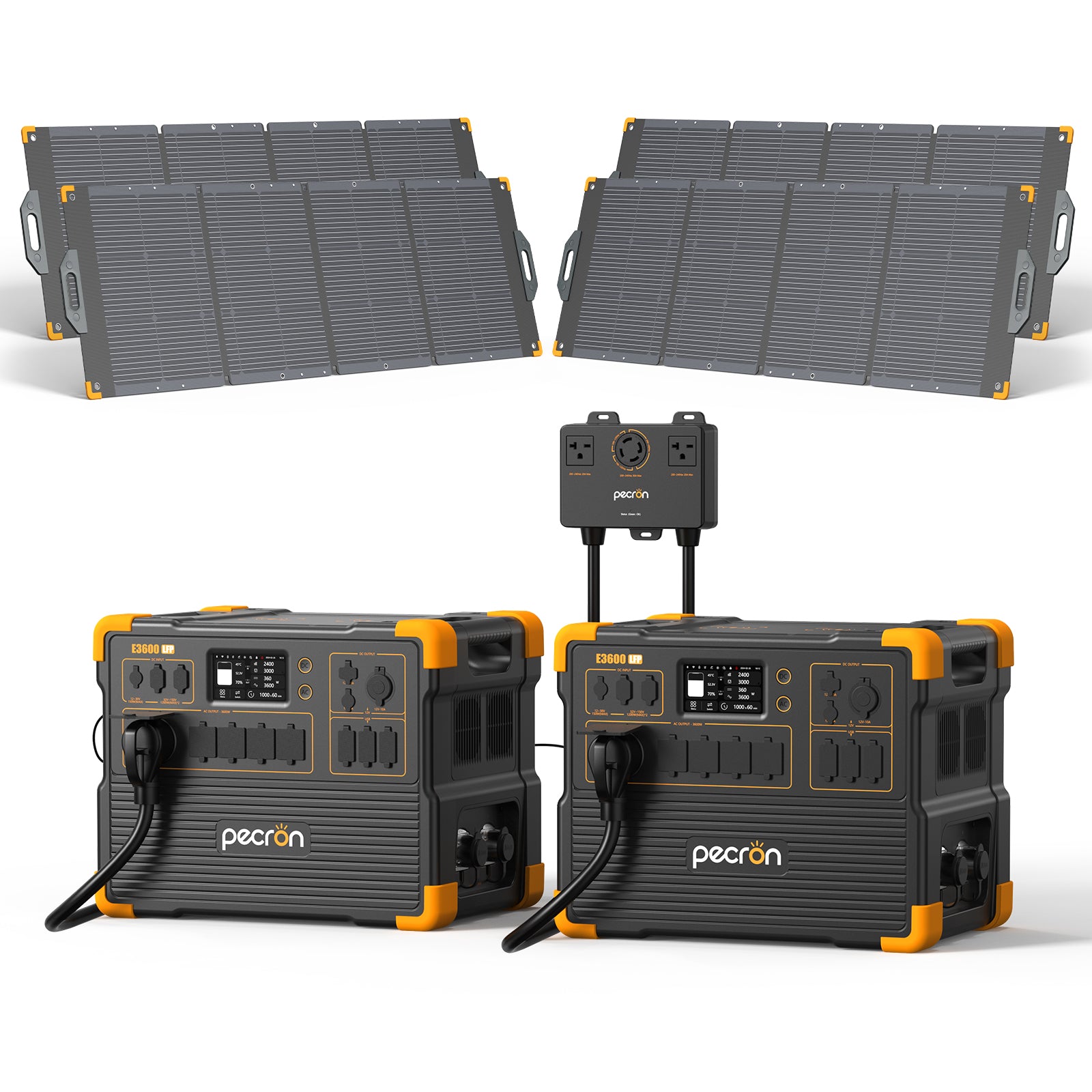
Pecron’s selected U.S. option 2*E3600LFP+240V box+4*PV300 combines two E3600LFP stations, the 240V Connect Box and four panels identified as PV300 by the exact product-page option. Each station is listed at 3,072 Wh; the pair’s nameplate sum is 6,144 Wh. Pecron says the two-station series kit produces 7,200 W at 240 V. The four panels are a separate bundle advantage, not proof that the complete array has a documented connection plan. This option was marked unavailable in the archived U.S. product JSON; check the current page for live stock and exact contents.
A system for loads that actually need 240 V
The paired mode is the defining reason to look here. A single E3600LFP is a 3,600 W, 120 V station; Pecron’s product-page description says two of them with the 240V series kit provide 7,200 W at 240 V. The separate Connect Box page also identifies two E3600LFPs as a compatible pair. Those claims support considering this configuration for a specifically verified 240 V load. They do not establish that a particular plug, transfer switch or home circuit is included. No receptacle standard, outlet current limit, paired surge figure, whole-home panel or installation instructions were found in the retained offer evidence.
Check the appliance nameplate and the connection design before choosing the bundle. A 240 V product headline is not enough to confirm that a pump, dryer, workshop machine or panel inlet will connect safely. The package is a collection of two heavy portable stations and a connection box, not a listed home-transfer system. If it will feed fixed household circuits, obtain the correct equipment and use qualified electrical advice rather than making a direct building-wiring connection.
Four panel names add 1,200 W of nameplate, not guaranteed harvest
The selected SKU names four PV300 panels; the manufacturer’s panel option is a 300 W class, so their listed nameplates sum to 1,200 W. That is a package-content figure, not a promise of 1,200 W in real conditions or proof of one approved array topology. The exact product image shows the paired stations, box and fold-out panel group, but a render cannot establish connector compatibility, cable inclusion, series/parallel wiring, or whether all panels may be combined on one station input. The station page lists two solar inputs per E3600LFP with a 2,400 W maximum per unit, yet the retained evidence does not map these four panels across both stations in the paired 240 V system.
For that reason, this bundle is more convincing for a buyer who wants panels supplied and is willing to confirm setup details than for a buyer who requires a guaranteed charging rate. The archived S300 manual is not enough to bridge the PV300 panel’s model identity, and the selected offer’s picture is not a wiring diagram. Ask Pecron which cables arrive and exactly how it intends these four panels to connect before treating their combined nameplate as available charging power.
Stored energy and handling still set the limits
Two 3,072 Wh station nameplates add to 6,144 Wh; Pecron does not publish the paired option’s usable AC energy. A 7,200 W rating is instantaneous output capability, not runtime. Long outages and high-draw equipment need an energy budget based on the actual load, reserve needs and recharge plan. Do not assume the four panels replenish a full battery each day without site, season and wiring details.
Each E3600LFP weighs about 79 lb, so the two station bodies total roughly 158 lb before the box, cables or panels. This four-panel option has no trolley in the selected title. It suits a prepared site where the stations and panel set can be placed and deployed, not someone who expects a compact grab-and-go kit. It also requires storage for two stations and several separate panel sections; the exact package image helps show the scale of the components but is not a dimensioned layout.
Who should choose this option?
Consider it when your essential load truly requires 240 V, the manufacturer’s 7,200 W rating covers that load, you want a two-station 6,144 Wh nameplate system, and a panel-in-box bundle is useful. The solar package differentiates it from the no-panel version. It is not automatically better if you already own compatible panels, lack space, require a cart, or need a confirmed transfer-switch and wiring kit. A single E3600LFP may be the more proportional choice for ordinary 120 V equipment, while another package may be safer for a fixed home-backup installation with documented switching equipment.
In the finder, select 240 V and set the continuous-output and nameplate-capacity floors. Requiring at least four included panels and 1,200 W of panel nameplate can distinguish this package from the no-panel option. Requiring all four panels to work together as one verified array should not pass on the evidence available here; that essential connection detail is still unknown. A manual or smart transfer-switch requirement should also exclude the package, and a threshold above 7,200 W or 6,144 Wh should reject it. If your needs depend on an exact array layout, outlet type, runtime or home-circuit plan, pause until Pecron confirms those details for this selected configuration.
Manufacturer references: exact four-panel E3600LFP option and 240V Connect Box compatibility page.
Key details at a glance
| Nameplate battery capacity | 6144 Wh |
|---|---|
| Rated AC output | 7200 W |
| Maximum solar input | 2400 W |
| Included panels, combined nameplate | 1200 W |
| Maximum USB-C output per port | 100 W |
| 12 V DC output | 360 W |
More specifications and setup details
| Maximum AC recharge input | 3200 W |
|---|---|
| Total rated DC output | 360 W |
| AC outlet output | Yes |
| USB-C ports | 2 |
| USB-A ports | 4 |
| Solar input ports | 2 |
| 12 V car-style output | 120 W |
| Vehicle charge input | 150 W |
| Battery chemistry | LiFePO4 |
| Expansion battery in this package | No |
| Home Power Panel in this package | No |
| Separate station units in offer | 2 |
| Smart Transfer Switch in this package | No |
| Solar panels in exact offer | 4 |
Use the exact model’s instructions for operating limits, supplied equipment and version differences.
Sources for this assessment

A useful match starts with the loads that matter.
Use the finder for hard electrical requirements, then check appliance starting behavior, actual run time and the exact package in the full assessment.