
On this page
Your needs, this model
Does it fit your priorities?
Does this exact two-station package meet your 240 V output and nameplate-energy floor?
Pecron states 7,200 W at 240 V for two E3600LFP stations with the series kit; the two 3,072 Wh nameplates sum to 6,144 Wh.
Explore this need in the finder →How many separate station units must the exact offer contain?
The selected SKU identifies two E3600LFP units; this is an offer count, not a claim that their electrical ratings can be freely added in every mode.
Explore this need in the finder →Do you require the exact package itself to include solar panels?
No panel is listed in this exact selected option. Individual station solar inputs exist, but the linked-system array plan is not established.
Explore this need in the finder →Must a manual transfer switch be in the exact box for your home-backup plan?
The selected option identifies the station pair and 240V Connect Box, not a manual transfer switch.
Explore this need in the finder →Pecron · paired 240 V backup
Pecron dual E3600LFP 240V Connect Box package review
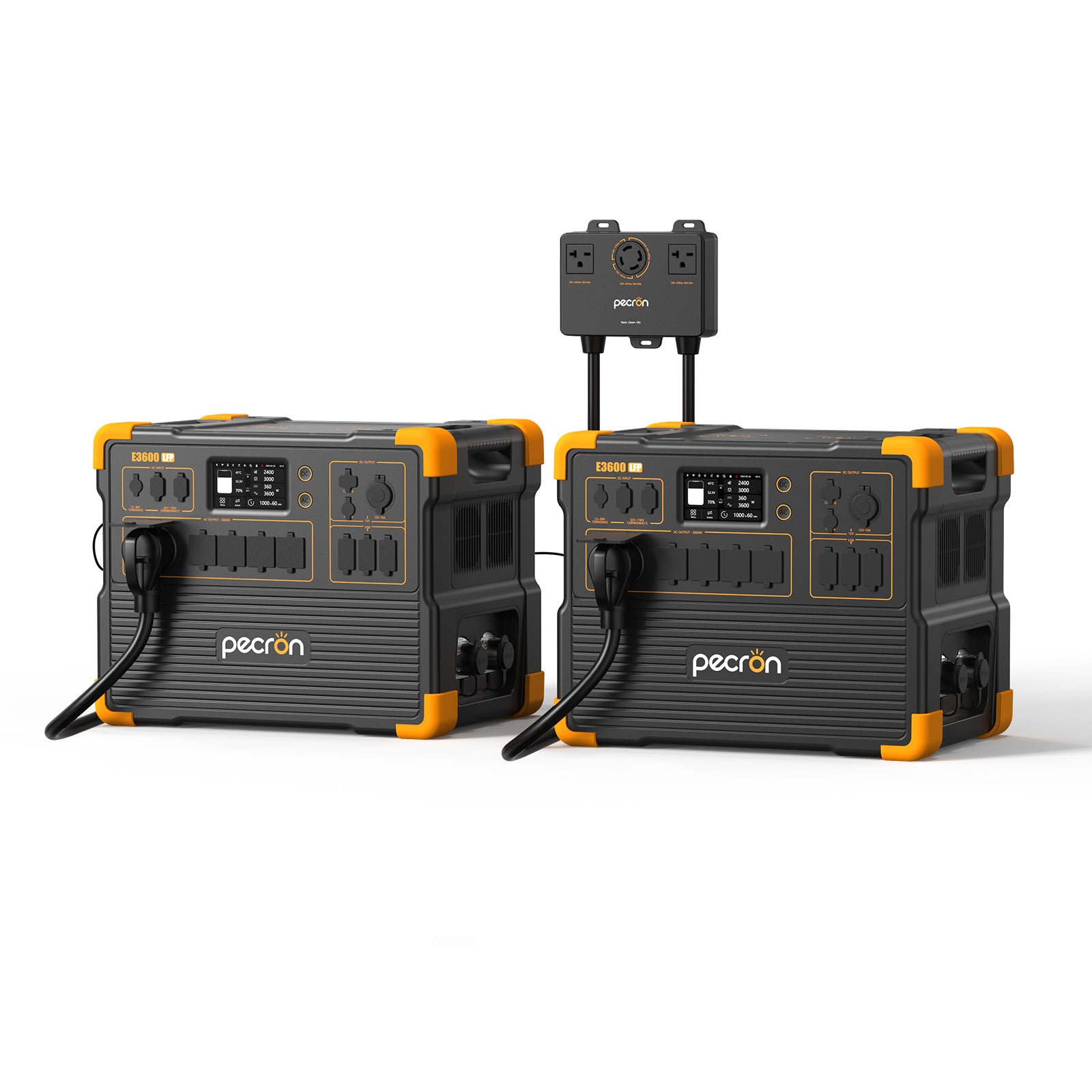
The exact U.S. selection is SKU 2*E3600LFP+240V box: two E3600LFP stations and Pecron’s 240V Connect Box, without the optional trolley or solar-panel bundle. In its product-page description, Pecron says the pair and series-connection kit provide 7,200 W at 240 V. A separate manufacturer page identifies this Connect Box as compatible with two E3600LFP stations. This is materially different from buying one E3600LFP, whose individual-station rating is 3,600 W at 120 V. The archived U.S. product JSON marked this exact selection unavailable when captured; stock can change, so verify the live option rather than assuming the page snapshot is a present offer.
Buy it only when the load truly needs 240 V
The reason to consider this larger configuration is a 240 V appliance or a specifically planned 240 V system. A single station does not become a 240 V source just because its model page also describes a paired kit. Pecron’s 7,200 W statement applies to two stations linked with the box. It should not be read as 7,200 W available from one 120 V outlet, or as proof that every 240 V appliance will plug into the box. The retained manufacturer material does not identify the box’s receptacle standard, per-outlet limits, surge behavior, wiring procedure, or an included home transfer switch.
Before selecting it, compare the appliance nameplate and startup requirements with the exact system rating, and confirm the connection method with Pecron. A 240 V headline does not establish compatibility with a home panel inlet or authorize backfeeding house wiring. For fixed circuits, use the equipment and qualified electrical help appropriate to the installation. If all of your loads are ordinary 120 V devices, one E3600LFP or a smaller station may avoid buying a second large unit and a specialized linking box.
Two station batteries are not the same as usable AC energy
Each E3600LFP is listed at 3,072 Wh, so the pair contains 6,144 Wh of summed nameplate battery capacity. That is a transparent arithmetic total, not a manufacturer-published usable-AC figure or a promise of runtime. Conversion losses, load behavior, temperature and operating conditions affect delivered energy; no defensible number of hours follows from the nameplate alone. The linked system’s 7,200 W output rating answers a different question: the rated power available in the stated paired mode. Heavy loads can draw through stored energy quickly even when they stay within that power ceiling.
The station is a substantial appliance, not a hand-carry backup. Pecron lists each E3600LFP at about 79 lb; two station bodies therefore total roughly 158 lb before the Connect Box, cables, packaging or any accessories. This SKU does not list a trolley. Plan the permanent location, access path and ventilation before delivery, and do not rely on the product image as a scale drawing or installation diagram.
Solar and expansion need separate confirmation
This exact option lists no solar panels. The individual E3600LFP station documentation describes solar inputs, but the retained materials do not give a complete paired-system solar wiring plan or an aggregate charging ceiling for the two-unit 240 V setup. Do not double an individual-station input figure into a system promise without the approved connection instructions. The base station page also describes expansion batteries, but its product copy and current selected options do not resolve every battery-version bridge; compatibility while the stations are connected in this 240 V configuration is not established here. A buyer who needs a particular recharge time, a specified solar array or added batteries should get a written configuration-specific answer before purchasing.
What changes with the finder
Choose 240 V and set the continuous AC-output and nameplate-capacity minimums that your load actually requires. This configuration’s reviewed plan is 7,200 W at 240 V with 6,144 Wh of summed station nameplates. Requiring an included solar panel should remove it: none is named in this selected option. A requirement for a manual or smart transfer switch should also remove it because the package is a station pair and Connect Box, not a listed transfer-switch kit. A demand above 7,200 W or 6,144 Wh should not be waved through on the strength of a surge number, estimated AC energy, or an unconfirmed expansion pack. Those limits are useful reasons to compare a different system rather than stretch the facts.
In short, this is a narrowly purposeful configuration for someone who has a verified 240 V use case, room for two large stations, and a separate plan for installation and charging. It is a poor fit for someone who mainly wants a portable 120 V box, a complete solar kit, a mobile cart, verified whole-home transfer equipment or an established runtime calculation. When the precise outlet and connection instructions matter, ask Pecron before treating the selected option as ready to use.
Manufacturer references: exact E3600LFP package option and 240V Connect Box compatibility page.
Key details at a glance
| Nameplate battery capacity | 6144 Wh |
|---|---|
| Rated AC output | 7200 W |
| Maximum solar input | 2400 W |
| Included panels, combined nameplate | 0 W |
| Maximum USB-C output per port | 100 W |
| 12 V DC output | 360 W |
More specifications and setup details
| Maximum AC recharge input | 3200 W |
|---|---|
| Total rated DC output | 360 W |
| AC outlet output | Yes |
| USB-C ports | 2 |
| USB-A ports | 4 |
| Solar input ports | 2 |
| 12 V car-style output | 120 W |
| Vehicle charge input | 150 W |
| Battery chemistry | LiFePO4 |
| Expansion battery in this package | No |
| Home Power Panel in this package | No |
| Separate station units in offer | 2 |
| Smart Transfer Switch in this package | No |
| Solar panels in exact offer | 0 |
Use the exact model’s instructions for operating limits, supplied equipment and version differences.
Sources for this assessment

A useful match starts with the loads that matter.
Use the finder for hard electrical requirements, then check appliance starting behavior, actual run time and the exact package in the full assessment.