
On this page
Your needs, this model
Does it fit your priorities?
Does the documented E3600LFP (U.S. standalone SKU E3600LFP, without trolley) station plan meet 3,072 Wh and 3,600 W at 120 V without counting any unverified package additions?
The E3600LFP (U.S. standalone SKU E3600LFP, without trolley) station itself is listed at 3,072 Wh and 3,600 W at 120 V. Any listed EP3800 modules or second-station arrangement is not added to a confirmed package capacity here.
Explore this need in the finder →Do you need two separate station units and the listed carts in the same offer?
The exact selected option identifies two station units and two carts; it does not confirm a combined 240 V operating plan.
Explore this need in the finder →Can the listed EP3800-48V pack(s) be counted as compatible included expansion capacity?
The selected option lists 8 EP3800-48V pack(s), but the exact E3600LFP (U.S. standalone SKU E3600LFP, without trolley) compatibility and cable path remain unresolved. Use the station-only plan unless Pecron confirms this specific revision and supported capacity.
Explore this need in the finder →Pecron · two E3600LFP stations · 240 V box and two carts listed
A very large package, not a verified 240 V plan
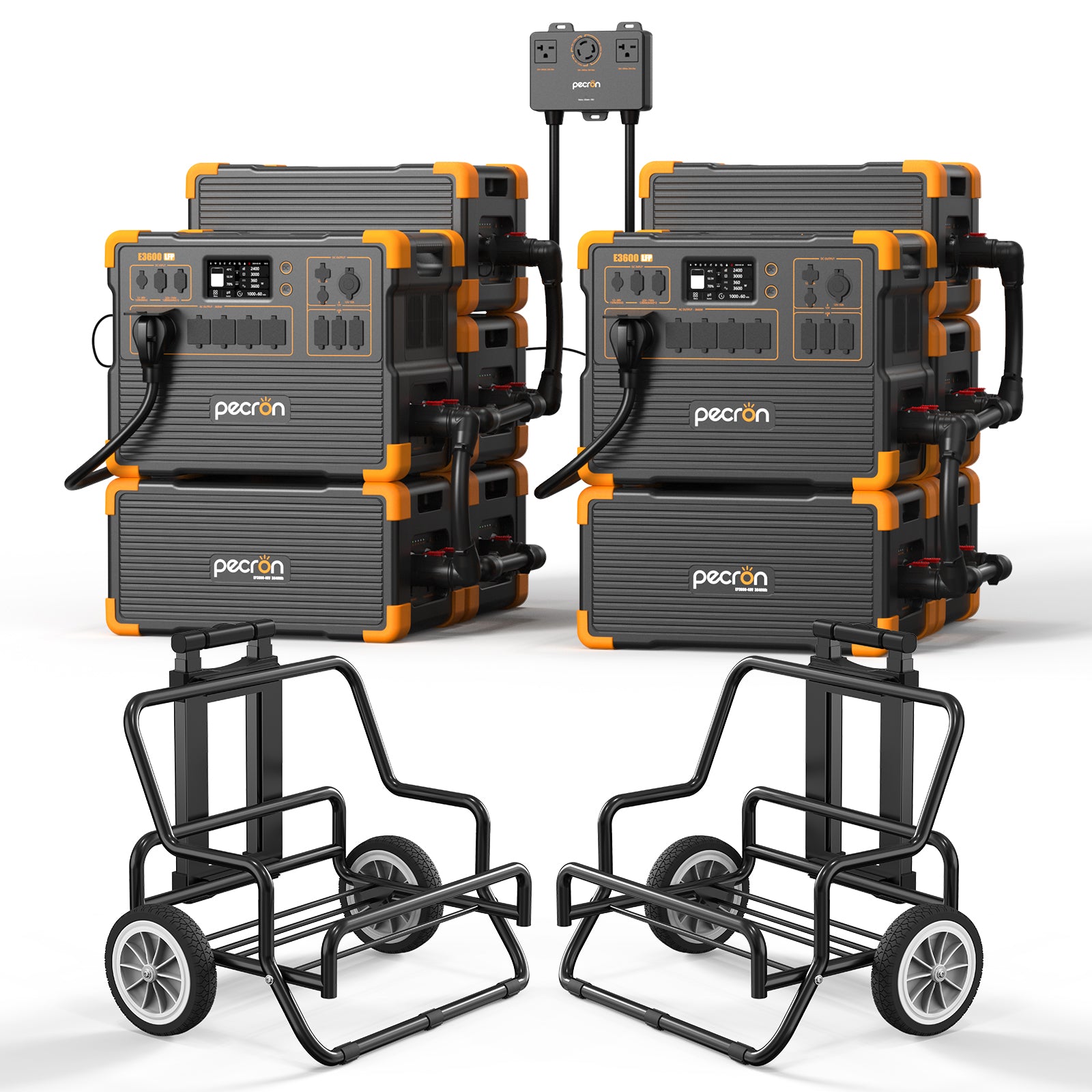
The selected option is unusually explicit about its contents: two E3600LFP stations, eight EP3800-48V packs, a 240V box and two carts. That is useful identity evidence, but the package title is not an installation manual. Each E3600LFP station is a 120 V, 3,600 W unit with a 3,072 Wh nameplate. This assessment treats those as individual station ratings; it does not add their output into one 7,200 W circuit or claim that the included box creates a supported 240 V system. The exact connection, permitted loads, cable set and system-level limits are not established in the reviewed material.
The eight named EP3800 packs are another reason to slow down. The selected product option lists them, but the E3600 manual and the pack documents do not bridge this exact station revision and eight-pack arrangement. Do not calculate a package capacity by multiplying a pack label or assume every battery connects to the stations. The finder therefore does not credit a compatible expansion-battery count or combined capacity for this offer. Ask Pecron for the exact station and pack revisions, an approved wiring diagram, required accessory models and the resulting supported capacity before using it as a home-backup design.
The image is a manufacturer rendering showing the dual stations, the box and carts, but a rendering cannot verify supplied leads or safe operation. The two carts are listed as included; their weight limits, caster/brake details, terrain use and dimensions remain unknown. Two heavy stations and multiple batteries are a substantial delivery, storage and setup job even if the cart helps once the equipment is on a suitable floor.
What can be planned from the saved evidence
The defensible plan is to view this as two individually specified E3600 units. Each unit’s own 120 V output can be evaluated against a 120 V appliance load up to its rated continuous limit. Whether each has its own separate circuit or shares a larger system is a site question that the package listing does not answer. Use each station’s 3,072 Wh nameplate as a per-unit reference, not a published combined usable-energy promise. Runtime depends on the load, inverter losses, reserve and whether both stations actually operate independently in the intended setup.
If your goal is 240 V equipment, pause here. A 240V box named in the variant may be intended for a system connection, but we do not have the exact manual evidence needed to tell you how it is wired or what load it can support. Do not connect it to home wiring or an appliance based only on the title or rendering. A licensed electrician and written manufacturer instructions are the right next steps for permanent or transfer-connected loads. If you need a predictable 120 V plan, compare one E3600 or a documented station-and-battery configuration instead.
For a stationary property with high outage needs, this might be worth investigating because the selected package contains two station bodies and accessory hardware rather than relying on an owner to assemble a list of parts. But the included-parts count should not be confused with verified system capability. Ask about parallel operation, 240 V output, pass-through charging, grounding, transfer equipment, approved battery connections and warranty coverage as a set. Missing one detail can change whether this bundle fits a real installation.
Who should skip it
Skip this package if you need immediately verifiable 240 V service, known total storage, a published transfer-switch plan or a compact transport solution. The only accepted output choice in the finder is the station-level 120 V plan. It can recognize that the option lists two station units and two carts; it will not match a 240 V need or eight compatible expansion batteries until the missing system bridge is established. The selected option was marked unavailable in the archived U.S. product data, so current availability is also uncertain. Confirm the exact SKU, full contents and installation documentation before making a high-cost purchase.
Key details at a glance
| Nameplate battery capacity | 3072 Wh |
|---|---|
| Rated AC output | 3600 W |
| Manufacturer surge rating | 7000 W |
| Maximum solar input | 2400 W |
| Included panels, combined nameplate | 0 W |
| Maximum USB-C output per port | 100 W |
More specifications and setup details
| Listed weight | 79 lb |
|---|---|
| Compatible extra-battery expansion | Yes |
| 12 V DC output | 360 W |
| Maximum AC recharge input | 3200 W |
| AC outlet output | Yes |
| USB-C ports | 2 |
| USB-A ports | 4 |
| Solar input ports | 2 |
| 12 V car-style output | 120 W |
| Vehicle charge input | 150 W |
| Battery chemistry | LiFePO4 |
| Home Power Panel in this package | No |
| Separate station units in offer | 2 |
| Smart Transfer Switch in this package | No |
| Solar panels in exact offer | 0 |
Use the exact model’s instructions for operating limits, supplied equipment and version differences.
Sources for this assessment

A useful match starts with the loads that matter.
Use the finder for hard electrical requirements, then check appliance starting behavior, actual run time and the exact package in the full assessment.