
On this page
Your needs, this model
Does it fit your priorities?
Do you need Pecron’s paired 240 V system and panels named in the selected option?
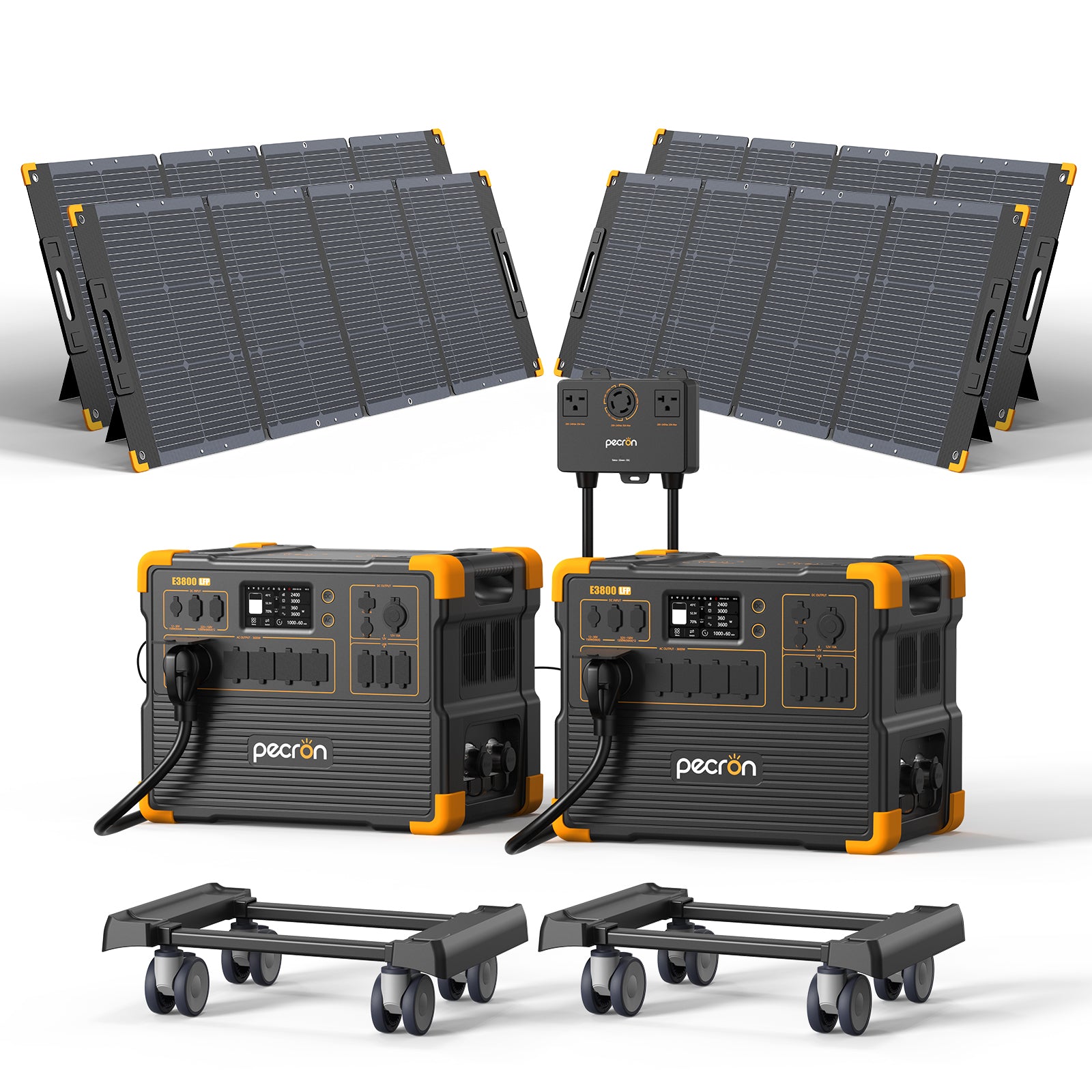
The exact SKU adds four PV300 panels to two E3800LFP stations and the 240V Connect Box; four 300 W panel ratings sum to 1,200 W nameplate, not guaranteed harvest.
Explore this need in the finder →Can one E3800LFP station serve a 120 V, 4,200 W load when used individually?
An individual E3800LFP is rated 4,200 W / 120 V; use the single-station plan and do not mistake the box for a 120V output combiner.
Explore this need in the finder →Do you need a single USB-C port rated above 100 W?
Each E3800LFP documents one 100 W USB-C port; the pair does not create a higher-wattage single port.
Explore this need in the finder →Pecron · two stations, four-panel 240 V option
Pecron E3800LFP 240V package with four PV300 panels review
The exact U.S. listing option 2*E3800LFP+240V box+ 4*PV300+2*Cart combines two E3800LFP stations, Pecron’s 240V Connect Box, four PV300 panels and two carts. It is not the one-station E3800LFP-PV300 kit with a larger inverter: Pecron identifies a separate dual-station 240 V mode and quotes up to 8,400 W for two E3800LFP units with the box. The four panels add a solar bundle; they do not create the paired output or increase the battery nameplate capacity.
The four panels are a starting point, not a harvest promise
The selected option names four PV300 panels. The standalone PV300 page rates a panel at 300 W, so the bundle has 1,200 W of total panel nameplate by arithmetic. That is not 1,200 W delivered continuously, a daily energy total, or a time-to-full estimate. Sun angle, shading, temperature, clouds, orientation, cable length, and conversion losses all matter. Four separate panels also take space to unfold, aim, secure, and store; the exact option adds more outdoor setup than the no-panel two-station bundle.
The E3800 manual describes two XT60 solar inputs per station, each rated up to 1,500 W, with a 32–150 V range and 20 A maximum; the stated single-station total is 3,000 W. Those are station input limits, not a confirmed total for the dual-unit 240 V system. The listing does not explain whether the four panels are split between the two stations, what adapter leads are included, or what array layout is approved. Do not treat the CGI arrangement as a wiring diagram. If solar charging is essential, ask the seller for the exact station-side cable list and the manufacturer’s connection instructions for this paired option before relying on all four panels together.
There is a panel-name bridge worth checking
The chosen U.S. package and its product-page option call the modules PV300, and the associated product page titles them as 300 W PV300 panels. The linked manual’s cover says 300 W / 36 V but its technical table labels the model S300. That table lists 36 V nominal operating voltage, 8.3 A operating current, 41.4 V open-circuit voltage, 8.7 A short-circuit current, MC4 connectors, and IP67 panel protection. This is useful electrical information, but it does not prove that PV300 and S300 are interchangeable revisions. The panel identity shown in the offer is clear; the naming-generation link and bundle wiring remain unresolved. The IP rating belongs to the panel, not to the E3800 station or Connect Box.
240 V changes the system, not the energy math
Each station is listed at 3,840 Wh and 4,200 W / 120 V. With two, the battery nameplates total 7,680 Wh; Pecron states 8,400 W at 240 V for the pair and Connect Box. The panels do not add to stored energy. A high-watt 240 V appliance may fit the voltage and output rating yet still draw down the batteries rapidly. Pecron does not publish usable AC watt-hours for this exact combination, and there is no support here for a measured runtime or a claim that any specific load will run a particular number of hours.
The box product page names two E3800LFP stations as a supported connection. It does not publish the 240 V receptacle type, outlet-by-outlet limits, surge rating, transfer-switch function, or installation diagram in the source material reviewed. The selected option should therefore be treated as a paired portable power system, not as a complete home-panel connection kit. Confirm the required outlet and installation method with Pecron and a qualified electrician when a building circuit is involved.
Who should choose this option
This is the more relevant of the two dual-unit offers when you need both a verified 240 V output claim and panels named in the same selected option. The source SKU lists two carts as well, but the complete package weight is not stated. Each station body is about 87.3 lb, so the pair’s station-only sum is 174.6 lb before the Connect Box, four panels, carts, and leads. The carts can make ground-level movement easier; they do not make the system light or remove the need for storage space.
Choose the no-panel dual option if you already have a documented solar plan or do not need supplied panels; choose the single-station E3800LFP with a panel set if 120 V, rather than 240 V, is the actual need. This package’s unique benefit is not “more power from the panels” but a 240 V paired E3800 arrangement plus a specific four-panel offer. The no-panel package has the same stated 8,400 W / 240 V and 7,680 Wh station-nameplate figures, so the solar bundle does not change those limits.
What to check before selecting it
Answer the finder’s 240 V and AC-output questions for the dual-station plan, then select the included-panel option only if supplied panels are important. The 1,200 W panel figure is a nameplate sum; it is not the same as the E3800’s per-station maximum solar-input rating. An essential need for a confirmed four-panel array topology, a particular MC4-to-station lead, a known 240 V outlet, or a home transfer switch is not settled by this option name or its image. The archived U.S. variant data marked the bundle available, while Pecron’s separate Connect Box page showed a notify state when checked, so verify current stock and contents rather than treating either capture as a live guarantee.
Manufacturer references: exact four-panel option, 240V Connect Box compatibility page, PV300 product page, and the linked 300 W panel manual.
Key details at a glance
| Nameplate battery capacity | 7680 Wh |
|---|---|
| Rated AC output | 8400 W |
| Maximum solar input | 3000 W |
| Included panels, combined nameplate | 1200 W |
| Maximum USB-C output per port | 100 W |
| 12 V DC output | 360 W |
More specifications and setup details
| Total rated DC output | 360 W |
|---|---|
| AC outlet output | Yes |
| USB-C ports | 4 |
| USB-A ports | 8 |
| Solar input ports | 2 |
| 12 V car-style output | 120 W |
| Vehicle charge input | 150 W |
| Battery chemistry | LiFePO4 |
| Expansion battery in this package | No |
| Home Power Panel in this package | No |
| Separate station units in offer | 2 |
| Smart Transfer Switch in this package | No |
| Solar panels in exact offer | 4 |
Use the exact model’s instructions for operating limits, supplied equipment and version differences.
Sources for this assessment

A useful match starts with the loads that matter.
Use the finder for hard electrical requirements, then check appliance starting behavior, actual run time and the exact package in the full assessment.