
On this page
Your needs, this model
Does it fit your priorities?
Does the documented E3800LFP (U.S. standalone SKU E3800LFP) station plan meet 3,840 Wh and 4,200 W at 120 V without counting any unverified package additions?
The E3800LFP (U.S. standalone SKU E3800LFP) station itself is listed at 3,840 Wh and 4,200 W at 120 V. Any listed EP3800 modules or second-station arrangement is not added to a confirmed package capacity here.
Explore this need in the finder →Do you need two separate station units and the listed carts in the same offer?
The exact selected option identifies two station units and two carts; it does not confirm a combined 240 V operating plan.
Explore this need in the finder →Can two separate E3800LFP stations meet a 120 V plan without assuming the box provides 240 V?
The option lists two stations and the saved E3800 evidence supports each unit at 120 V; the 240 V box does not establish a linked 240 V operating plan.
Explore this need in the finder →Pecron · dual E3800LFP bundle · 240 V box and two carts
Two high-output stations and a named box
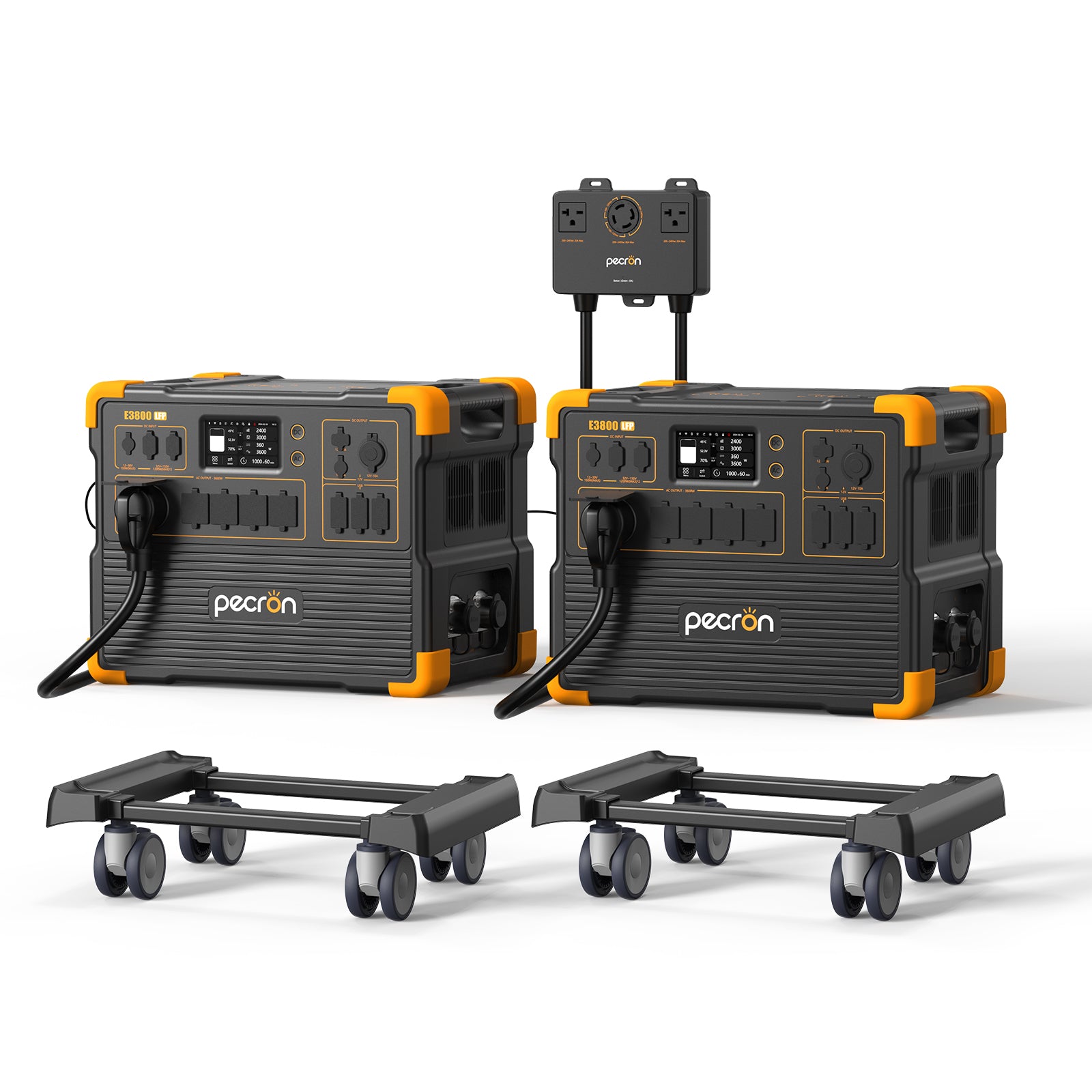
The selected U.S. package names two E3800LFP power stations, a 240V box and two carts. Each E3800 is independently specified as a 3,840 Wh LiFePO4 station with 4,200 W rated AC output at 120 V and a 3,000 W solar-input maximum. The paired offer is therefore a two-station package, not one unusually large inverter. The product option’s “240V box” wording signals an intended system component, but it does not document the exact linked operating plan, connection cable, continuous 240 V output or installation limits. This review does not treat the box as proof that any 240 V appliance can be connected.
For a buyer who wants two separate 120 V sources, the package’s individual station ratings are useful. A 4,200 W per-station ceiling can accommodate some high-draw 120 V loads, subject to their startup and continuous requirements. The two nameplates are each 3,840 Wh; because the package page does not provide a verified combined 240 V operating plan, I would not present 7,680 Wh as a documented single-system capacity or add the two outputs into one circuit. Think of this as two units with a named linking accessory until Pecron supplies exact system instructions.
What the carts do—and do not tell you
Both carts are part of the selected title, so a buyer who needs a cart in the exact order can distinguish this offer from the bare stations. The images show low platform carts, but do not establish load limits, brakes, surface clearance, stair use or whether each cart is rated for the station’s full mass. The E3800LFP body is itself heavy. Confirm the cart model, payload and fit before planning to move the batteries through doors, over thresholds or across uneven ground. A trolley can make positioning easier without making the station portable in the everyday sense.
There are no solar panels listed in this option. Solar charging is supported by each E3800, but the package does not satisfy a need for a supplied panel or a ready-to-connect solar array. The station’s two XT60 solar inputs have published voltage and current limits; a separate panel purchase still needs compatible electrical ratings and the correct cable. If you expect to recharge during an outage, plan how panels will be set up and where the stations can remain ventilated and protected. A headline 3,000 W input ceiling is not a prediction that a chosen panel array will deliver that amount.
Decide whether you need the linked system
The most important pre-purchase question is what “240V box” means for the exact selected option. Ask Pecron for the supported topology, box model, connecting leads, load limits, grounding requirements, charging behavior and whether two stations must be at matching charge levels. If the package will connect to home circuits, have the arrangement reviewed by a qualified electrician and follow the manufacturer’s instructions. A transfer switch or 240 V receptacle should never be inferred from a photo. If the manufacturer cannot document the linked plan, use each E3800 only within its separately published 120 V setup.
This package suits a stationary home, workshop or property owner who has room for two power stations and genuinely values the included carts and linking hardware. It is less appropriate for van use, small RV storage or a single-person carry-upstairs routine. Check the delivery route, storage footprint, ventilation and working clearances before choosing it. Since no panels are included, also budget space and cable reach for separate solar equipment if that is part of your resilience plan.
Alternatives and finder behavior
If one 120 V unit is enough, the single E3800LFP is a simpler comparison and avoids paying for an undocumented dual-station arrangement. If your only requirement is higher energy, an E3800 with a manufacturer-confirmed compatible EP3800 battery configuration may be easier to assess than a pair of stations plus a box. The included carts here are a real bundle distinction; the output plan is not yet a confirmed 240 V capability.
The finder can require two station units, two carts and a minimum per-station 120 V rating. It will not match a 240 V requirement or imply that the two units operate as one 240 V source. It also will not claim included solar panels or batteries. The archived manufacturer option was marked available, but that snapshot is not a live stock or price check. Verify the exact SKU and full accessory list before buying.
Key details at a glance
| Nameplate battery capacity | 3840 Wh |
|---|---|
| Rated AC output | 4200 W |
| Maximum solar input | 3000 W |
| Included panels, combined nameplate | 0 W |
| Maximum USB-C output per port | 100 W |
| Listed weight | 87.3 lb |
More specifications and setup details
| Compatible extra-battery expansion | Yes |
|---|---|
| 12 V DC output | 360 W |
| Maximum AC recharge input | 3200 W |
| AC outlet output | Yes |
| USB-C ports | 2 |
| USB-A ports | 4 |
| Solar input ports | 2 |
| 12 V car-style output | 120 W |
| Vehicle charge input | 150 W |
| Battery chemistry | LiFePO4 |
| Expansion battery in this package | No |
| Home Power Panel in this package | No |
| Separate station units in offer | 2 |
| Smart Transfer Switch in this package | No |
| Solar panels in exact offer | 0 |
| Included expansion batteries | 0 units |
Use the exact model’s instructions for operating limits, supplied equipment and version differences.
Sources for this assessment

A useful match starts with the loads that matter.
Use the finder for hard electrical requirements, then check appliance starting behavior, actual run time and the exact package in the full assessment.