
On this page
Your needs, this model
Does it fit your priorities?
Do you need an exact two-station 240 V option rated at 8,400 W with 7,680 Wh of summed nameplate capacity?
Pecron lists two E3800LFP stations with its 240V Connect Box and states 8,400 W at 240 V; the two 3,840 Wh nameplates sum to 7,680 Wh.
Explore this need in the finder →Can one E3800LFP in the package serve a 120 V, 4,200 W station-level need?
The E3800 manual rates an individual station at 4,200 W / 120 V and 3,840 Wh; it does not turn the pair into a single 120 V 8,400 W output.
Explore this need in the finder →Do you need the option itself to include a solar panel?
No panel is listed in this selected option; a panel-included requirement should select a different exact package.
Explore this need in the finder →Pecron · dual-station 240 V system
Pecron E3800LFP dual-station 240V Connect Box package review
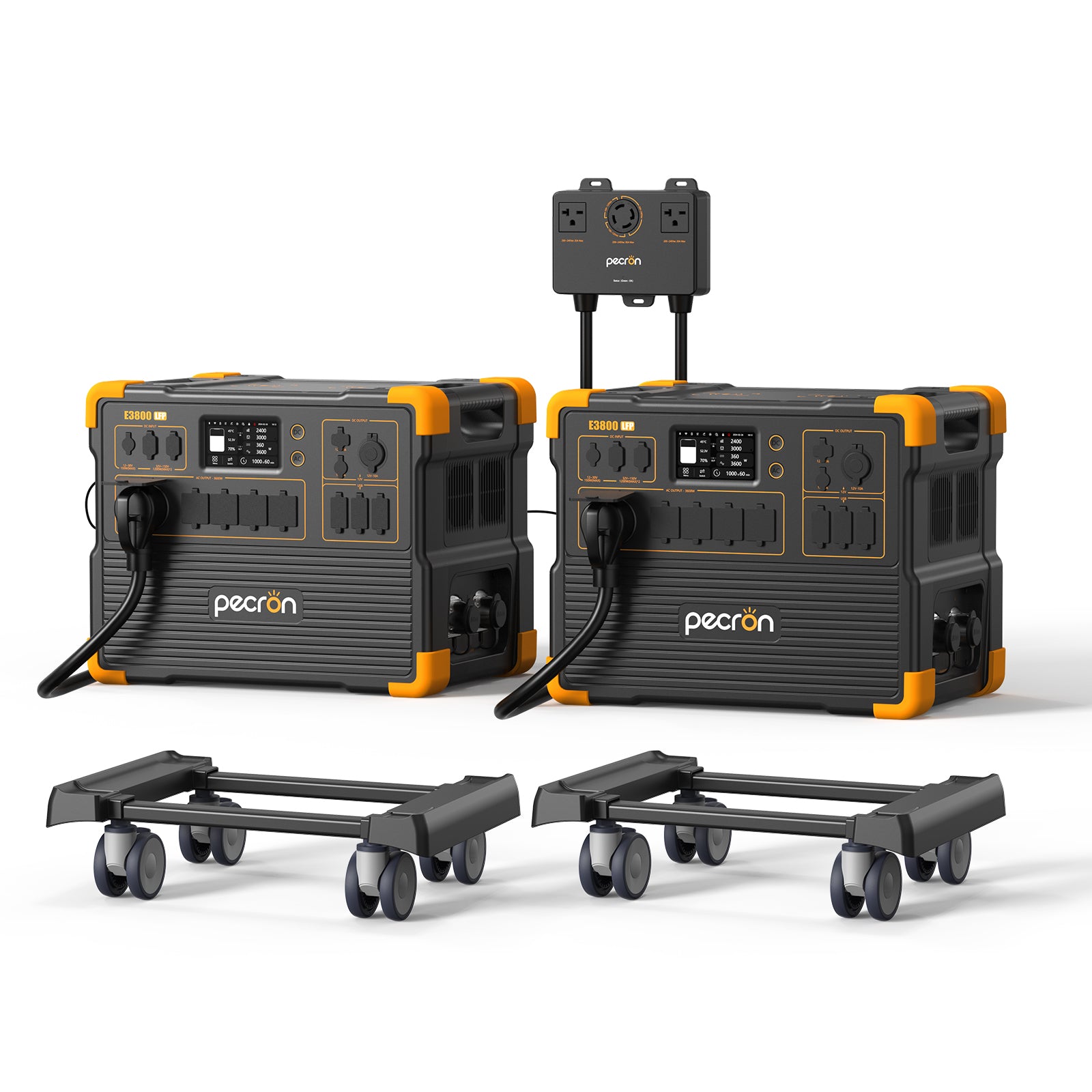
Pecron’s U.S. E3800LFP listing has a materially different option from the familiar single-unit station: SKU 2*E3800LFP+240V box+ 2*Cart. It names two E3800LFP stations, a 240V Connect Box and two carts. Pecron’s box page separately identifies two E3800LFPs as a supported pairing, and the station listing says that two E3800LFP units plus the box provide up to 8,400 W at 240 V. This is a complete selected configuration to evaluate, not a single station whose inverter silently doubles.
A 240 V need is the reason to choose the pair
One E3800LFP is specified at 4,200 W and 120 V. The added station and Connect Box change the available system mode to the manufacturer’s stated 240 V / 8,400 W combination. That can matter for a load whose nameplate actually requires 240 V; it is not a reason to buy two units for ordinary 120 V devices alone. The product page does not identify the Connect Box’s receptacle type, per-outlet current limit, surge behavior, or a transfer-switch function. A 240 V rating is not by itself proof that a particular appliance plug, panel inlet, or home circuit is supported.
Two batteries still mean finite stored energy
Each E3800LFP has 3,840 Wh of LiFePO4 nameplate capacity. The two-station sum is 7,680 Wh, while the paired output claim is 8,400 W. Those figures answer different questions: watts describe the rated power level; watt-hours describe stored energy before conversion and other losses. The manufacturer does not publish usable AC energy for this pair in the material reviewed here, so a runtime estimate would be false precision. A large instantaneous load can consume stored energy quickly even when it stays below the output rating. Match your required voltage and running watts first, then budget for the actual energy and recharge window.
Moving it is a two-unit job
The manual gives about 87.3 lb for each station. Together the station bodies alone are about 174.6 lb, before the Connect Box, two carts, leads, cartons or any accessories. The selected SKU lists two carts, which is a practical difference from the standalone SKU, but the source does not identify a cart model or publish a complete package weight. Treat each station as a heavy appliance to roll over suitable surfaces, not as one portable box for frequent stairs, car camping, or a quick hand carry. The image shows the separated components; it is not a dimensional drawing or proof of how the box and carts are packed.
Solar and expansion are not automatic bonuses
This no-panel option does not list a solar panel. Each E3800LFP station has two XT60 solar inputs with up to 3,000 W combined per station in its documented voltage range, but the reviewed Connect Box page does not describe a total solar rating for the paired setup or how to wire two charging stations in 240 V mode. If you already own compatible panels, verify the approved connections and cables for each unit rather than multiplying the single-station ceiling into a promised 6,000 W system input. Similarly, each station has an expansion-battery pathway, but no source reviewed here explains whether extra EP3800 packs can be added to a balanced two-station 240 V system. That system-level expansion requirement remains unconfirmed.
Where it beats a single E3800—and where it does not
Choose this package when 240 V is essential, a pair-based setup is acceptable, and the 8,400 W manufacturer rating covers the specified load. The included carts make more sense than lifting two nearly 90 lb stations, and the exact selected option removes the need to separately identify a 240 V box. It still is not a whole-home kit: the option does not name a transfer switch, wiring panel, or electrical installation components. For home-circuit connection, use the appropriate equipment and qualified installation advice; do not connect a station directly to building wiring on the strength of a product-page headline.
If your loads are 120 V, compare the single E3800LFP review instead. One unit is already rated at 4,200 W / 120 V and 3,840 Wh, and avoids a second station and the box. This two-unit option’s advantages are the higher-voltage paired mode and additional stored energy, not a universal improvement to every 120 V setup. It also brings more footprint, more components to manage, and an unknown all-in carrying weight. A shopper requiring a specific 240 V outlet, a verified run time, expansion while paired, or a documented plug-and-play home transfer setup should pause until Pecron provides those exact instructions.
How the finder changes its recommendation
In the finder, select 240 V and set the AC-output and nameplate-capacity floors that describe your actual load. The supported paired plan is 8,400 W / 240 V with 7,680 Wh of summed station nameplates; it does not turn the single 4,200 W / 120 V station plan into a 240 V product. Requiring an included solar panel should exclude this option, because none is listed. A requirement for a verified 240 V outlet style, 240 V transfer switching, or a supported two-station expansion arrangement cannot be answered from these source facts and must not be inferred. The selected variant’s archived availability flag and the separate Connect Box page’s notify state did not agree, so confirm current supply and package contents before purchase.
Manufacturer references: exact E3800LFP package option, 240V Connect Box compatibility page, and the E3800LFP manual.
Key details at a glance
| Nameplate battery capacity | 7680 Wh |
|---|---|
| Rated AC output | 8400 W |
| Maximum solar input | 3000 W |
| Included panels, combined nameplate | 0 W |
| Maximum USB-C output per port | 100 W |
| 12 V DC output | 360 W |
More specifications and setup details
| Total rated DC output | 360 W |
|---|---|
| AC outlet output | Yes |
| USB-C ports | 4 |
| USB-A ports | 8 |
| Solar input ports | 2 |
| 12 V car-style output | 120 W |
| Vehicle charge input | 150 W |
| Battery chemistry | LiFePO4 |
| Expansion battery in this package | No |
| Home Power Panel in this package | No |
| Separate station units in offer | 2 |
| Smart Transfer Switch in this package | No |
| Solar panels in exact offer | 0 |
Use the exact model’s instructions for operating limits, supplied equipment and version differences.
Sources for this assessment

A useful match starts with the loads that matter.
Use the finder for hard electrical requirements, then check appliance starting behavior, actual run time and the exact package in the full assessment.