
On this page
Your needs, this model
Does it fit your priorities?
Does the E1000 station in this exact offer meet a 120 V / 1,800 W AC and 1,024 Wh station floor?
The E1000 station is specified at 120 V, 1,800 W and 1,024 Wh; a bundle accessory does not raise those station ratings.
Explore this need in the finder →Does the selected offer name 1 included solar panel(s) at 200 W combined?
The selected U.S. title/SKU names the panel count and wattage; exact panel model and package electrical details remain unknown.
Explore this need in the finder →Can an essential requirement for all supplied panels to work together at their published ratings be confirmed?
No. The saved selected offer omits the exact panel electrical specifications and cable arrangement; the E1000 manual gives limits and requires two-panel parallel wiring, not a verified bundle plan.
Explore this need in the finder →Pecron · E1000LFP with one 200 W solar panel
Pecron E1000LFP with one 200 W solar panel review
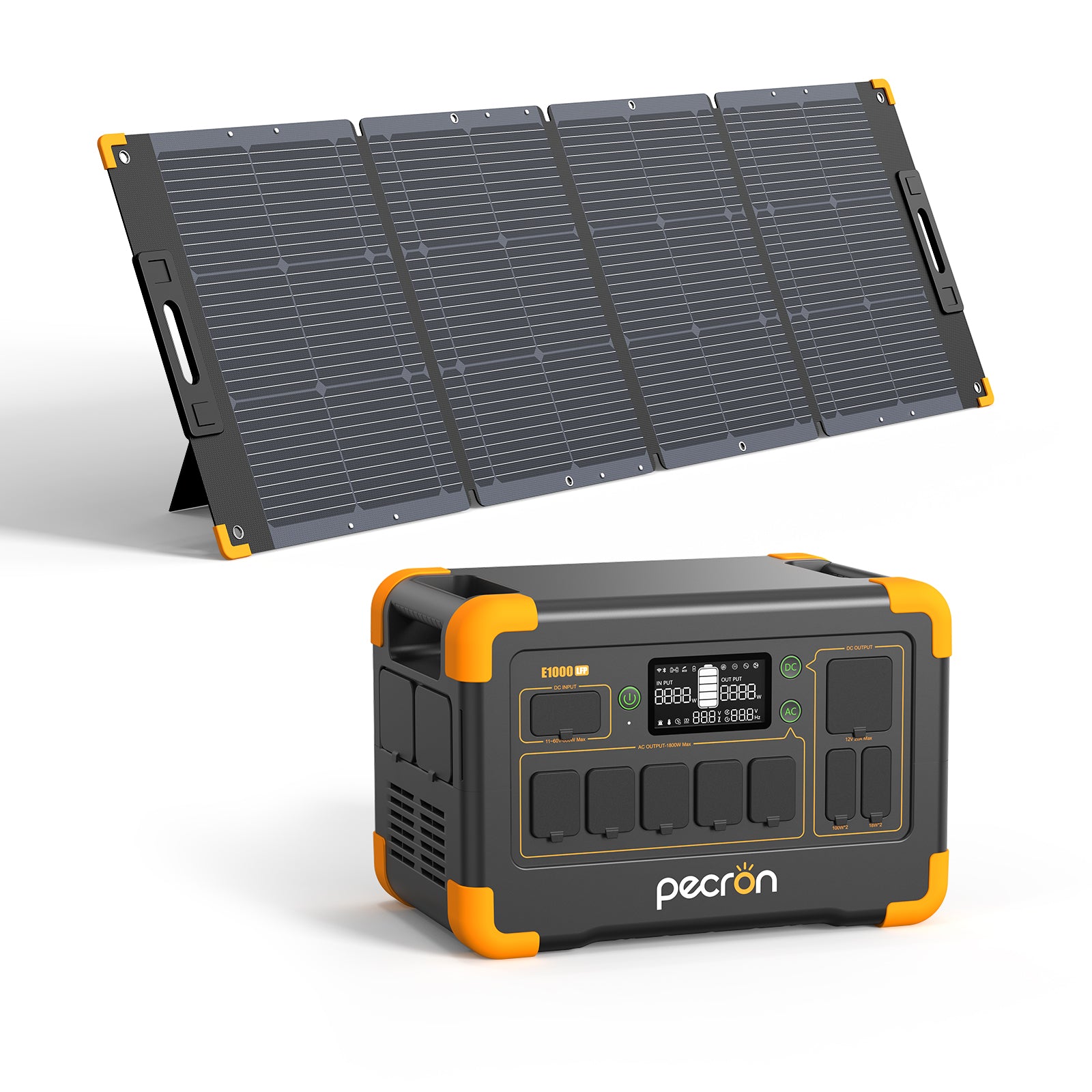
This is the exact U.S. E1000LFP product option identified by Pecron SKU E1000LFP-200W, not the station-only E1000 listing. The selected title and SKU name one 200 W solar panel; the available manufacturer record does not identify its panel model or electrical specifications. The station itself remains a 1,024 Wh, 1,800 W model. In the saved U.S. product data this option was unavailable on October 25, 2026. That capture-time status does not erase the bundle, but it also is not a promise of present stock.
The panel adds an accessory, not more battery or inverter
Pecron rates the E1000LFP for 1,800 W of 120 V AC output and lists a 3,000 W surge figure. The station has 1,024 Wh of LiFePO4 storage, one 12 V DC outlet group rated at 240 W, a 100 W USB-C port, and two USB-A outputs rated up to 18 W each. The 200 W panel does not change any of those station limits. A load can be within the inverter rating and still drain this roughly one-kilowatt-hour battery quickly; nameplate watt-hours are not a promise of AC energy delivered to an appliance. For a long outage, size the station around the actual load and hours, rather than assuming a panel will continuously cover it.
The manual lists a claimed 3,500 cycles to 80% capacity for the LiFePO4 battery. That is a manufacturer statement, not a lifetime guarantee, and there is no independent test result or warranty detail in the sources reviewed for this option. At about 29 lb and 14.9 × 9.4 × 10 inches, the E1000 is more manageable than a large home-backup unit, though it is not a featherweight to carry any distance. Its 1,800 W continuous limit is useful for moderate AC tasks, but this is still one 120 V inverter; the solar panel does not create a 240 V output.
What the included 200 W panel does—and does not—settle
The selected manufacturer option establishes that one 200 W-rated panel is part of this bundle. It does not establish an exact panel model, open-circuit voltage, operating current, or the specific cable and adapter in the box. The E1000 manual gives the station’s solar-input envelope as 11–60 V, up to 600 W and 20 A through its XT60 input. Those limits are helpful for checking a panel, but they cannot substitute for the missing panel specifications or prove what connector is supplied. Before planning an essential solar recharge, confirm the panel’s voltage and current and the included lead for this exact bundle.
Even with a compatible panel, 200 W is its rating under test conditions, not a guaranteed 200 W of charging in a campsite. Sun angle, shade, temperature and charging losses change the result. The option is better understood as a modest included recharge source than as a guarantee of overnight replacement for heavy use. If you already own a compatible array and cable, compare this option’s bundle contents against the station-only SKU instead of paying for a panel you will not use.
Who should choose this exact package?
It is a plausible fit for someone who wants a single, identifiable 200 W panel alongside a compact 1,024 Wh station and can verify the missing electrical and cable details before relying on solar. It is less suitable when a precisely specified panel, a complete plug-and-play cable set, fast multi-panel charging, or longer runtime is essential. The ordinary finder can recognize the included-panel count and rating from the selected option. It should not infer an exact panel model or treat an unknown all-panel connection as confirmed. A requirement for at least 200 W of included panel nameplate can match; an essential requirement that the panel and supplied leads are verified together should remain unresolved until the package documentation confirms it.
Compared with the station-only E1000LFP, the meaningful change is the included panel—not capacity, AC output, weight of the station itself, or expansion capability. The E1000 option with two 200 W panels is the more relevant comparison if your priority is more panel nameplate, but its connection and cable details also need checking. If the actual need is greater battery reserve or a larger output ceiling, look at a larger station such as Pecron’s E1500LFP V3 rather than expecting a 200 W accessory to upgrade the E1000. Its exact operating plan and panel package still need their own separate checks.
Bottom line: this is an exact one-panel E1000 bundle, not a higher-capacity version of the station. Its core 1,024 Wh / 1,800 W proposition is clear; the included panel’s detailed identity and ready-to-use wiring are not. Treat solar compatibility as a confirm-before-relying-on-it detail, and do not buy it for a guaranteed charging rate or a longer battery runtime than the station’s capacity supports.
Key details at a glance
| Nameplate battery capacity | 1024 Wh |
|---|---|
| Rated AC output | 1800 W |
| Manufacturer surge rating | 3000 W |
| Maximum solar input | 600 W |
| Included panels, combined nameplate | 200 W |
| Maximum USB-C output per port | 100 W |
More specifications and setup details
| Listed weight | 29 lb |
|---|---|
| Compatible extra-battery expansion | Yes |
| 12 V DC output | 240 W |
| Maximum AC recharge input | 1000 W |
| AC outlet output | Yes |
| USB-C ports | 1 |
| USB-A ports | 2 |
| Solar input ports | 1 |
| Vehicle charge input | 100 W |
| Battery chemistry | LiFePO4 |
| Expansion battery in this package | No |
| Home Power Panel in this package | No |
| Separate station units in offer | 1 |
| Smart Transfer Switch in this package | No |
| Solar panels in exact offer | 1 |
| Included expansion batteries | 0 units |
Use the exact model’s instructions for operating limits, supplied equipment and version differences.
Sources for this assessment

A useful match starts with the loads that matter.
Use the finder for hard electrical requirements, then check appliance starting behavior, actual run time and the exact package in the full assessment.