
On this page
Your needs, this model
Does it fit your priorities?
Does the selected E1000 offer meet a 120 V / 1,800 W AC and 1,024 Wh station floor?
The E1000 station is listed at 120 V, 1,800 W and 1,024 Wh; included panels do not raise those station ratings.
Explore this need in the finder →Does the official selected title/SKU establish three included 200 W-titled panels?
Yes. The selected E1000LFP+3*200W title/SKU names three 200 W panels, a 600 W combined nameplate sum; exact panel models remain unknown.
Explore this need in the finder →Can this exact three-panel bundle be confirmed as a compatible array with the required lead included?
No. The station manual gives its input limits and a two-panel parallel instruction, but the offer does not identify panel electrical values, three-panel wiring, or cable contents.
Explore this need in the finder →Pecron · E1000LFP with three 200 W solar panels
Pecron E1000LFP with three 200 W solar panels review
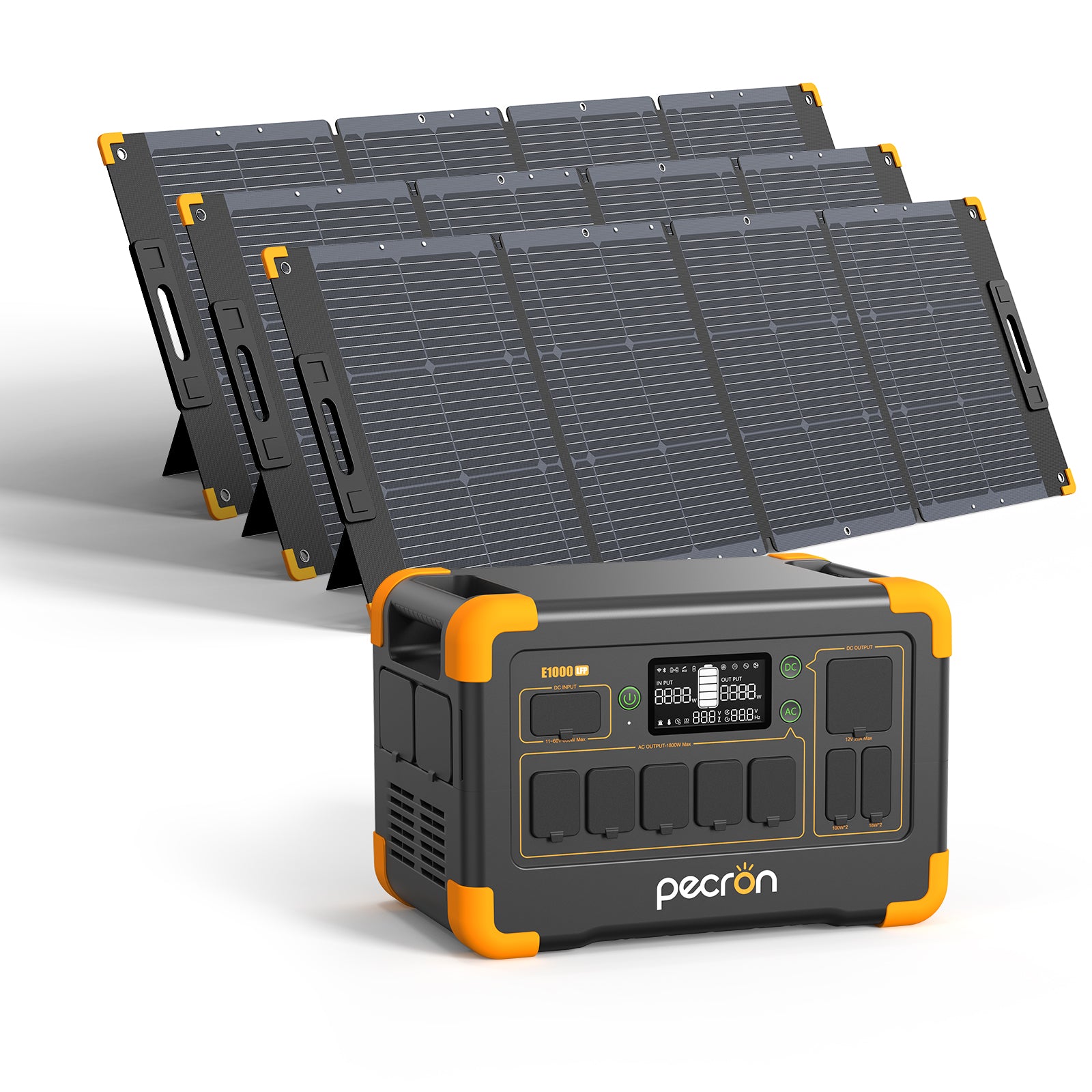
The exact U.S. option E1000LFP+3*200W pairs Pecron’s E1000LFP station with three panels named at 200 W each. That is a 600 W combined nameplate sum on the selected offer, not a 600 W AC output, a bigger battery, or a guaranteed solar input rate. The official product JSON captured on October 26, 2026 marked this selected option unavailable; that dated source snapshot does not establish present stock.
What changes—and what does not
The E1000 remains a 1,024 Wh LiFePO4 station with 1,800 W rated 120 V AC output and a manufacturer-listed 3,000 W surge figure. The three-panel bundle does not change its inverter limit or energy stored for nighttime use. Pecron lists one 240 W 12 V DC outlet group, one USB-C port up to 100 W, and two USB-A ports up to 18 W each. If your essential load is an appliance whose running draw approaches 1,800 W, the number of included panels does not make that load easier for the inverter. If your need is many hours of runtime, calculate the load’s energy use first; the 1,024 Wh station capacity—not the panel-label sum—sets the starting energy reserve.
At about 29 lb and 14.9 × 9.4 × 10 inches, the E1000 is more manageable than a home-backup stack, yet it is not a pocket-sized unit. Its LiFePO4 chemistry and the manufacturer’s 3,500-cycle-to-80% claim describe the battery design and a published claim, not a lab test of this kit. The saved sources do not establish this selected package’s warranty or AC-usable energy, so those are not used as deciding numbers here.
A 600 W label meets the input ceiling on paper, not proof of a usable array
The selected title and SKU name three 200 W panels. The official selected-option image is a manufacturer rendering that visually shows the E1000 with three folding-panel assemblies; it is not a photo of a tested setup. The option JSON does not identify the panel models or their open-circuit voltage, operating voltage, or current, and it does not confirm the connecting cable in the box.
The E1000 manual lists a solar input range of 11–60 V, up to 20 A and 600 W. Its guidance discusses two panels in parallel and says the parallel Y cable is sold separately. That is not an electrical plan for this three-panel configuration. Although the 600 W nameplate sum equals the station’s stated wattage ceiling, the available evidence does not show whether these specific panels can be combined safely within all voltage and current limits, whether a three-way lead is needed, or whether that lead is included. Do not read the picture as proof of wiring or package contents. Confirm exact panel data and an approved connection diagram with Pecron before connecting the full set.
Even a verified compatible array would not deliver its label continuously. Sun angle, shading, clouds, panel temperature and conversion losses change the input. Without an exact array specification, a recharge-time promise would be guesswork. Treat the panel total as an offer description, not a measured result or assured charge rate.
How the package changes the finder result
For an ordinary need—120 V AC, at least 1,800 W output, at least 1,024 Wh, and three included 200 W-titled panels—the selected option meets the stated product-page figures. It is distinguishable from the one-panel and two-panel E1000 options because the selected SKU names three panels. Choosing a higher station-capacity floor rejects it: a 600 W panel package still has only 1,024 Wh of stored energy.
An advanced requirement that every supplied panel be proven to work together at its ratings is different. This offer does not pass that essential condition because exact panel electrical specifications, three-panel wiring and the included lead are unresolved. A buyer who is comfortable confirming those details may compare the package for its named panel count; a buyer who needs a documented plug-in array should wait for written configuration details or select a bundle that publishes them. The finder should not turn an unknown into a positive match.
Who should compare it with the alternatives?
This configuration is worth comparing for someone who wants three panels in the offer and can verify the electrical plan before use. The one- and two-panel E1000 kits are simpler package choices if that panel count fits, though the same panel-model and cable cautions apply to their own selected offers. A station with greater than 1,024 Wh capacity is the better direction if stored energy is the bottleneck; adding panels cannot solve an overnight capacity shortfall. If the key requirement is an immediately usable high-wattage array, choose only after the exact panel and wiring details are documented.
Bottom line: the selected E1000 option is clearly named as three 200 W-titled panels with the same 1,024 Wh, 1,800 W station. Its 600 W panel sum reaches the published solar-input ceiling only as a nameplate calculation. The available manufacturer evidence does not establish that the three panels form a compatible array or that the connection lead is included, so it is a conditional comparison—not a verified plug-and-play charging kit.
Key details at a glance
| Nameplate battery capacity | 1024 Wh |
|---|---|
| Rated AC output | 1800 W |
| Manufacturer surge rating | 3000 W |
| Maximum solar input | 600 W |
| Included panels, combined nameplate | 600 W |
| Maximum USB-C output per port | 100 W |
More specifications and setup details
| Listed weight | 29 lb |
|---|---|
| Compatible extra-battery expansion | Yes |
| 12 V DC output | 240 W |
| Maximum AC recharge input | 1000 W |
| AC outlet output | Yes |
| USB-C ports | 1 |
| USB-A ports | 2 |
| Solar input ports | 1 |
| Vehicle charge input | 100 W |
| Battery chemistry | LiFePO4 |
| Expansion battery in this package | No |
| Home Power Panel in this package | No |
| Separate station units in offer | 1 |
| Smart Transfer Switch in this package | No |
| Solar panels in exact offer | 3 |
| Included expansion batteries | 0 units |
Use the exact model’s instructions for operating limits, supplied equipment and version differences.
Sources for this assessment

A useful match starts with the loads that matter.
Use the finder for hard electrical requirements, then check appliance starting behavior, actual run time and the exact package in the full assessment.