
Your needs, this model
Does it fit your priorities?
Does 1,800 W at 120 V with 1,024 Wh cover a short AC task?
The base E1000 is rated for 1,800 W at 120 V and 1,024 Wh nameplate capacity; runtime depends on the device.
Explore this need in the finder →Is 600 W enough solar input if the panel is bought separately?
The E1000 accepts up to 600 W through one XT60 input; the standalone SKU is not a panel kit.
Explore this need in the finder →Would one EP3000-48V expansion pack meet your future capacity need?
Pecron states one EP3000-48V can take the E1000 to 4,096 Wh. The expansion pack is not included.
Explore this need in the finder →Pecron · compact expandable AC station
Pecron E1000LFP review
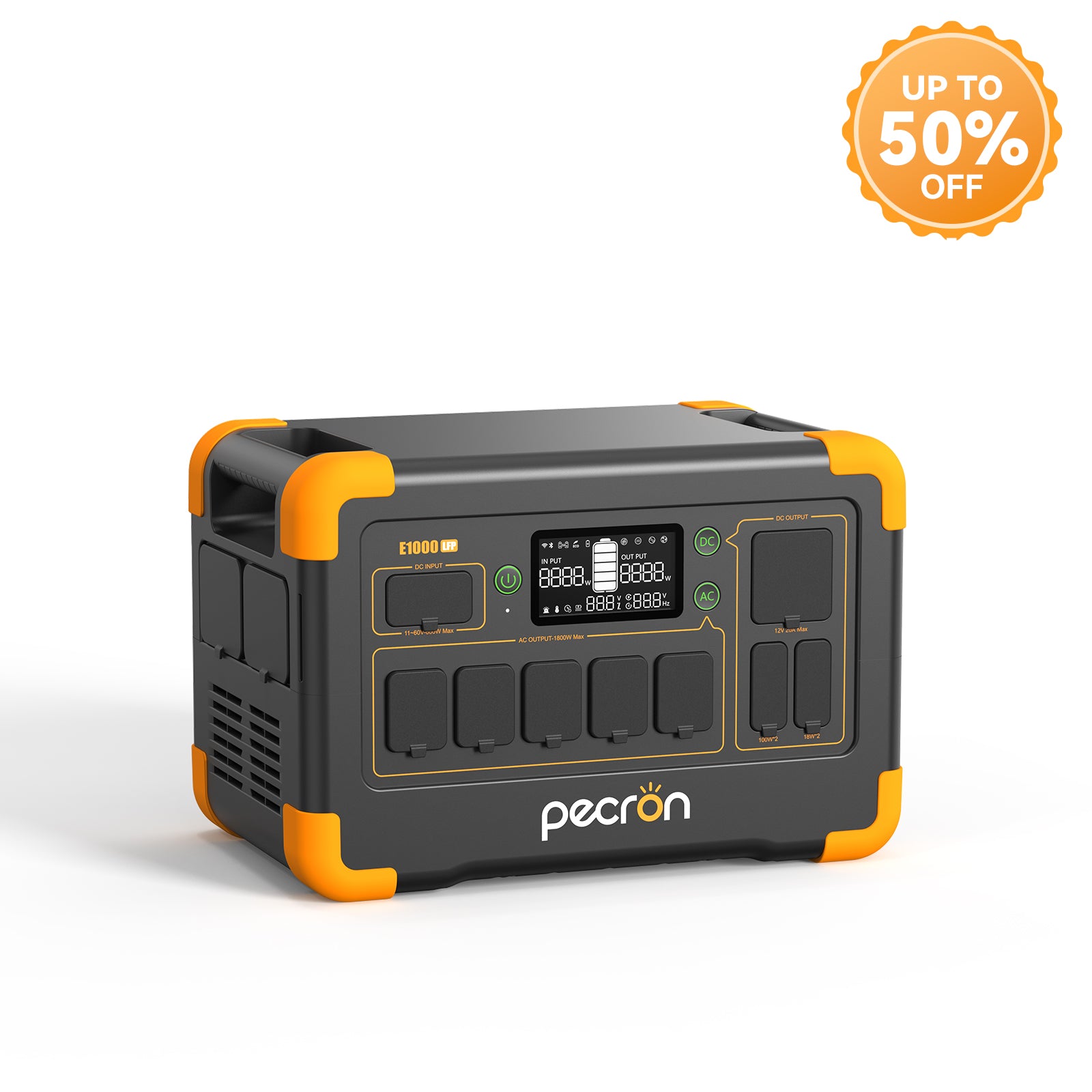
The E1000LFP is a roughly 1 kWh LiFePO4 station with an 1,800 W inverter. That pairing is useful when a small appliance needs a household outlet, but it does not provide large-outage runtime just because it can supply a high short-term watt load. The current U.S. product page and manual identify the model as E1000LFP; although the product URL still contains “2000w,” the published spec table gives 1,800 W rated output, 3,000 W peak and 1,024 Wh capacity. This assessment follows the model and current specification table, not the stale URL text.
Power for modest loads, with a small battery behind it
Pecron specifies 100–120 V pure-sine AC output, 1,800 W rated power and a 3,000 W peak figure (the page labels that peak as 10 ms). Nameplate battery storage is 1,024 Wh. A refrigerator or other cycling appliance may run differently from a steady electrical load, so plan from the actual device draw and required duration, not the inverter maximum. Do not treat the peak rating as a continuous allowance for a device that exceeds the 1,800 W rating.
The product page lists a 12 V, 20 A XT60 output, Wi-Fi and Bluetooth app control, UPS functionality and a 100 W USB-C output. That 12 V rating is not the same as a generic cigarette-lighter socket; check the connector and cable for the device you intend to power. Pecron lists four outlet types in its station diagram and 12 versatile outputs, but the exact per-port current and shared limits still matter. The unit is about 29 lb and 14.9 × 9.4 × 10 inches, so it is portable in the sense of being movable—not featherweight.
Solar and expansion are separate from the base package
The E1000's XT60 solar input accepts up to 600 W over a published 11–60 V window, and Pecron lists up to 1,000 W of AC charging. The page advertises a fast charge, but the actual time depends on the charging mode and starting battery state. Its standalone SKU is the station itself; the page shows distinct solar kit choices, so do not assume the pictured panel or a solar lead is in the base box. Check the option name and package list rather than selecting by the shared product-page title.
Pecron says the station can cascade with an EP3000-48V expansion battery to reach a stated 4,096 Wh. The pack is a separate purchase. The current site also lists different expansion models for parts of the E-series, so match the E1000 revision and manual before buying a battery. Expansion changes the number of components and the system's handling; it does not turn a station-only offer into a bundle. If an extra battery is a hard requirement, the E1000 has a documented expansion path, but the exact pack and cable should be confirmed for the unit in hand.
Model, status and setup caveats
The U.S. product JSON identifies a separate E1000LFP base option, and it was marked unavailable when captured on October 25, 2026. The model remains relevant even when a particular captured offer is out of stock. Manufacturer page claims include LiFePO4 chemistry, more than 3,500 cycles to 80%, app control, adjustable charging speed and a UPS mode. Those are manufacturer descriptions, not laboratory results. The page's warranty summary says 2+1 years; the exact base term and registration conditions are not resolved here, so check Pecron's current warranty terms if they affect the purchase.
The official manual calls out the extra-battery port, 100–120 V AC operation and input limits; see Pecron's [E1000LFP manual](https://cdn.shopify.com/s/files/1/0509/5263/4556/files/PECRON_E1000LFP_user_manual_100V_120V_-20240627_78dd98dc-d262-4c68-8274-205c0e44987d.pdf?v=1731987961) before attaching a panel or expansion battery. Keep ventilation openings clear and follow the manual's charging-temperature instructions. For critical electronics, test UPS behavior with the exact load rather than equating the feature name with zero interruption.
Who should move up or sideways?
The E1000 makes sense for a user who wants more than the smallest phone-and-laptop station, needs up to 1,800 W of AC output for a bounded task, and values a real expansion option. Its 600 W solar ceiling is useful for moderate replenishment but much lower than the 1,000 W input on the E1500LFP V3. That model also raises capacity to 1,536 Wh and rated output to 2,200 W, but weighs about 38 lb. The F1000LFP sits nearby in capacity at 960 Wh and rates AC output to 1,500 W; it advertises very fast AC charging and quiet operation, while its expansion support is not confirmed in this review.
If a single appliance needs more than 1,800 W, if 240 V is essential, or if it must run for many hours under a sustained load, choose a larger documented configuration rather than relying on the E1000's peak figure. If solar panel inclusion is essential, select a confirmed panel bundle; the base E1000LFP plan does not include one. Match the right pack, cable, AC voltage and runtime to your real use case before buying.
Key details at a glance
| Nameplate battery capacity | 1024 Wh |
|---|---|
| Rated AC output | 1800 W |
| Manufacturer surge rating | 3000 W |
| Maximum solar input | 600 W |
| Included panels, combined nameplate | 0 W |
| Maximum USB-C output per port | 100 W |
| Listed weight | 29 lb |
| Compatible extra-battery expansion | Yes |
| 12 V DC output | 240 W |
| Maximum AC recharge input | 1000 W |
| AC outlet output | Yes |
| USB-C ports | 1 |
| USB-A ports | 2 |
| Solar input ports | 1 |
| Vehicle charge input | 100 W |
| Battery chemistry | LiFePO4 |
| Expansion battery in this package | No |
| Home Power Panel in this package | No |
| Separate station units in offer | 1 |
| Smart Transfer Switch in this package | No |
| Solar panels in exact offer | 0 |
Use the exact model’s instructions for operating limits, supplied equipment and version differences.
Sources for this assessment

A useful match starts with the loads that matter.
Use the finder for hard electrical requirements, then check appliance starting behavior, actual run time and the exact package in the full assessment.