
On this page
Your needs, this model
Does it fit your priorities?
Does this exact E1500 option meet a 120 V / 2,200 W AC load and 1,536 Wh station capacity floor?
The base E1500 V3 meets those published station limits; the panel does not raise its output or battery capacity.
Explore this need in the finder →Does the selected offer include 2 PV300 unit(s), 600 W combined by title/SKU?
The exact selected title/SKU establishes the panel count and rating; the generic 200 W options do not establish a PV200 model identity.
Explore this need in the finder →Can a panel-in-box need be met if all-panel array compatibility is not essential, and what if it is?
The exact offer names the panel(s); cable/wiring remains unknown, so an essential all-panels-together requirement does not pass.
Explore this need in the finder →Pecron · E1500LFP V3 with two PV300 panels
Pecron E1500LFP V3 with 2× PV300 review
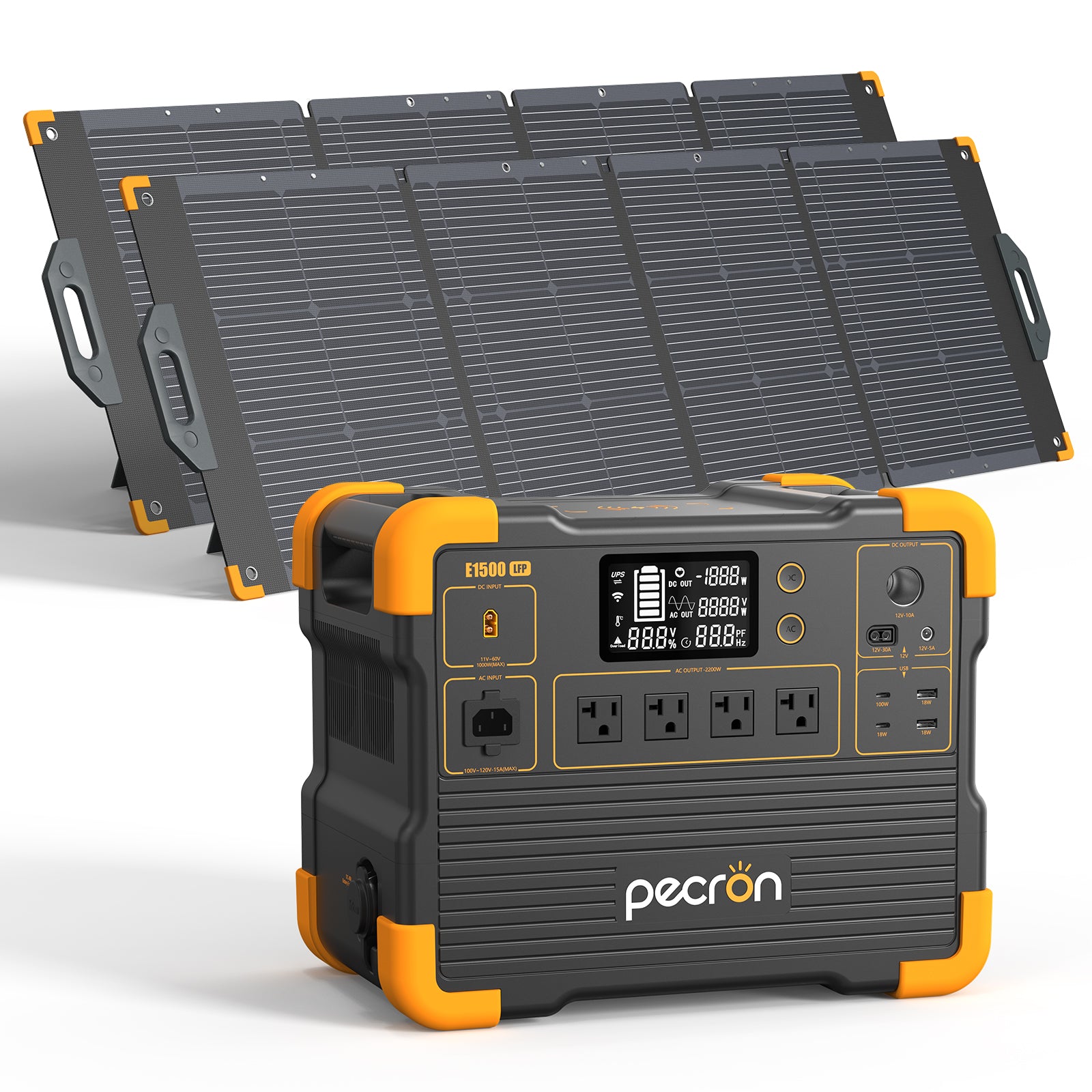
Pecron’s U.S. E1500LFP product JSON contains a separate option, SKU E1500LFP+2*PV300, variant 42918142836924. Its selected title specifies two PV300 panels with the E1500LFP V3 station. The captured offer was unavailable on October 25, 2026. That dated stock state is not a reason to collapse it into the one-PV300 option: panel count and the practical wiring question are different.
Six hundred watts of panels does not enlarge the battery
Two PV300 panels provide 600 W of combined nameplate panel rating. The station’s battery remains 1,536 Wh, its rated AC output remains 2,200 W at 120 V, and its 4,400 W surge rating remains a brief peak. It is a solar-input bundle, not a 3,072 Wh or 600 W AC station. If your priority is longer output after sunset, look at an expansion-battery configuration instead. If your appliance is above the E1500’s rated continuous load, more panels do not address that problem.
The separate Pecron PV300 page identifies each panel as a 4-fold, 300 W (+5%) model. Its listed maximum-power voltage is 36 V (+5%), current 8.3 A (+5%), Voc 41.4 V (+5%) and Isc 8.7 A (+5%). The E1500 specifies one XT60 solar input, 11–60 V, 20 A maximum and 1,000 W maximum. Two panels add to 600 W, below the watt ceiling. If connected in parallel, the published operating currents sum to about 16.6 A and the published short-circuit current to about 17.4 A, with voltage remaining at one panel’s level. Those figures appear within the station’s voltage/current ratings, but the exact bundle’s prescribed wiring and cable are not documented in the selected-option record. A theoretical arrangement should not be presented as the supplied or manufacturer-approved lead arrangement.
Space, cable and panel-array checks
Each PV300 is a large four-fold panel. Pecron lists about 12.74 kg per panel, so two add roughly 25.5 kg (about 56 lb) before cables, on top of a station listed at 38.4 lb. One panel unfolds to roughly 2.36 × 0.79 m; two require a clear place to position them and keep them clear of shade. The station’s case dimensions and solar input are unchanged. The PV300 page gives an IP67 rating for the panel only; do not extend that protection claim to the E1500, connectors or loose leads.
The product option image shows the E1500 with two panel graphics, and the SKU identifies them as PV300. The artwork does not show a wiring diagram. Before depending on both panels together, confirm the included connectors, whether Pecron intends a parallel connection, and whether the exact cable preserves the manufacturer’s voltage and current limits. One panel at a time is a different plan from both supplied panels running together. A stricter matcher choice requiring every included panel to be a confirmed compatible array should stay unsatisfied until those details are verified.
When the second panel is worthwhile
The two-panel choice is for someone with a larger deployment area who wants more nominal solar capacity in the package and can verify array instructions. It may offer more collection area in good conditions than the single-PV300 selection, but no daily energy yield or recharge-time advantage can be guaranteed from nameplate ratings alone. Shade across one panel, poor angle or a hot panel can make results differ substantially. No measured performance is claimed.
In the questionnaire, select a 600 W panel floor and two-panel minimum only if those package contents matter; 601 W or three panels will exclude this SKU. It meets the E1500’s 120 V / 2,200 W AC station limits, not a higher output threshold. The finder can require an included panel, but should not count the kit as satisfying a strict all-panels-together requirement while wiring and cables remain unconfirmed. Choose one PV300 for a simpler single-panel plan, one 200 W option if a smaller panel rating suits your storage space, or an EP3800 bundle if battery reserve rather than solar collection is the problem. Recheck current availability and the exact selected SKU before purchase.
Key details at a glance
| Nameplate battery capacity | 1536 Wh |
|---|---|
| Rated AC output | 2200 W |
| Manufacturer surge rating | 4400 W |
| Maximum solar input | 1000 W |
| Included panels, combined nameplate | 600 W |
| Maximum USB-C output per port | 100 W |
More specifications and setup details
| Listed weight | 38.4 lb |
|---|---|
| Compatible extra-battery expansion | Yes |
| 12 V DC output | 360 W |
| Maximum AC recharge input | 1400 W |
| AC outlet output | Yes |
| USB-C ports | 2 |
| USB-A ports | 2 |
| Solar input ports | 1 |
| 12 V car-style output | 120 W |
| Vehicle charge input | 100 W |
| Battery chemistry | LiFePO4 |
| Expansion battery in this package | No |
| Home Power Panel in this package | No |
| Separate station units in offer | 1 |
| Smart Transfer Switch in this package | No |
| Solar panels in exact offer | 2 |
| Included expansion batteries | 0 units |
Use the exact model’s instructions for operating limits, supplied equipment and version differences.
Sources for this assessment

A useful match starts with the loads that matter.
Use the finder for hard electrical requirements, then check appliance starting behavior, actual run time and the exact package in the full assessment.