
On this page
Your needs, this model
Does it fit your priorities?
Does this exact E1500 option meet a 120 V / 2,200 W AC load and 1,536 Wh station capacity floor?
The base E1500 V3 meets those published station limits; the panel does not raise its output or battery capacity.
Explore this need in the finder →Does the selected offer include 3 PV300 unit(s), 900 W combined by title/SKU?
The exact selected title/SKU establishes the panel count and rating; the generic 200 W options do not establish a PV200 model identity.
Explore this need in the finder →Can a panel-in-box need be met if all-panel array compatibility is not essential, and what if it is?
The exact offer names the panel(s); cable/wiring remains unknown, so an essential all-panels-together requirement does not pass.
Explore this need in the finder →Pecron · E1500LFP V3 with three PV300 panels
Pecron E1500LFP V3 with 3× PV300 review
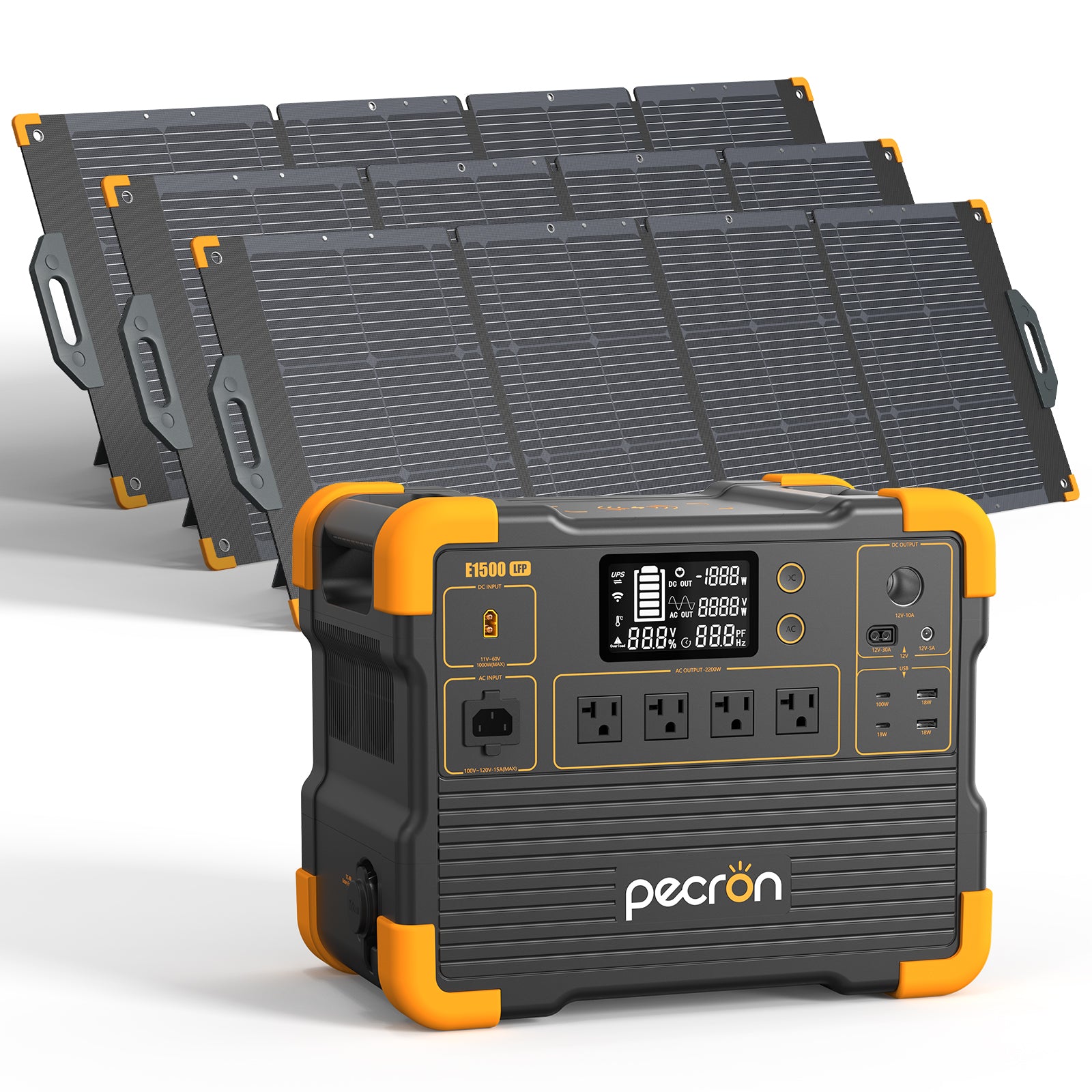
The U.S. product page identifies a distinct “E1500LFP+3*PV300” selection, SKU E1500LFP+3*PV300, variant 46667956551868. It pairs one E1500LFP V3 with three named PV300 panels. The captured product JSON marks the selection unavailable on October 25, 2026, but it remains a real observed option and should not be dropped solely for stock status.
A 900 W panel package with a real input-limit problem
Three PV300 panels have 900 W combined nameplate power, still below the E1500’s maximum solar input power of 1,000 W. That watt comparison does not prove that all three can be used together. The station has one XT60 solar input rated for 11–60 V and 20 A maximum. Pecron’s standalone PV300 page specifies roughly 36 V operating voltage, 41.4 V open-circuit voltage, 8.3 A operating current and 8.7 A short-circuit current per panel, each with the listed tolerance. A three-panel series string would put open-circuit voltage well above the station’s 60 V upper limit. A three-panel parallel set would place the panels’ short-circuit currents above the 20 A maximum. The saved sources do not document a special controller or other topology that makes this three-panel array work at all three panels’ published ratings.
This means the option title proves that three panels are selected in the offer, but the data do not support saying they all form a compatible full-rating input on the E1500. Do not assume that 900 W being below 1,000 W resolves voltage and current. Do not build a series/parallel connection from guesswork or attach the panels until the manufacturer provides an approved configuration and exact cable. The ordinary solar-input question still accurately records that the station itself can accept solar; the stricter need that every supplied panel work together cannot be treated as met for this three-panel configuration on the published numbers available here.
What the package still is—and is not
The station remains 1,536 Wh, 2,200 W continuous at 120 V and 4,400 W peak for 10 ms. Three PV300 panels do not enlarge its battery or AC inverter. The panel product page identifies each as a 4-fold monocrystalline panel with about 12.74 kg stated mass, so the three panels together are approximately 38.2 kg (84 lb) before leads, in addition to the E1500’s approximately 38.4 lb. The unfolded panel size is about 2.36 × 0.79 m each. A three-panel layout takes meaningful ground area and transport volume; one panel’s weather rating does not make the station weatherproof.
Its package rendering depicts the station alongside three folding panel shapes, but the image is illustrative product-page art, not a wiring chart. The selected title and SKU supply the panel count/model; the art does not establish electrical compatibility or included leads. The product was unavailable in the saved JSON, and nothing here is an independent test of solar production. Even with ample sunlight, shade, angle, temperature, cable loss and charge state affect received power.
Questionnaire treatment and alternatives
A visitor seeking a 900 W solar kit and at least three included panels can distinguish this offer from the one- and two-panel options. Raising the minimum beyond 900 W or requiring four panels should exclude it. A 120 V / 2,200 W AC threshold is still met by the station. The essential “all panels together within the published input limits” choice should reject this package, because its three-panel series/parallel arrangements exceed one of the E1500’s published voltage or current boundaries at the panels’ ratings. Someone willing to buy extra panels for other equipment, use fewer than all three on this station, or obtain a manufacturer-approved controller/cabling plan has a different requirement and should verify that separate plan before purchase.
For a straightforward E1500 solar configuration, one PV300 is the simpler comparison; two PV300 panels total 600 W and have an apparently workable parallel current/voltage envelope, but the exact wiring/cable is still unconfirmed. For longer overnight backup, compare one or two EP3800-48V expansion options, which add nameplate storage rather than panel area. If you need 240 V or more than 2,200 W of continuous AC, consider a different station family. Confirm stock, included components and an approved three-panel connection in writing before treating this bundle as a usable all-panel system.
Key details at a glance
| Nameplate battery capacity | 1536 Wh |
|---|---|
| Rated AC output | 2200 W |
| Manufacturer surge rating | 4400 W |
| Maximum solar input | 1000 W |
| Included panels, combined nameplate | 900 W |
| Maximum USB-C output per port | 100 W |
More specifications and setup details
| Listed weight | 38.4 lb |
|---|---|
| Compatible extra-battery expansion | Yes |
| 12 V DC output | 360 W |
| Maximum AC recharge input | 1400 W |
| AC outlet output | Yes |
| USB-C ports | 2 |
| USB-A ports | 2 |
| Solar input ports | 1 |
| 12 V car-style output | 120 W |
| Vehicle charge input | 100 W |
| Battery chemistry | LiFePO4 |
| Expansion battery in this package | No |
| Home Power Panel in this package | No |
| Separate station units in offer | 1 |
| Smart Transfer Switch in this package | No |
| Solar panels in exact offer | 3 |
| Included expansion batteries | 0 units |
Use the exact model’s instructions for operating limits, supplied equipment and version differences.
Sources for this assessment

A useful match starts with the loads that matter.
Use the finder for hard electrical requirements, then check appliance starting behavior, actual run time and the exact package in the full assessment.