
On this page
Your needs, this model
Does it fit your priorities?
Does this exact E1500 option meet a 120 V / 2,200 W AC load and 1,536 Wh station capacity floor?
The base E1500 V3 meets those published station limits; the panel does not raise its output or battery capacity.
Explore this need in the finder →Does the selected offer include 1 PV300 unit(s), 300 W combined by title/SKU?
The exact selected title/SKU establishes the panel count and rating; the generic 200 W options do not establish a PV200 model identity.
Explore this need in the finder →Can a panel-in-box need be met if all-panel array compatibility is not essential, and what if it is?
The exact offer names the panel(s); cable/wiring remains unknown, so an essential all-panels-together requirement does not pass.
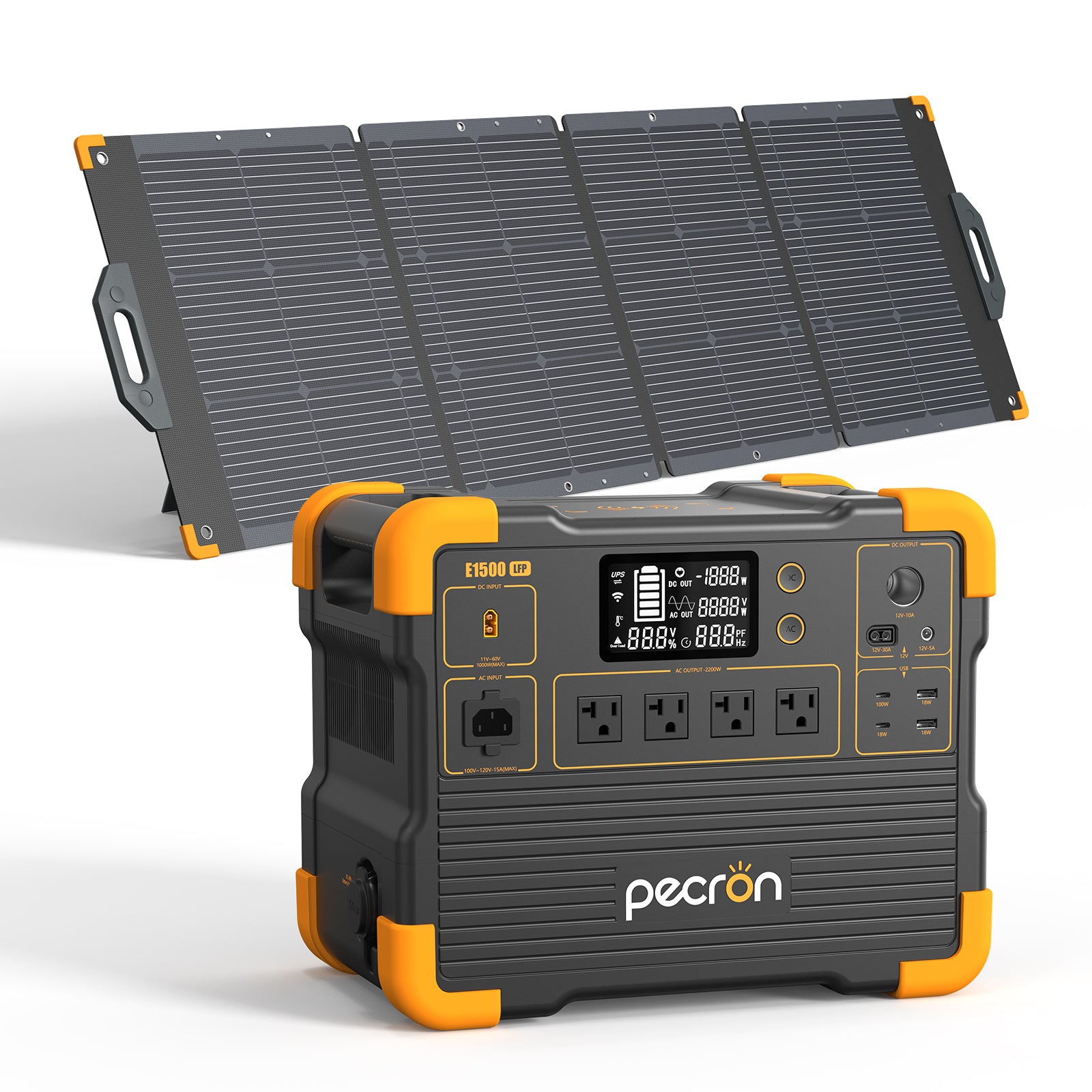
Explore this need in the finder →Pecron · E1500LFP V3 with one PV300 panel
Pecron E1500LFP V3 with one PV300 review
The selected U.S. option is SKU E1500LFP+PV300, variant 46666734993596: one E1500LFP V3 station and one PECRON PV300 panel. Unlike the product page’s generic “200W” option, this selected SKU names PV300. Pecron separately lists the U.S. PV300 as a 300 W foldable panel, so this is an exact model-to-package bridge rather than an identity guessed from a picture. The selected variant was unavailable in the saved station JSON on October 25, 2026, which records one offer snapshot only.
What 300 W adds to the E1500
The station remains 1,536 Wh and 2,200 W AC at 120 V. The panel adds a 300 W nameplate input source but no stored energy. One PV300 therefore cannot increase the E1500’s continuous load ceiling, supply a 240 V circuit or guarantee a full battery by a certain hour. The PECRON panel page lists a four-fold monocrystalline design and publishes 300 W (+5%), operating voltage 36 V (+5%), operating current 8.3 A (+5%), open-circuit voltage 41.4 V (+5%) and short-circuit current 8.7 A (+5%). Those are panel-side specifications, not a promise of actual station input under field conditions.
For one panel, the published PV300 voltage and current figures are within the E1500’s stated 11–60 V, 20 A solar-input window, and 300 W is below the station’s 1,000 W input-power ceiling. The selected station page also sells this exact PV300 option. That is useful direct compatibility context. It still does not establish the exact kit’s cable or package list: the standalone PV300 page describes its own panel connectors, while the E1500 bundle record does not provide a box-by-box cable inventory. If a connector and lead need to be confirmed before purchase, ask for the exact U.S. option’s included cable and approved setup.
Panel size and real-world use
Pecron describes the PV300 as a four-fold panel with a folded footprint around 636 × 789 × 49 mm and an unfolded size around 2,362 × 787 × 4.5 mm; its stated mass is about 12.74 kg, roughly 28 lb, before the station and cable. A vehicle-based buyer should plan for panel storage and a wide area to place it, not just the E1500’s 38.4 lb station weight. The panel product page says it is rated IP67, but that rating belongs to the panel; it does not make the power station weatherproof. Keep the station protected as its own instructions require.
Solar output varies with angle, season, shade, cloud, heat, dirt and cable losses. Even a panel with a 300 W nameplate does not deliver that level at all times, and battery charge acceptance changes as the station fills. There is no measured output or recharging trial represented here. The E1500’s 1,000 W ceiling is a maximum input specification, not a harvested-energy estimate.
Who should pick this offer?
This configuration makes sense when you want one known PV300 panel with a mid-sized E1500 station and can handle an approximately 28 lb panel plus the station. It is not the right choice if your essential load exceeds 2,200 W, if a 240 V output is required, if the folded panel dimensions do not fit your vehicle, or if you need a larger battery rather than solar input. In the finder, requiring a panel and selecting at least 300 W / one panel identifies this offer; 301 W should exclude it. The strict all-supplied-panels answer should be used only when the exact cable and input arrangement are documented, rather than silently treating the shared artwork as proof.
The 200 W bundles are lighter on panel rating but their exact model is not named in the selected offer. The two-PV300 option puts 600 W of panels in the box, but introduces a wiring question that the single-panel option avoids. For less setup and a known panel model, one PV300 is the simplest of these E1500 panel configurations. Confirm that the option is back in stock and that the V3 station, panel, cable and package count on the retailer’s live selection still match this review.
Key details at a glance
| Nameplate battery capacity | 1536 Wh |
|---|---|
| Rated AC output | 2200 W |
| Manufacturer surge rating | 4400 W |
| Maximum solar input | 1000 W |
| Included panels, combined nameplate | 300 W |
| Maximum USB-C output per port | 100 W |
More specifications and setup details
| Listed weight | 38.4 lb |
|---|---|
| Compatible extra-battery expansion | Yes |
| 12 V DC output | 360 W |
| Maximum AC recharge input | 1400 W |
| AC outlet output | Yes |
| USB-C ports | 2 |
| USB-A ports | 2 |
| Solar input ports | 1 |
| 12 V car-style output | 120 W |
| Vehicle charge input | 100 W |
| Battery chemistry | LiFePO4 |
| Expansion battery in this package | No |
| Home Power Panel in this package | No |
| Separate station units in offer | 1 |
| Smart Transfer Switch in this package | No |
| Solar panels in exact offer | 1 |
| Included expansion batteries | 0 units |
Use the exact model’s instructions for operating limits, supplied equipment and version differences.
Sources for this assessment

A useful match starts with the loads that matter.
Use the finder for hard electrical requirements, then check appliance starting behavior, actual run time and the exact package in the full assessment.