
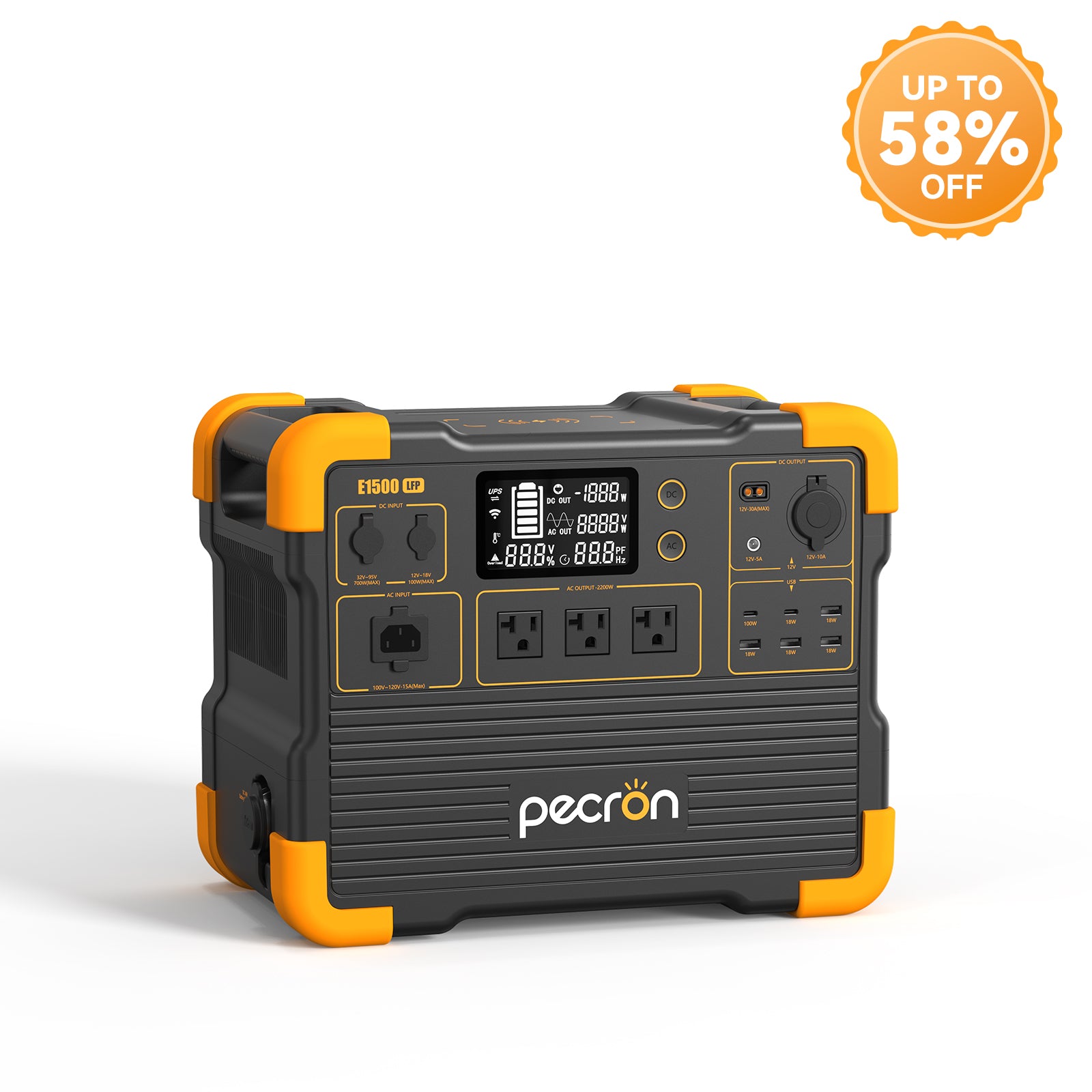
Your needs, this model
Does it fit your priorities?
Does the V3 provide 2,200 W at 120 V with 1,536 Wh capacity?
The exact V3 base variant is rated for 2,200 W and 1,536 Wh; its peak rating is for 10 ms.
Explore this need in the finder →Will 1,000 W of solar input meet the recharge plan?
The V3 lists one XT60 input from 11–60 V and up to 1,000 W; the base offer includes no panel.
Explore this need in the finder →Is an EP3800 expansion path and 100 W USB-C useful later?
Pecron lists up to two EP3800-48V packs for V3; neither battery is part of the station-only SKU.
Explore this need in the finder →Pecron · E1500LFP V3, 1,536 Wh
Pecron E1500LFP V3 review
The E1500LFP V3 is a 1,536 Wh, 2,200 W station with a 1,000 W solar-input ceiling and a documented expansion route. This is the V3 version specifically shown on Pecron's current U.S. product page and manual; do not merge it with older E1500 revisions based on a similar model name. The base variant was marked unavailable in the captured offer on October 25, 2026, but the model remains a real part of the category and its absence from one snapshot is not a reason to drop it.
A practical middle size, with a DC and wireless bonus
Pecron specifies 100–120 V pure-sine AC, 2,200 W rated output and a 4,400 W peak for 10 ms. The battery is 51.2 V/30 Ah LiFePO4 for 1,536 Wh nameplate capacity. The listed weight is about 38.4 lb and the case measures 14.8 × 9.3 × 12 inches. It is less awkward to move than the E2400 or F3000, yet still heavy enough to plan a stable storage location and carry path.
The port selection includes four AC outlets, 12 V/30 A DC, a 12 V car-style socket, DC5525, USB-A, two USB-C ports with up to 100 W available from the high-power outlet, and a 15 W wireless charging pad. The official page counts 12 versatile outputs. Match each device to its port rating and connector; a 30 A XT60/DC output is not the same as the car-style socket. Pecron's 2,200 W output figure is not a runtime figure, and a motor's starting demand may exceed the steady load. Use the appliance's actual requirements.
Solar and expansion are central strengths
The V3 page lists up to 1,000 W of solar input through the XT60 port, over an 11–60 V range and up to 20 A. Wall charging is listed at up to 1,400 W, with a manufacturer estimate of about 1.8 hours. The selected standalone E1500LFP does not include a solar panel; the product selector has separate panel-kit and expansion-battery options. Pecron's page lists an AC cable and an MC4-to-XT60 solar charging lead in its packing list, so that station-side cable is treated as included for this exact base offer. Confirm the package contents on a current checkout page before relying on the lead or choosing a panel.
Pecron says the V3 can connect up to two EP3800-48V expansion batteries, increasing the system to 9,216 Wh. Neither battery is included in the base SKU. The current option list exposes the same expansion family. This is a genuine documented system choice, but it adds multiple heavy components and uses a specific connection cable; a generic 48 V battery is not a substitute. The [E1500LFP V3 manual](https://cdn.shopify.com/s/files/1/0509/5263/4556/files/PECRON_E1500LFP_100_120V_V3_20260.pdf?v=1778228699) shows the port layout and operating requirements. Pecron also lists app control over Wi-Fi/Bluetooth, UPS behavior and LiFePO4 cycle-life claims; no hands-on or independent performance test is implied.
Limits and separate package details
The E1500 is a 120 V station, not a single-unit 240 V source. Its 1,536 Wh is half a 3 kWh-class unit's nameplate capacity, so even with a 2,200 W inverter it cannot maintain a high load for a long time. The manufacturer lists a 0–45°C charging range and −20–45°C discharging range. Keep the cooling openings clear, stay inside the stated temperature limits and check UPS transfer behavior against critical devices instead of assuming “UPS” means zero interruption.
Package options on the same page combine the station with solar panels or EP3800-48V expansion batteries. These are materially different purchases; the base station profile does not claim a panel or battery in the box. The product copy advertises a 2+3-year warranty, and a later manufacturer notice says the warranty term was extended. Check the terms that apply to your exact purchase and registration rather than treating the offer text as an unconditional five-year commitment. The V3 manual and exact SKU are the source for the hardware assessment; panel count and extra batteries depend on the selected package.
Compare it with the E2400 and E1000
The E1500LFP V3 is the better candidate when 1,000 W of solar input, lighter handling and a specific expansion path are more important than the extra 512 Wh and 200 W of AC output in the E2400LFP. The E2400 increases capacity to 2,048 Wh and inverter rating to 2,400 W, but weighs about 45 lb and has a lower 700 W published solar maximum. The E1000LFP is less expensive to carry at about 29 lb and has a smaller 1,024 Wh battery with 1,800 W output, but its solar ceiling is 600 W.
Choose the V3 when its 1,536 Wh battery can cover the planned load duration, the 1,000 W input helps meet a specific recharge window, and the known EP3800 expansion route has value. Do not buy it on the assumption that the pictured solar panel or extra battery is included. If 240 V output, a larger single-unit energy reserve or frequent lifting is essential, this is not the right setup. A good match depends on the exact version and selected package, not the family name alone.
Key details at a glance
| Nameplate battery capacity | 1536 Wh |
|---|---|
| Rated AC output | 2200 W |
| Manufacturer surge rating | 4400 W |
| Maximum solar input | 1000 W |
| Included panels, combined nameplate | 0 W |
| Maximum USB-C output per port | 100 W |
| Listed weight | 38.4 lb |
| Compatible extra-battery expansion | Yes |
| 12 V DC output | 360 W |
| Maximum AC recharge input | 1400 W |
| AC outlet output | Yes |
| USB-C ports | 2 |
| USB-A ports | 2 |
| Solar input ports | 1 |
| 12 V car-style output | 120 W |
| Vehicle charge input | 100 W |
| Battery chemistry | LiFePO4 |
| Expansion battery in this package | No |
| Home Power Panel in this package | No |
| Separate station units in offer | 1 |
| Smart Transfer Switch in this package | No |
| Solar panels in exact offer | 0 |
Use the exact model’s instructions for operating limits, supplied equipment and version differences.
Sources for this assessment

A useful match starts with the loads that matter.
Use the finder for hard electrical requirements, then check appliance starting behavior, actual run time and the exact package in the full assessment.