
On this page
Your needs, this model
Does it fit your priorities?
Does the E2400LFP station in this exact package meet a 120 V, 2,400 W AC and 2,048 Wh station plan?
Yes. The selected solar bundle does not change the E2400LFP station's published 120 V output, 2,400 W continuous AC rating or 2,048 Wh nameplate capacity.
Explore this need in the finder →Does the selected offer include 1 panel(s) with 200 W combined nameplate rating?
The official selected title/SKU names 1 panel(s) at 200 W each; the exact panel model and package cable are not identified.
Explore this need in the finder →Can every panel in this exact package be relied on to charge the E2400 together at the panels’ published ratings?
That exact array is not established. Panel electrical specifications and the bundle wiring/cable arrangement are missing, so an essential all-panel compatibility condition cannot be assumed.
Explore this need in the finder →Pecron · E2400LFP with one 200 W solar panel
Pecron E2400LFP with one 200 W solar panel review
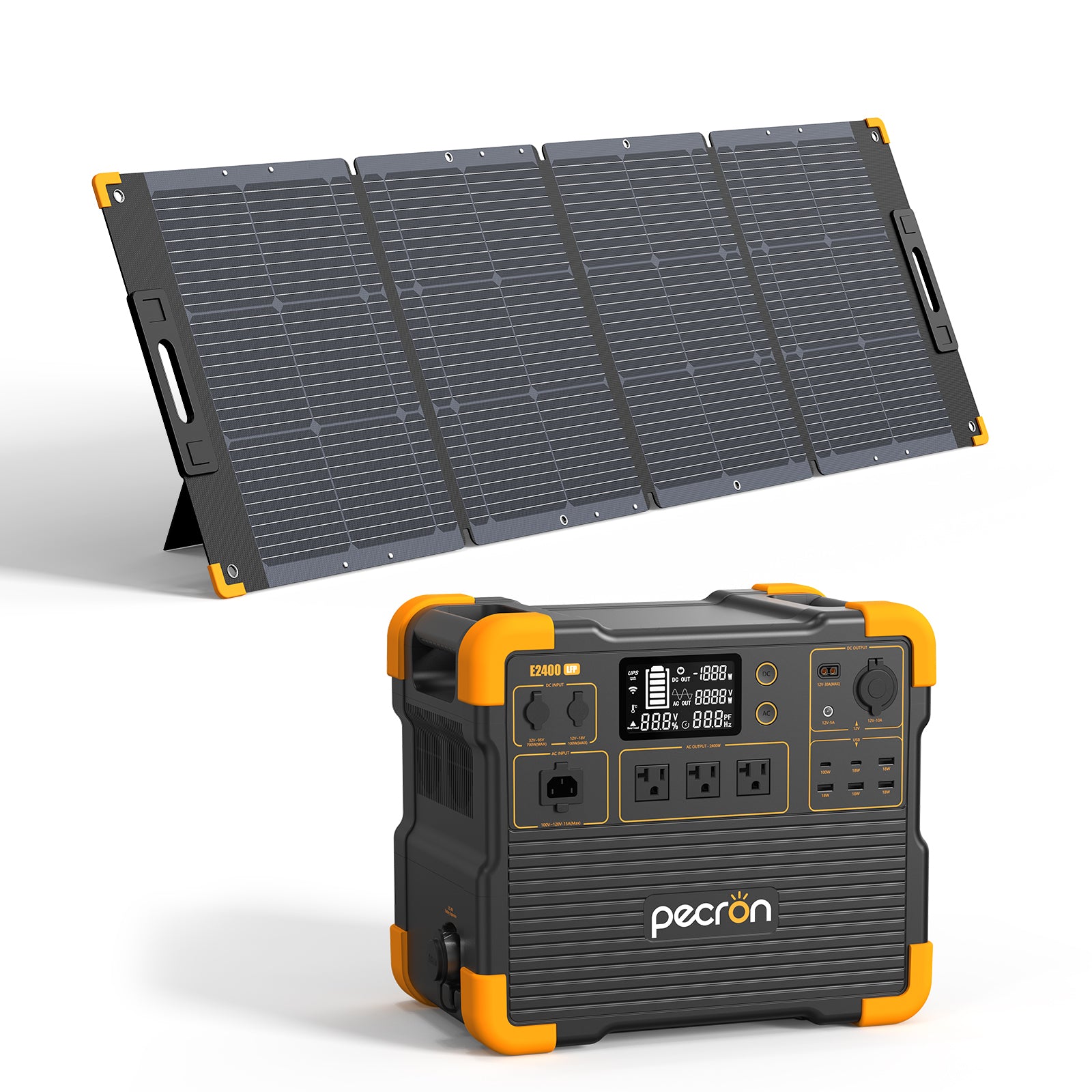
This is the selected U.S. E2400LFP option labeled E2400LFP-200W Solar Panel, not the bare station listing. The product title identifies one 200 W panel in the bundle. It does not identify the panel model, its voltage and current specifications, or the station-side cable supplied. Treat the bundle as a verified panel-in-box offer, not as proof that every detail of an off-grid solar plan is settled.
What remains the same as the station-only E2400
The power station is still Pecron’s 2,048 Wh, 2,400 W AC model. Its 120 V outlets can serve ordinary household-voltage loads whose continuous demand fits the inverter rating; they do not become 240 V outlets, and adding a panel does not increase battery storage or inverter output. The manual gives a short 4,000 W surge figure, not permission to run a load above 2,400 W continuously. Actual runtime depends on the appliance’s draw, cycling, conversion losses and conditions, so nameplate watt-hours are not a promised number of delivered AC watt-hours.
Pecron lists three AC receptacles, USB-C with up to 100 W output, USB-A ports and several 12 V outputs. Check which connector the intended device needs: the 30 A DC port is not interchangeable with a vehicle-style socket or a small barrel connector. At about 45 lb, the station is a substantial lift even before counting a folded panel, and the package’s combined carry weight is not established in the saved option data. It is a better fit for a vehicle-side setup or short moves than repeated long carries on foot.
A small starter array, with an important compatibility check
One 200 W-rated panel is the lightest solar bundle among these E2400 panel offers. It may suit a buyer who wants a modest, portable panel to supplement charging during a trip or a short outage, while keeping the station’s large battery available for appliances after sundown. It is not a rapid-recharge promise. The station’s published solar ceiling is 700 W on the main input, but the selected panel’s electrical values are absent; its nominal wattage alone cannot establish that it will operate inside the station’s 32–95 V and 15 A input window.
The product page also describes a separate 100 W DC5521 input, while the headline feature copy states 700 W maximum solar charging. This review uses 700 W conservatively rather than adding separate port labels into a larger total. Before relying on this kit as an essential charging path, confirm the panel’s open-circuit voltage and operating current, the connector arrangement and whether the exact bundle includes the necessary lead. Those details are not settled by the one-panel SKU or its product image.
When the other packages make more sense
If you expect to set out a larger array, the same selector offers two 200 W panels, larger groups of 200 W panels, and one- or two-panel 300 W options. Those are separate bundle choices, not accessories that this SKU is known to include. The one-panel option is the simplest starting point; its tradeoff is less named panel capacity than a multi-panel package, with no verified panel-level advantage beyond its 200 W label. If a user’s need is “a panel comes in the box,” this listing fits. If the essential need is “all supplied panels charge together at their full ratings,” no E2400 panel bundle can be assumed to pass without documented panel electrical specifications and wiring.
Who should consider it
Consider this configuration when the E2400’s 2 kWh-class storage and 2,400 W 120 V output suit the loads, you prefer to start with one included panel, and you are willing to verify the solar lead before depending on it. The station can also be recharged by AC, car input or a compatible generator, so a panel is one part of a charging plan rather than a substitute for storage or a backup charging method. Pecron advertises adjustable charging and a roughly 1.5-hour full AC recharge; those are manufacturer claims, not a test of this review or a guaranteed result on every circuit.
Look elsewhere if you need a verified 240 V or split-phase plan, a much lighter carry, a known panel model and cable in the box, or a documented all-panel wiring plan on day one. A separate station-only E2400 may be preferable if you already own compatible panels; the two-panel and 300 W bundles are worth comparing if more panel nameplate capacity matters more than a single-module kit. In every case, size the battery around the loads and the solar input around confirmed electrical limits.
Manufacturer evidence: Pecron E2400LFP U.S. product page and selected option; E2400LFP 100–120 V user manual (April 2025).
Key details at a glance
| Nameplate battery capacity | 2048 Wh |
|---|---|
| Rated AC output | 2400 W |
| Manufacturer surge rating | 4000 W |
| Maximum solar input | 700 W |
| Included panels, combined nameplate | 200 W |
| Maximum USB-C output per port | 100 W |
More specifications and setup details
| Listed weight | 45 lb |
|---|---|
| Compatible extra-battery expansion | Yes |
| 12 V DC output | 360 W |
| Maximum AC recharge input | 1800 W |
| AC outlet output | Yes |
| USB-C ports | 2 |
| USB-A ports | 4 |
| Solar input ports | 2 |
| 12 V car-style output | 120 W |
| Vehicle charge input | 100 W |
| Battery chemistry | LiFePO4 |
| Expansion battery in this package | No |
| Home Power Panel in this package | No |
| Separate station units in offer | 1 |
| Smart Transfer Switch in this package | No |
| Solar panels in exact offer | 1 |
| Included expansion batteries | 0 units |
Use the exact model’s instructions for operating limits, supplied equipment and version differences.
Sources for this assessment


A useful match starts with the loads that matter.
Use the finder for hard electrical requirements, then check appliance starting behavior, actual run time and the exact package in the full assessment.