
On this page
Your needs, this model
Does it fit your priorities?
Does the E2400LFP station in this exact package meet a 120 V, 2,400 W AC and 2,048 Wh station plan?
Yes. The selected solar bundle does not change the E2400LFP station's published 120 V output, 2,400 W continuous AC rating or 2,048 Wh nameplate capacity.
Explore this need in the finder →Does the selected offer include 2 panel(s) with 600 W combined nameplate rating?
The official selected title/SKU names 2 panel(s) at 300 W each; the exact panel model and package cable are not identified.
Explore this need in the finder →Can every panel in this exact package be relied on to charge the E2400 together at the panels’ published ratings?
That exact array is not established. Panel electrical specifications and the bundle wiring/cable arrangement are missing, so an essential all-panel compatibility condition cannot be assumed.
Explore this need in the finder →Pecron · E2400LFP with two 300 W solar panels
Pecron E2400LFP with two 300 W solar panels review
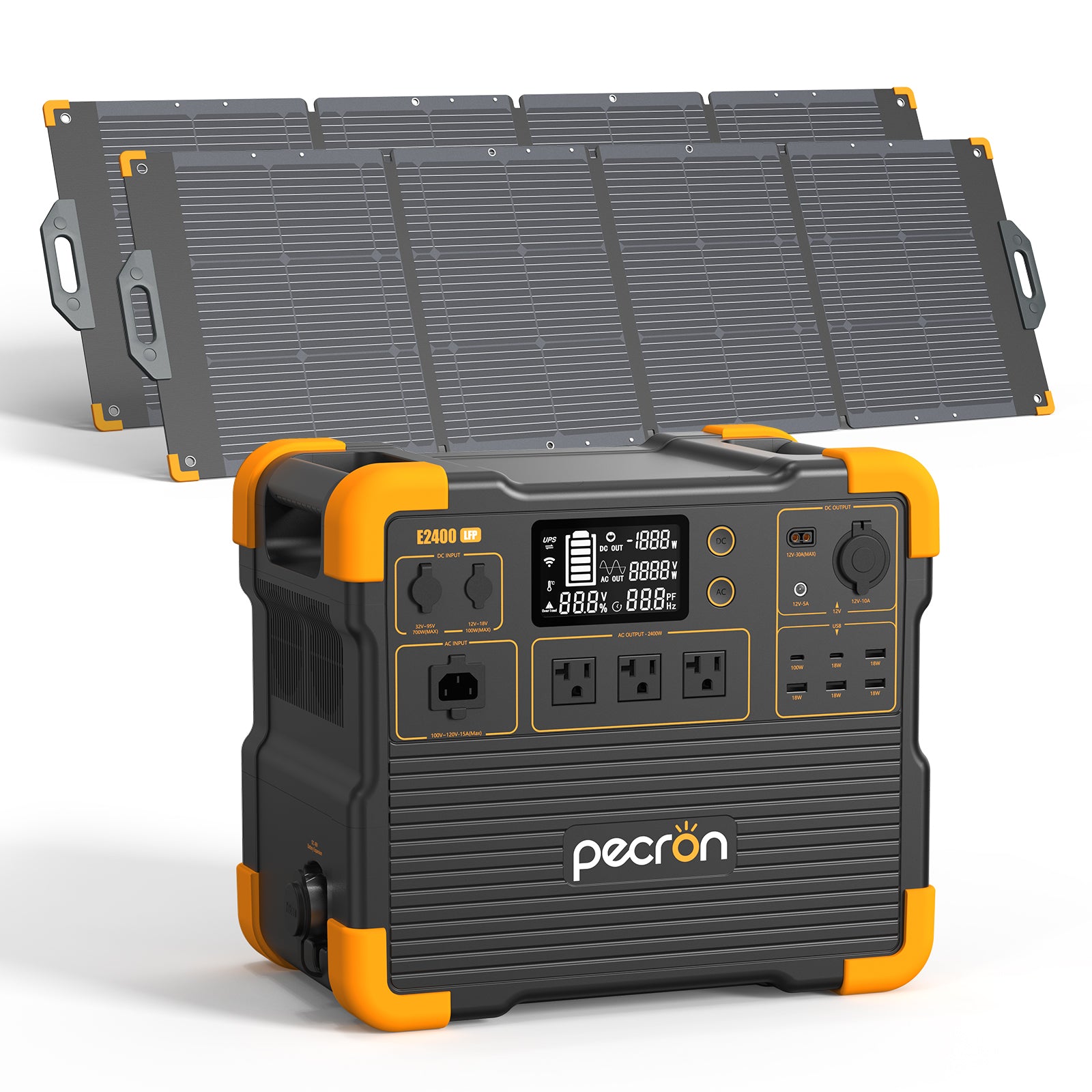
The selected U.S. offer is titled E2400LFP-2*300W Solar Panel, specifying a pair of 300 W-rated panels with the E2400 station. The package therefore has 600 W of combined nominal panel rating. The exact panel model, panel voltage/current values and required bundle wiring are not identified by the selected title. This is an important limitation to separate from the station’s own documented solar input: the bundle name tells you what is offered, but not whether the two modules are intended to connect simultaneously through a particular cable arrangement.
The station supplies the same 120 V / 2 kWh-class plan
The E2400LFP is a single station with 2,048 Wh of nameplate LiFePO4 capacity, 2,400 W rated AC output and a short 4,000 W surge figure. Its AC output is 120 V; two panels do not make a 240 V system. The 2,400 W rating is the continuous planning limit, not the surge number. Energy capacity and inverter output answer different questions: the inverter sets which instantaneous loads fit, while battery capacity determines how long a load can be served. A panel bundle changes neither.
Pecron specifies multiple AC, USB and DC outputs, including USB-C up to 100 W and a 30 A DC connection. Check the exact outlet type because the high-current DC port is not a vehicle socket. The 45 lb station is a substantial object to move; two panels add more handling and storage, although this offer’s combined mass and panel dimensions are not available in the captured record. It is more sensible for a base-camp or vehicle plan than a setup where every component must be carried a long way.
The 600 W panel package is near the E2400 solar ceiling
Pecron’s detailed product specification lists a main solar input of up to 700 W, 32–95 V and 15 A. It separately identifies a 100 W DC5521 port at 12–18 V, while the main feature summary calls out 700 W maximum solar charging. The conservative system plan here uses 700 W as the total upper limit rather than adding port figures. Two 300 W panels have 600 W combined nominal ratings, but actual harvest will vary with light, orientation, shade, temperature and charge behavior.
Panel wattage does not prove compatibility. The selected option lacks each module’s open-circuit voltage and operating current, and it does not list a wiring lead. A two-panel array can be wired in more than one way; without the manufacturer’s plan, neither a series nor parallel arrangement should be assumed. The manufacturer image shows a pair of panel forms and the E2400, but it is a CGI/render and not an electrical schematic. Confirm the panel model and exact combined connection with Pecron before relying on an essential solar-recharge requirement.
Why choose two 300 W panels instead of other kits?
This is the highest named panel total in the E2400 solar selector at 600 W, matching the three-200 W bundle’s total but using two higher-rated panels. Compared with two 200 W panels, it doubles the combined nameplate rating from 400 W to 600 W; compared with a single 300 W panel, it offers twice that nominal panel total. Those comparisons are useful for selecting the offer, not for predicting charge time: the input cap, exact panel electrical values, sunlight and wiring all matter. Two pieces may be easier to lay out than three, though panel size and folding style are not confirmed by the source.
For day-to-day use, decide first how much energy your loads need after sunset, then whether the daytime array can replenish a meaningful portion without exceeding the station limits. Pecron advertises adjustable AC charging and about a 1.5-hour full recharge with fast AC input, but that is a manufacturer figure that depends on the supply and settings. The panels are a supplemental charging choice, not a replacement for enough stored energy or a backup charging path during poor weather.
Who should consider it
Consider this bundle if the E2400’s 2,048 Wh capacity and 2,400 W 120 V output fit, you want two 300 W-rated panels included, and you can verify their model, cable and combined electrical plan. It may be a good comparison point against the 600 W three-panel kit for someone who prefers fewer modules, but those two packages cannot be ranked by real-world output from the available facts. Choose the station-only unit if you already own compatible panels. Choose another platform if 240 V service, a verified turnkey solar connection or a lighter lift is essential.
Manufacturer evidence: Pecron E2400LFP U.S. product page and selected option; E2400LFP 100–120 V user manual (April 2025).
Key details at a glance
| Nameplate battery capacity | 2048 Wh |
|---|---|
| Rated AC output | 2400 W |
| Manufacturer surge rating | 4000 W |
| Maximum solar input | 700 W |
| Included panels, combined nameplate | 600 W |
| Maximum USB-C output per port | 100 W |
More specifications and setup details
| Listed weight | 45 lb |
|---|---|
| Compatible extra-battery expansion | Yes |
| 12 V DC output | 360 W |
| Maximum AC recharge input | 1800 W |
| AC outlet output | Yes |
| USB-C ports | 2 |
| USB-A ports | 4 |
| Solar input ports | 2 |
| 12 V car-style output | 120 W |
| Vehicle charge input | 100 W |
| Battery chemistry | LiFePO4 |
| Expansion battery in this package | No |
| Home Power Panel in this package | No |
| Separate station units in offer | 1 |
| Smart Transfer Switch in this package | No |
| Solar panels in exact offer | 2 |
| Included expansion batteries | 0 units |
Use the exact model’s instructions for operating limits, supplied equipment and version differences.
Sources for this assessment


A useful match starts with the loads that matter.
Use the finder for hard electrical requirements, then check appliance starting behavior, actual run time and the exact package in the full assessment.