
On this page
Your needs, this model
Does it fit your priorities?
Does the E2400LFP station in this exact package meet a 120 V, 2,400 W AC and 2,048 Wh station plan?
Yes. The selected solar bundle does not change the E2400LFP station's published 120 V output, 2,400 W continuous AC rating or 2,048 Wh nameplate capacity.
Explore this need in the finder →Does the selected offer include 1 panel(s) with 300 W combined nameplate rating?
The official selected title/SKU names 1 panel(s) at 300 W each; the exact panel model and package cable are not identified.
Explore this need in the finder →Can every panel in this exact package be relied on to charge the E2400 together at the panels’ published ratings?
That exact array is not established. Panel electrical specifications and the bundle wiring/cable arrangement are missing, so an essential all-panel compatibility condition cannot be assumed.
Explore this need in the finder →Pecron · E2400LFP with one 300 W solar panel
Pecron E2400LFP with one 300 W solar panel review
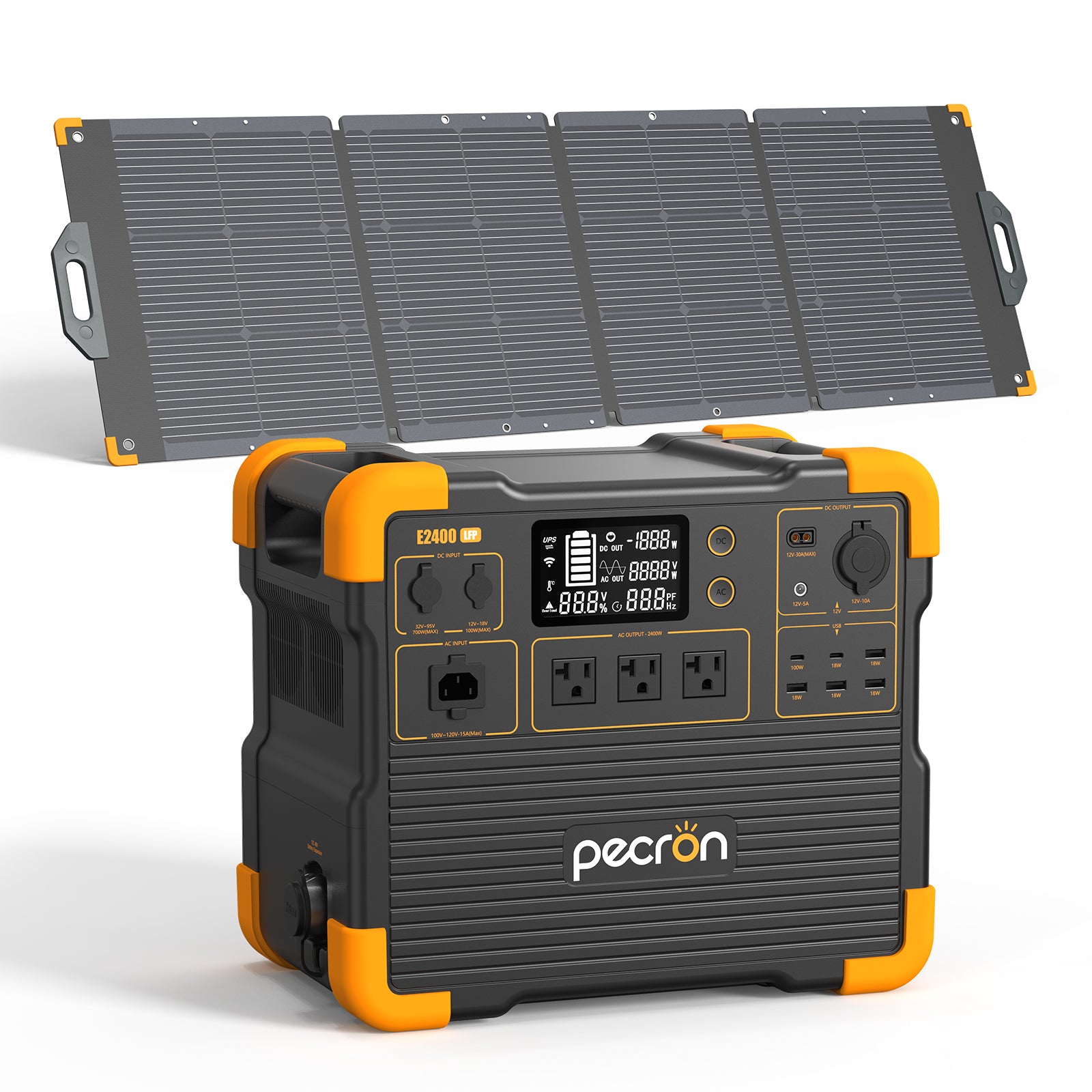
This selected U.S. configuration is labeled E2400LFP-300W Solar Panel. The offer identifies one 300 W-rated panel with the E2400LFP, but the archived product information does not name its panel model, electrical specifications or included station-side lead. That makes this a panel-inclusive option with a clearly stated wattage, not a fully documented ready-to-connect solar kit. The distinction is especially important for an essential off-grid charging plan.
One panel, the same sizeable E2400 station
The E2400LFP provides 2,048 Wh of nameplate LiFePO4 storage and a 2,400 W 120 V AC inverter. Pecron lists a 4,000 W surge figure for short bursts; do not size a continuous appliance above the 2,400 W rating. One included panel changes neither battery reserve nor AC output. A 2,048 Wh battery can cover some loads for meaningful periods, but the real duration depends on how much power the appliance draws, how often it runs and conversion losses.
The station has a mix of AC and DC outputs, including USB-C up to 100 W and a 30 A 12 V connection that is not a car-style socket. Verify the exact outlet and connector required by your equipment. At about 45 lb, it is better suited to a car-side camp, a stationary backup corner or a short move than frequent long carries. The one-panel bundle may reduce the amount of separate solar equipment compared with a multi-panel package, but the combined station-plus-panel weight and panel dimensions are not established.
300 W is useful context, not guaranteed harvest
The single 300 W rating is greater than the one-panel 200 W offer’s label and lower than the 400 W two-200 W bundle’s combined nameplate. That offers a straightforward middle choice for someone preferring one panel form over multiple panels, but the supplied item’s exact size and construction are unknown. The selected-option image shows one folding panel form beside the E2400; as a manufacturer CGI/render it documents how the offer is represented, not how the product performs or connects.
Pecron’s main solar input is specified up to 700 W at 32–95 V and 15 A. The page’s detailed table also lists a separate 100 W DC5521 input, while the high-level description states a 700 W maximum for solar. I use 700 W conservatively as the overall ceiling. The panel’s 300 W nameplate does not prove that its open-circuit voltage stays below the station’s limit, that its operating current is suitable, or that the right lead is included. Ask for the exact panel specification and connection details before making this your only recharge path.
Planning charging around real use
A panel does not mean the E2400 can run indefinitely. The station can collect energy during usable daylight and store it for later, but shading, clouds, angle and season change the amount. For a refrigerator, communications gear or tools, estimate the daily energy need and include a reserve for cloudy periods. This is a better way to decide whether the one 300 W bundle is enough than comparing panel wattage alone.
AC charging is a useful alternative: Pecron advertises up to 1,800 W input and a roughly 1.5-hour full recharge under its fast setting. That is a manufacturer claim, not a guarantee for every outlet or temperature. The product page also advertises app/Wi-Fi control, adjustable charging and a LiFePO4 life of 3,500+ cycles to 80%; these are specifications or claims from Pecron, not independent testing. The manual’s operating and temperature directions should take precedence over any assumption that the station can be left running outdoors in adverse weather.
Who should compare this with another option
This bundle may fit a buyer who has selected the E2400’s 2 kWh-class storage and 2,400 W 120 V output, wants a single included panel named at 300 W, and is willing to verify the connection before depending on it. Choose the one-200 W package for a smaller named panel rating; consider two-200 W or one-300 W based on the panel layout you can actually use; compare two-300 W or three-200 W for a 600 W combined nominal package. Those options do not raise the E2400’s 700 W conservative station input or battery capacity.
Look beyond the E2400 if you need a lighter carry, verified 240 V output, a panel with published compatibility details in the box, or an array known to work at full rating without extra confirmation. A station-only E2400 may be the better buy if you already own tested compatible panels. In every case, treat the station and panel as separate parts of a plan and confirm the actual connector, voltage and current before connecting equipment.
Manufacturer evidence: Pecron E2400LFP U.S. product page and selected option; E2400LFP 100–120 V user manual (April 2025).
Key details at a glance
| Nameplate battery capacity | 2048 Wh |
|---|---|
| Rated AC output | 2400 W |
| Manufacturer surge rating | 4000 W |
| Maximum solar input | 700 W |
| Included panels, combined nameplate | 300 W |
| Maximum USB-C output per port | 100 W |
More specifications and setup details
| Listed weight | 45 lb |
|---|---|
| Compatible extra-battery expansion | Yes |
| 12 V DC output | 360 W |
| Maximum AC recharge input | 1800 W |
| AC outlet output | Yes |
| USB-C ports | 2 |
| USB-A ports | 4 |
| Solar input ports | 2 |
| 12 V car-style output | 120 W |
| Vehicle charge input | 100 W |
| Battery chemistry | LiFePO4 |
| Expansion battery in this package | No |
| Home Power Panel in this package | No |
| Separate station units in offer | 1 |
| Smart Transfer Switch in this package | No |
| Solar panels in exact offer | 1 |
| Included expansion batteries | 0 units |
Use the exact model’s instructions for operating limits, supplied equipment and version differences.
Sources for this assessment


A useful match starts with the loads that matter.
Use the finder for hard electrical requirements, then check appliance starting behavior, actual run time and the exact package in the full assessment.