
On this page
Your needs, this model
Does it fit your priorities?
Does the E2400LFP station in this exact package meet a 120 V, 2,400 W AC and 2,048 Wh station plan?
Yes. The selected solar bundle does not change the E2400LFP station's published 120 V output, 2,400 W continuous AC rating or 2,048 Wh nameplate capacity.
Explore this need in the finder →Does the selected offer include 3 panel(s) with 600 W combined nameplate rating?
The official selected title/SKU names 3 panel(s) at 200 W each; the exact panel model and package cable are not identified.
Explore this need in the finder →Can every panel in this exact package be relied on to charge the E2400 together at the panels’ published ratings?
That exact array is not established. Panel electrical specifications and the bundle wiring/cable arrangement are missing, so an essential all-panel compatibility condition cannot be assumed.
Explore this need in the finder →Pecron · E2400LFP with three 200 W solar panels
Pecron E2400LFP with three 200 W solar panels review
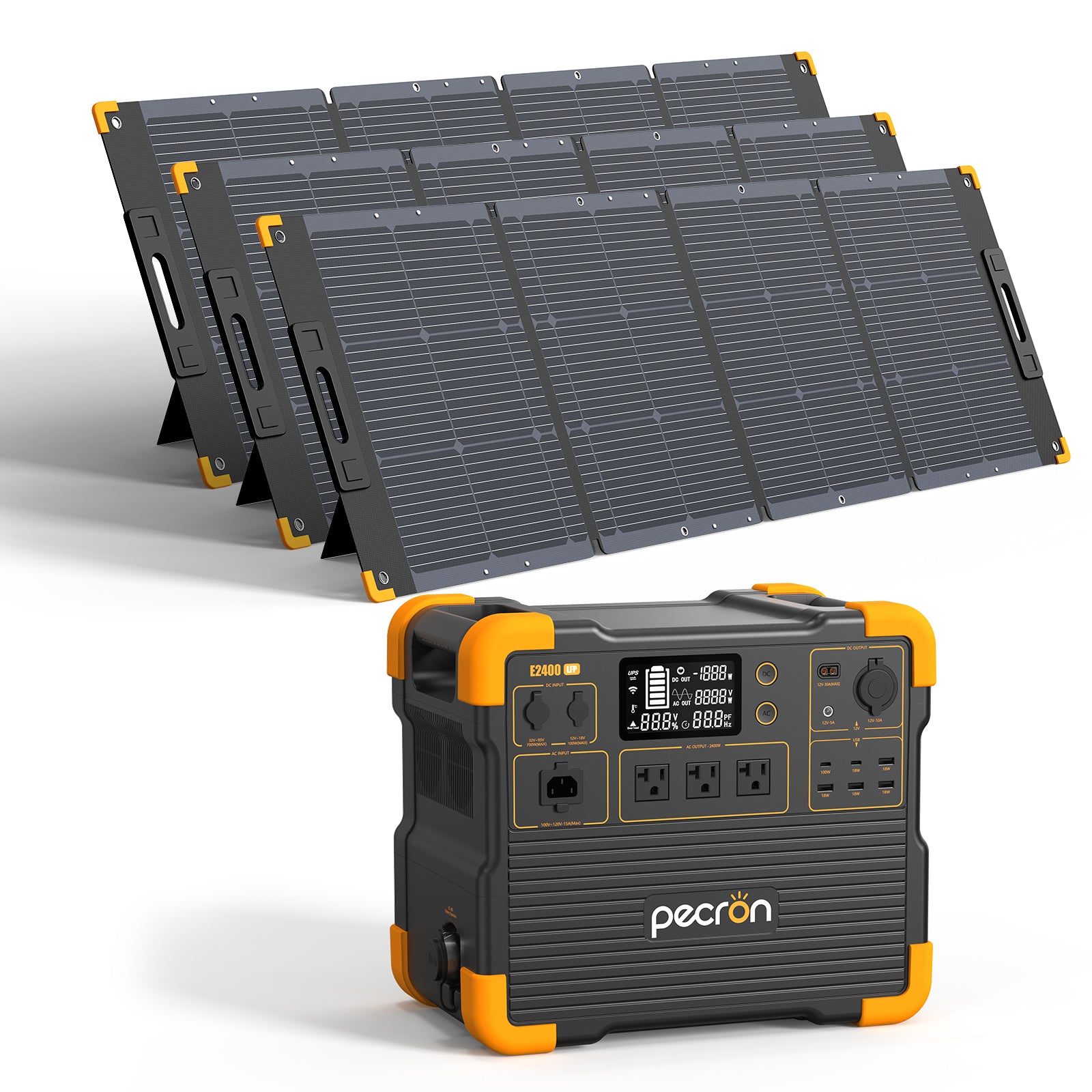
Pecron’s U.S. selector identifies this option as E2400LFP-3*200W Solar Panel: the selected package names three 200 W panels, giving 600 W of combined nominal panel rating. This review treats that as the bundle identity, not as proof of real-world harvest or a fully specified electrical array. The exact panel model, voltage/current values and bundle cable arrangement are not stated in the archived selection. That distinction matters because the panel sum approaches the station’s own solar-input ceiling.
Why this bundle sits near the E2400’s charging limit
The E2400LFP remains a single 2,048 Wh station with a 2,400 W, 120 V AC inverter. Pecron advertises 4,000 W surge, but a short surge rating does not support a continuous load above the ordinary 2,400 W rating. Three panels do not enlarge the battery or inverter. Their combined 600 W nameplate rating is below the product page’s 700 W maximum solar figure; actual input can be lower because of sunlight, shade, temperature, angle and the station’s conversion behavior.
The product page’s detailed limits list a 700 W GX16MF solar input at 32–95 V and 15 A and a separate DC5521 input up to 100 W at 12–18 V. Its feature copy describes 700 W maximum solar charging. To avoid overstating the system, this review treats 700 W as the station’s conservative maximum rather than summing the separate labels. The bundle’s 600 W panel total is a useful comparison point, but it cannot verify that a three-panel string or parallel array will stay within the voltage and current window.
More panels are useful only if the array is practical
Three panels may suit a user with a fixed sunny place to set them out and enough time to reposition them during the day. For a tight campsite or a quick stop, a three-piece setup can be more equipment to unpack, orient and secure than a single 300 W panel. The official selected-option image shows multiple panel forms alongside the station; it is a product-page CGI/render, not a wiring diagram or proof of what connectors are included. Neither the image nor the option name establishes panel dimensions, whether the panels fold, or the correct series/parallel topology.
Ask Pecron for the exact panel model and array wiring, then compare the documented panel open-circuit voltage and operating current against the manual’s station limits. Also confirm that a station-side lead is supplied. A panel’s own output cable is not necessarily the lead required by the station. Until those details are confirmed, the kit can match a shopper’s broad request for an E2400 with three included 200 W panels, but not a hard requirement that all three deliver their full ratings together.
What the E2400 is good for—and where it is not
At roughly 45 lb before the bundle panels, this station is best moved a short distance or staged near the loads it serves. It has three AC receptacles and a collection of USB and DC outlets, including a 30 A 12 V output that uses a different connection from a car-style socket. Check the connector and current needed by the device, not just its voltage. Nameplate storage of 2,048 Wh is substantial for a portable unit but still finite: a sustained 1,000 W load will draw far more energy than a phone or router, and AC conversion reduces delivered energy from the battery rating.
Pecron also advertises adjustable charging, app/Wi-Fi control, a LiFePO4 pack and 3,500+ cycles to 80% capacity. The cycle figure is a manufacturer claim, not a test result here. The page’s roughly 1.5-hour full AC-recharge figure is likewise a claim rather than a guaranteed outcome. A three-panel package may make sense as daytime replenishment for selected loads, but the battery must still cover evening use and periods when panels are shaded.
Who should consider this exact package
Consider it if the E2400’s 120 V output and 2 kWh-class storage fit your load plan, you want three 200 W-rated panels included, and you will verify their combined electrical setup before depending on it. The 600 W nameplate bundle is more panel than the 400 W two-panel package, without reaching the 800 W nameplate total of the four-panel 200 W offer. A single 300 W kit is simpler to deploy but has half the named total. Buy the station-only SKU if you already have a compatible array; select a different power architecture if 240 V, a verified all-panel wiring plan or a much lighter carry is essential.
Manufacturer evidence: Pecron E2400LFP U.S. product page and selected option; E2400LFP 100–120 V user manual (April 2025).
Key details at a glance
| Nameplate battery capacity | 2048 Wh |
|---|---|
| Rated AC output | 2400 W |
| Manufacturer surge rating | 4000 W |
| Maximum solar input | 700 W |
| Included panels, combined nameplate | 600 W |
| Maximum USB-C output per port | 100 W |
More specifications and setup details
| Listed weight | 45 lb |
|---|---|
| Compatible extra-battery expansion | Yes |
| 12 V DC output | 360 W |
| Maximum AC recharge input | 1800 W |
| AC outlet output | Yes |
| USB-C ports | 2 |
| USB-A ports | 4 |
| Solar input ports | 2 |
| 12 V car-style output | 120 W |
| Vehicle charge input | 100 W |
| Battery chemistry | LiFePO4 |
| Expansion battery in this package | No |
| Home Power Panel in this package | No |
| Separate station units in offer | 1 |
| Smart Transfer Switch in this package | No |
| Solar panels in exact offer | 3 |
| Included expansion batteries | 0 units |
Use the exact model’s instructions for operating limits, supplied equipment and version differences.
Sources for this assessment


A useful match starts with the loads that matter.
Use the finder for hard electrical requirements, then check appliance starting behavior, actual run time and the exact package in the full assessment.