
On this page
Your needs, this model
Does it fit your priorities?
Does the E2400LFP station in this exact package meet a 120 V, 2,400 W AC and 2,048 Wh station plan?
Yes. The selected solar bundle does not change the E2400LFP station's published 120 V output, 2,400 W continuous AC rating or 2,048 Wh nameplate capacity.
Explore this need in the finder →Does the selected offer include 4 panel(s) with 800 W combined nameplate rating?
The official selected title/SKU names 4 panel(s) at 200 W each; the exact panel model and package cable are not identified.
Explore this need in the finder →Can every panel in this exact package be relied on to charge the E2400 together at the panels’ published ratings?
That exact array is not established. Panel electrical specifications and the bundle wiring/cable arrangement are missing, so an essential all-panel compatibility condition cannot be assumed.
Explore this need in the finder →Pecron · E2400LFP with four 200 W solar panels
Pecron E2400LFP with four 200 W solar panels review
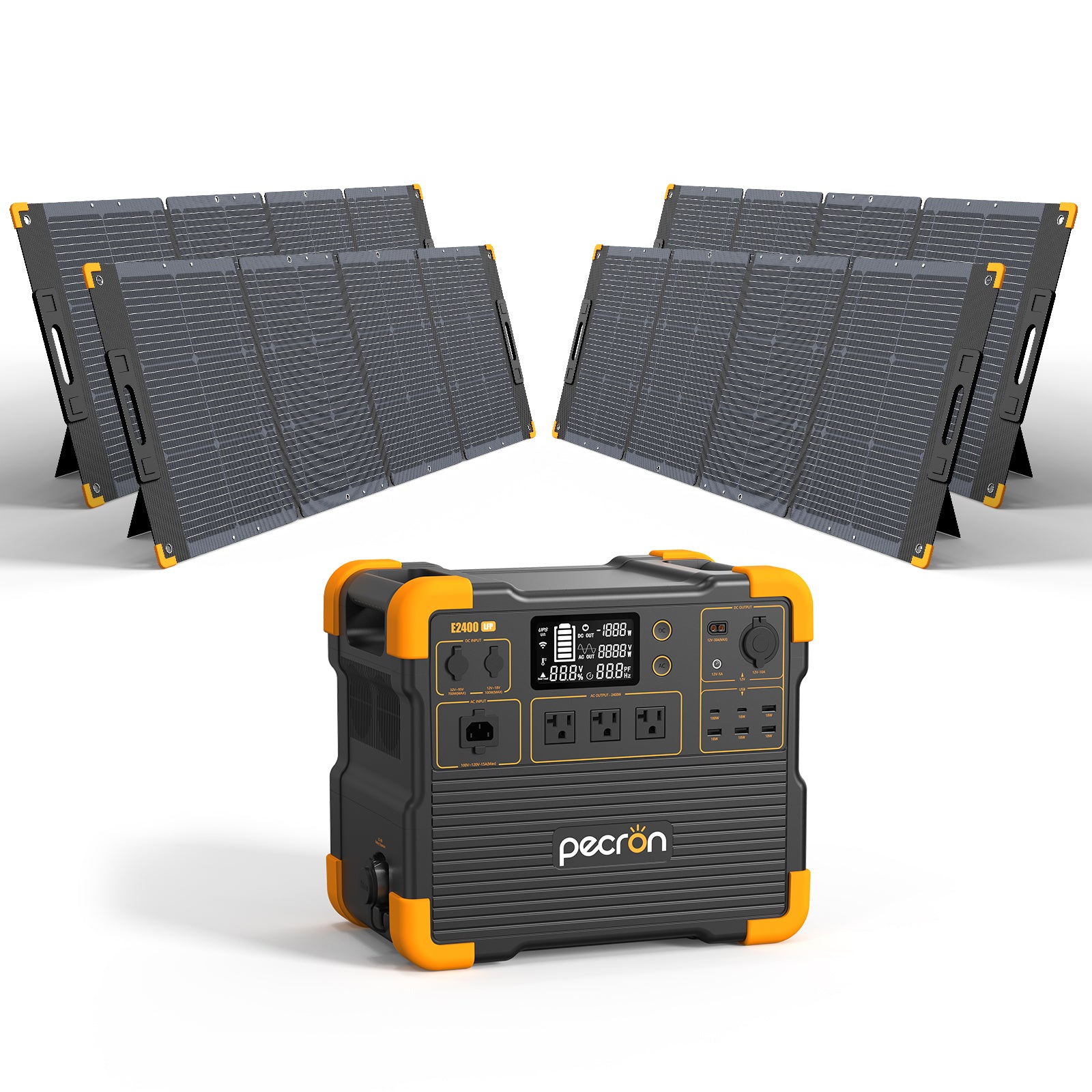
The selected U.S. variant is labeled E2400LFP-4*200W Solar Panel, identifying four 200 W-rated panels in the manufacturer’s offer. Their 800 W combined nameplate rating is higher than the E2400 product page’s stated 700 W maximum solar-charging figure. That does not by itself prove the bundle is unsafe or unusable; actual array voltage/current and controller behavior matter. It does mean a buyer should not interpret “800 W of panels” as 800 W entering the battery, and should get the intended wiring and input limits confirmed before relying on the full kit.
The station’s output and stored energy do not change
This is still the E2400LFP: 2,048 Wh of LiFePO4 storage, a 2,400 W 120 V AC inverter and a brief 4,000 W surge rating. The panel bundle does not add more battery or increase the continuous output. It cannot provide 240 V from one station. For an appliance, compare its continuous draw and startup behavior with the inverter rating, then plan runtime using its actual energy use rather than equating 2,048 nameplate watt-hours with delivered AC energy.
The unit weighs about 45 lb before panels, which makes it more at home in a vehicle-based camp or backup location than in a carry-all-day setup. The 12 V section includes different connectors with different current limits; a 30 A output is not the same plug as a car outlet. Pecron lists three AC outlets, USB-C up to 100 W and several USB-A/DC connections. If the gear uses a specialized DC connector, verify the proper lead rather than relying on an adapter assumption.
800 W of panel labels is not an 800 W charging promise
Pecron’s product detail lists up to 700 W for the main GX16MF solar input at 32–95 V and 15 A. The page also describes a separate 100 W DC5521 input at 12–18 V, while its feature summary caps solar charging at 700 W. The conservative operating plan here uses the stated 700 W overall maximum; it does not add separate port figures. With four panels labeled 200 W each, the bundle’s arithmetic total is 800 W, but the manual does not establish the exact panels’ operating values or the arrangement for this offer. A controller may limit input, and a panel nameplate sum alone cannot determine whether the array fits the input window.
Before purchase, ask for the exact panel model, open-circuit voltage, current, connection topology, and whether the necessary station-side cable is in the box. The selected product image is a manufacturer CGI/render associated with this option. It shows the station with multiple panel forms, but it is not a wiring diagram and does not answer those electrical questions. An essential requirement that every supplied panel work together at full rating is not confirmed by the current source set.
Who benefits from the larger bundle
A four-panel package may appeal to someone who wants substantial panel nameplate capacity for a fixed sunny deployment and does not mind carrying, placing and securing several pieces. It could give more choice in positioning around partial shade, but no exact panel geometry or electrical independence is documented for these items, so treat that as a question to resolve rather than a guaranteed feature. If you need a lower-complexity kit, one 300 W panel or one 200 W panel is easier to stage. The two-300 W option and three-200 W option each name 600 W total, below the E2400’s stated maximum; they still need exact cable and panel verification.
For emergency use, the stored energy must carry the load through night and weather, not just a clear noon period. Pecron advertises adjustable AC charging and about 1.5 hours to full at the specified fast-charge setting, but this is a manufacturer figure and depends on the input supply and settings. A compatible generator or wall outlet may be a more predictable recharge path when solar conditions are poor.
Bottom line
Choose this exact E2400 bundle only if the station’s 120 V, 2,400 W and 2,048 Wh limits fit your plan, four included 200 W-rated panels are useful, and you can confirm the complete array’s electrical arrangement with Pecron. The listing establishes the included panel count and ratings; it does not establish 800 W at the station input or a supported full-array topology. Skip it if you require a ready-to-use, documented panel system without additional verification, need 240 V, or expect the solar bundle to extend battery capacity. The station-only E2400 is the cleaner option for owners with known compatible panels.
Manufacturer evidence: Pecron E2400LFP U.S. product page and selected option; E2400LFP 100–120 V user manual (April 2025).
Key details at a glance
| Nameplate battery capacity | 2048 Wh |
|---|---|
| Rated AC output | 2400 W |
| Manufacturer surge rating | 4000 W |
| Maximum solar input | 700 W |
| Included panels, combined nameplate | 800 W |
| Maximum USB-C output per port | 100 W |
More specifications and setup details
| Listed weight | 45 lb |
|---|---|
| Compatible extra-battery expansion | Yes |
| 12 V DC output | 360 W |
| Maximum AC recharge input | 1800 W |
| AC outlet output | Yes |
| USB-C ports | 2 |
| USB-A ports | 4 |
| Solar input ports | 2 |
| 12 V car-style output | 120 W |
| Vehicle charge input | 100 W |
| Battery chemistry | LiFePO4 |
| Expansion battery in this package | No |
| Home Power Panel in this package | No |
| Separate station units in offer | 1 |
| Smart Transfer Switch in this package | No |
| Solar panels in exact offer | 4 |
| Included expansion batteries | 0 units |
Use the exact model’s instructions for operating limits, supplied equipment and version differences.
Sources for this assessment


A useful match starts with the loads that matter.
Use the finder for hard electrical requirements, then check appliance starting behavior, actual run time and the exact package in the full assessment.