
Your needs, this model
Does it fit your priorities?
Would 2,048 Wh and 2,400 W cover your 120 V plan?
The E2400 standalone plan has 2,048 Wh and 2,400 W rated output; its 4,000 W peak is stated for 10 ms.
Explore this need in the finder →Does a 700 W conservative solar ceiling fit your panel plan?
The product page states 700 W maximum solar input; exact input combination behavior needs manual review.
Explore this need in the finder →Do you require 12 V/30 A DC and an expansion route?
Pecron lists 12 V/30 A output and expansion, but EP pack names conflict across the page and current options.
Explore this need in the finder →Pecron · mid-capacity 120 V station
Pecron E2400LFP review
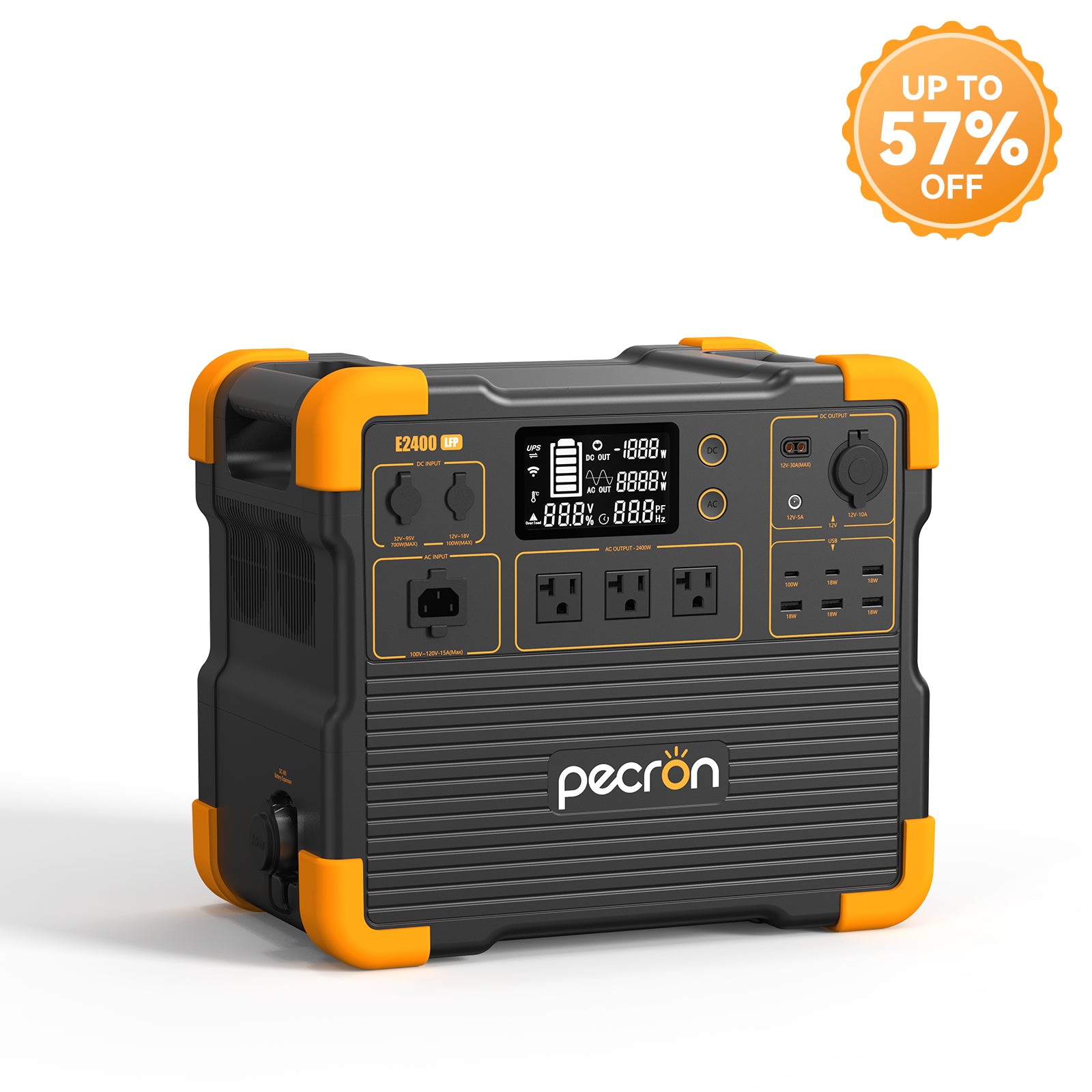
The E2400LFP fills a useful space between roughly 1 kWh travel stations and very large backup systems: 2,048 Wh of LiFePO4 capacity and 2,400 W of 100–120 V output in a 45 lb chassis. Its 4,000 W peak rating is brief—the manufacturer lists 10 ms—and should not be used to size a sustained load. This is a substantial one-person carry only for short moves, not a station for frequent long-distance hauling.
Output options for an actual 120 V plan
Pecron lists three AC outlets, a 12 V/30 A output, two USB-C ports with a maximum 100 W output, four 18 W USB-A ports, a car-style socket, a DC5525 port and app/Wi-Fi control. The exact connector and per-port limits matter: 30 A DC is not a cigarette-lighter socket, and the car-style outlet has its own current ceiling. Check the load's plug and current requirement rather than treating every “12 V” connector as equivalent.
The 2,048 Wh battery is a nameplate capacity. A 2,400 W inverter can support a demanding instantaneous load within its rated conditions, but it cannot deliver that load for long. Actual runtime depends on AC conversion losses, device cycling, temperature and how much capacity remains. Pecron's published 3,500-cycle-to-80% figure is a manufacturer claim, not a cycle test conducted for this review. For a fridge, pump or kitchen appliance, use its measured/labelled draw and startup requirement to estimate whether the battery reserve is enough.
Solar input is adequate for some plans, not all
The official product specification lists up to 700 W on the main GX16MF solar input at 32–95 V and up to 100 W on a separate DC5521 input at 12–18 V. The page's feature copy describes a 700 W maximum across the solar arrangement, so this assessment uses 700 W as the conservative station maximum rather than adding the port ratings. Confirm the exact voltage window for the connector you intend to use; a panel wattage by itself does not show that its open-circuit voltage is compatible.
The base E2400LFP SKU does not include a solar panel. The official product selector separately exposes 200 W and 300 W panel packages and expansion-battery combinations. A selected kit may change the package contents, but it should not be inferred from the standalone station image or title. The product page lists AC charging up to 1,800 W and a manufacturer-stated recharge time around 1.5 hours. The actual input depends on the wall circuit and charge settings; the figure is not an independent charging test.
Expansion is available, though the pack model matters
Pecron markets the E2400 as expandable and the current U.S. offer selector includes E2400LFP packages with EP3800-48V batteries. The descriptive product text and manual also mention EP3000-48V expansion and an 8,192 Wh maximum, while the newer EP3800 module has a different nameplate capacity. Because the current page contains both references, this review does not pass a maximum expanded capacity as a hard matching fact. The key practical point is that expansion is separate from the standalone unit and must use the exact compatible pack/cable and station revision; check the manual and manufacturer before ordering.
The page advertises two-plus-one-year warranty wording and UPS behavior. The registration and warranty details are not resolved here, and the UPS label alone does not prove a connected computer, medical device or motor will tolerate a transfer. Follow the official [E2400LFP manual](https://cdn.shopify.com/s/files/1/0509/5263/4556/files/PECRON_E2400LFP_user_manual_100V_120V_-2025-04.pdf?v=1761901263) for ports, thermal alarms and expansion. The manual gives a 0–45°C charging range and −20–45°C discharge range; keep the intake clear and the station dry.
Who should compare it with the E1500?
The E2400 makes sense when you want more nameplate storage and a 2,400 W inverter than the E1500LFP V3, and you can accept a lower published solar ceiling. The V3 E1500 has 1,536 Wh and 2,200 W output but lists up to 1,000 W of solar input, a lighter 38.4 lb weight and a documented expansion path; it also has a 15 W wireless charger. If solar recharge is the core plan, the E1500 may be a better fit despite its smaller battery. If you need the E2400's 2,048 Wh and can replenish at up to 700 W solar, its larger energy reserve may matter more.
The E1000LFP weighs less but has half the battery and a 1,800 W inverter; the F3000LFP doubles output and raises solar input but is about 63 lb. The E2400 is the middle option when a 45 lb case, 120 V only output, UPS/app features and 2 kWh capacity match the expected loads. It does not offer 240 V from one unit and does not include a panel in its base SKU. Check the current selected option, expansion model and load plan before purchasing.
Key details at a glance
| Nameplate battery capacity | 2048 Wh |
|---|---|
| Rated AC output | 2400 W |
| Manufacturer surge rating | 4000 W |
| Maximum solar input | 700 W |
| Included panels, combined nameplate | 0 W |
| Maximum USB-C output per port | 100 W |
| Listed weight | 45 lb |
| Compatible extra-battery expansion | Yes |
| 12 V DC output | 360 W |
| Maximum AC recharge input | 1800 W |
| AC outlet output | Yes |
| USB-C ports | 2 |
| USB-A ports | 4 |
| Solar input ports | 2 |
| 12 V car-style output | 120 W |
| Vehicle charge input | 100 W |
| Battery chemistry | LiFePO4 |
| Expansion battery in this package | No |
| Home Power Panel in this package | No |
| Separate station units in offer | 1 |
| Smart Transfer Switch in this package | No |
| Solar panels in exact offer | 0 |
Use the exact model’s instructions for operating limits, supplied equipment and version differences.
Sources for this assessment

A useful match starts with the loads that matter.
Use the finder for hard electrical requirements, then check appliance starting behavior, actual run time and the exact package in the full assessment.