
On this page
Your needs, this model
Does it fit your priorities?
Do you need a solar panel to be named in the exact station option?
The selected E300LFP-100W option names one 100 W panel; the exact panel model and bundle cable remain unconfirmed.
Explore this need in the finder →Will the E300LFP’s 288 Wh and 600 W AC ceiling fit the devices you plan to run?
Its 120 V AC plan is rated at 600 W and its station battery is 288 Wh. That describes nameplate limits, not guaranteed runtime.
Explore this need in the finder →Must the included panel be confirmed to work within the station’s exact published voltage limit?
The selected panel option is known, but Pecron’s station voltage documents conflict and the exact bundle cable/compatibility is not confirmed. If this is essential, verify the exact revision and cable before relying on it.
Explore this need in the finder →Pecron · compact station with a 100 W panel option
Pecron E300LFP + 100 W Solar Panel review
This is a package choice for the small E300LFP, not a new power-station generation: the selected U.S. option is titled “E300LFP+100W Solar Panel,” SKU E300LFP-100W, variant 44010872438972. The station remains a 288 Wh LiFePO4 unit with a 600 W, 100–120 V pure-sine inverter. Pecron’s product JSON showed this option available when it was captured on October 25, 2026; that dated record is not a promise about today’s stock.
The panel changes what arrives, not the station’s ceiling
The useful difference from the E300LFP-1 station-only listing is an included panel rated at 100 W in the selected option name. The inverter, battery capacity and port limits stay those of the E300LFP: two AC outlets with a 600 W rating, one USB-C output up to 100 W, two USB-A ports rated up to 18 W each, a 12 V/10 A car-style socket, 24 V/5 A and 12 V/5 A barrel outputs, and wireless charging listed at up to 15 W. Those ratings do not all apply at once, and a 600 W inverter does not make 288 Wh a long-duration supply. Think of this as a compact source for short, modest-power jobs, not a whole-home backup battery.
A panel in the box can save a separate sourcing step for someone who wants to start with solar, but 100 W is still a small input ceiling. Solar nameplate power is not a promised harvest rate: orientation, shade, clouds, temperature and station state all affect what reaches the battery. Pecron lists the E300’s maximum solar input as 100 W, so a larger array does not create a faster recharge path than the station is designed to accept. The offer does not establish an extra battery or extend the 288 Wh capacity.
What the exact package record does and does not say
The captured product page and Shopify record establish a separate E300LFP+100W Solar Panel selection, with its own variant ID and SKU; the station-only review remains a different configuration. The option title gives the panel’s 100 W class but does not name its exact panel model. Pecron also sells a standalone PV100 100 W panel, but that adjacent product page is not proof that this E300 bundle contains that model. I therefore leave the kit panel’s exact identity unresolved rather than borrowing PV100 specifications for it.
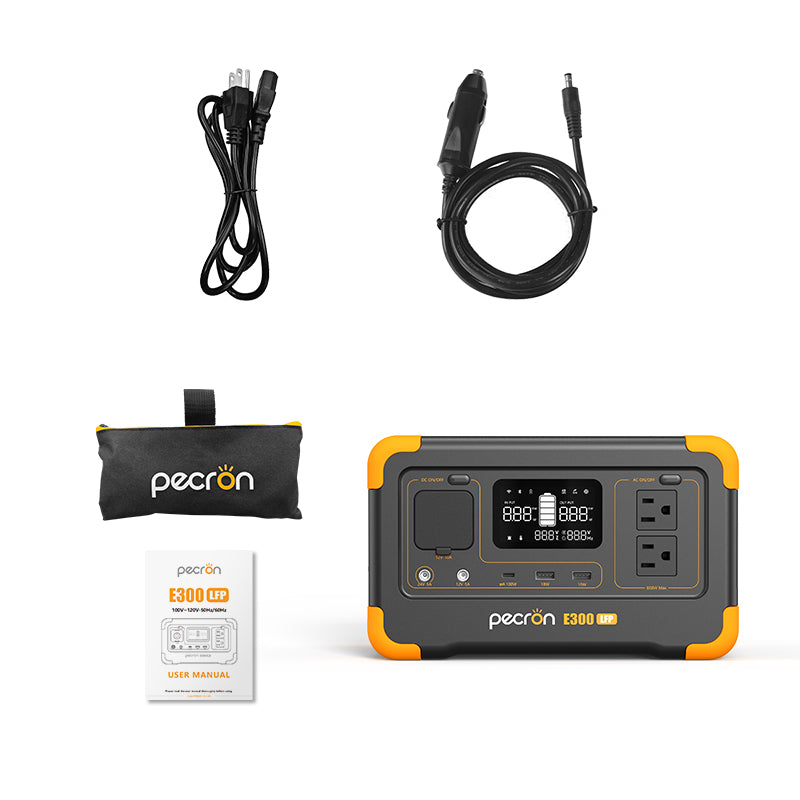
The bundle’s selected-option rendering depicts the labeled E300LFP station, not a station-and-panel arrangement. The public image is the exact station model, but it does not document box contents. The variant name is the evidence for the included panel. The station manual says its solar charging lead is separate from the standalone package; the selected bundle’s detailed in-box list does not resolve whether a station-side lead is added here. Do not assume a cable is included just because a panel is named.
Solar setup needs a voltage check
Pecron’s E300 page and manual state a 100 W DC5521 solar input and a 12–28 V range, while the same U.S. page’s FAQ gives a lower Voc ceiling of 25 V. The confirmed limit is the 100 W input class; the voltage documentation conflicts, so a strict edge-of-range compatibility requirement is not settled by this assessment. The panel model in this exact bundle is also unstated. If safe, verified solar operation is essential, ask Pecron to identify the supplied panel and the correct cable and confirm the voltage limit for the exact E300 revision before relying on the kit.
The E300 manual rates its battery at 288 Wh and its station mass at about 10.6 lb. The panel’s mass and therefore the total kit weight are not established for this option. The station is not a 240 V or split-phase source, and there is no confirmed expansion-battery plan for this U.S. model. Its 600 W AC rating is a ceiling, not a surge allowance; the published materials do not give a verified surge rating to use for motor starts.
How shopping choices change the fit
If you require a panel to be supplied, this selected option qualifies on the manufacturer’s 100 W bundle title, while the E300LFP-1 standalone profile does not. A minimum of 100 W in the package also fits; a requirement above 100 W does not. Requiring a known exact panel model, a verified cable, all supplied panels operating together within a confirmed voltage envelope, more than 288 Wh, more than 600 W AC, or compatible expansion should send you elsewhere or prompt a direct check with Pecron. Unknown cable and compatibility details are not affirmative evidence.
This bundle suits a car camper, day-use workstation or emergency charging kit when the intended devices fit within the E300’s modest energy reserve and the buyer values having a panel option selected with the station. It is a poor match for long refrigerator runtime, heavy tools, multiple high-draw appliances, or a firm 240 V need. If longer runtime matters more than compactness, compare the E500LFP’s 576 Wh package choices: it keeps the same 600 W output limit but doubles the nameplate storage. For larger appliances or faster solar input, compare a genuinely higher-output station rather than treating the panel as an inverter upgrade.
Key details at a glance
| Nameplate battery capacity | 288 Wh |
|---|---|
| Rated AC output | 600 W |
| Maximum solar input | 100 W |
| Included panels, combined nameplate | 100 W |
| Maximum USB-C output per port | 100 W |
| Listed weight | 10.6 lb |
More specifications and setup details
| 12 V DC output | 120 W |
|---|---|
| Maximum AC recharge input | 300 W |
| Manufacturer UPS transfer figure | 20 ms |
| AC outlet output | Yes |
| USB-C ports | 1 |
| USB-A ports | 2 |
| Solar input ports | 1 |
| 12 V car-style output | 120 W |
| Vehicle charge input | 100 W |
| Battery chemistry | LiFePO4 |
| Solar panels in exact offer | 1 |
Use the exact model’s instructions for operating limits, supplied equipment and version differences.
Sources for this assessment
A useful match starts with the loads that matter.
Use the finder for hard electrical requirements, then check appliance starting behavior, actual run time and the exact package in the full assessment.