
Your needs, this model
Does it fit your priorities?
Can a compact 288 Wh station cover your 120 V, 600 W-or-less AC task?
The E300LFP-1 standalone plan is rated for 100–120 V pure-sine AC output up to 600 W and contains a 288 Wh nameplate battery. Capacity, not the inverter rating, limits duration.
Explore this need in the finder →Is a 100 W solar-input ceiling enough when you supply the compatible panel and lead yourself?
The exact standalone plan accepts up to 100 W solar, but does not include a panel or station-side solar charging lead. Its panel voltage range is unresolved because the official sources conflict.
Explore this need in the finder →Can you carry a 10.6 lb station and accept its UPS transfer interval?
The manual lists about 10.6 lb and an 8–20 ms UPS changeover. The manufacturer says zero-millisecond transfer is unavailable; use a 20 ms upper-bound threshold, not a zero-transfer claim.
Explore this need in the finder →Pecron · compact AC station
Pecron E300LFP review
The E300LFP is a small, 288 Wh LiFePO4 power station whose 600 W pure-sine inverter is much larger than its battery. That combination is useful when a device needs a normal household plug but only for a short, modest-power task. It is not a substitute for a larger outage battery: nameplate watt-hours, not the inverter number, limit how long it can run a load.
Choose it for short AC jobs, not long runtime
Pecron lists two 100–120 V AC outlets with 600 W rated output and a 288 Wh battery. A 600 W rating describes the station's stated output ceiling; it does not mean a 600 W appliance can run for an hour. Actual usable energy depends on the connected device, conversion losses, temperature and battery state. Size the battery around the hours you need, and check motor or compressor startup requirements separately. The manual says not to power an AC device above 600 W and does not supply a surge rating that should be used as a substitute for that continuous limit.
For lighter gear, the port selection is broader than the capacity suggests: two USB-A ports are rated up to 18 W each, one USB-C output reaches 100 W, wireless charging is listed at up to 15 W, and the DC panel includes a 12 V/10 A car-style socket plus 24 V/5 A and 12 V/5 A barrel outputs. The individual port ratings are not a promise that every port can deliver its peak simultaneously. Keep the load within the station's operating limits and use the voltage and connector the device actually requires.
Recharge options are modest but flexible
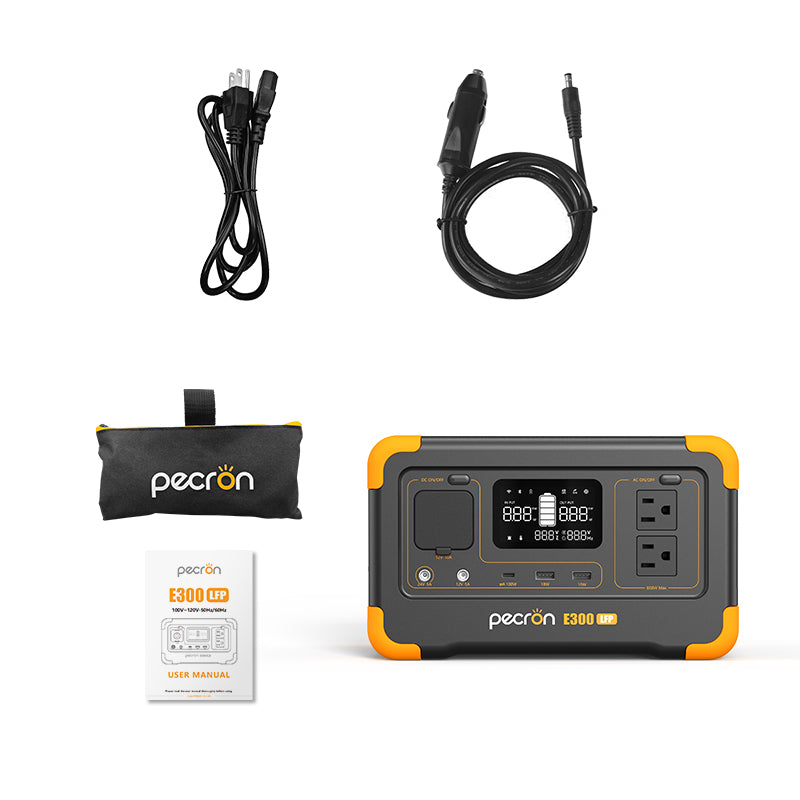
The official standalone U.S. offer identifies variant E300LFP-1, SKU E300LFP-1. Its listed package contains the station, AC charger, car-charging cable, manual and accessories bag; it does not list a solar panel or a solar charging cable. Pecron separately offers an E300LFP plus 100 W panel selection. That is a different package option, and the manufacturer's page does not identify the exact panel model in the option title, so do not assume the station-only offer includes one or treat an unspecified panel as a known component.
Pecron rates AC charging at up to 300 W and says the battery can reach 80% in 60 minutes and full charge in 80 minutes. Solar input through the DC5521 port is limited to 100 W; the car input is also listed at up to 100 W. The manual says AC, solar DC and USB-C charging can operate together, with total charging limited to 300 W. The charging lead for solar is sold separately. There is a material voltage discrepancy: the specification and manual describe 12–28 V solar input (with panel Voc below 28 V), while the FAQ on the same U.S. product page says Voc 12–25 V. The verified 100 W ceiling is useful; if your panel sits near either voltage edge, confirm compatibility with Pecron before connecting it rather than guessing from the wattage.
What the questionnaire changes
If a 120 V AC outlet and at least 600 W are essential, the documented U.S. plan meets those stated ratings. Selecting a higher minimum capacity will remove it quickly; the E300's 288 Wh is its central compromise. Requiring solar charging keeps it in only up to the 100 W station input, while requiring a supplied panel removes the standalone offer. Requiring the station-side solar lead also removes it because Pecron says that cable is sold separately. A request for a compatible extra battery is not confirmed for this exact U.S. model, so that answer cannot produce a positive match. The U.S. page also does not establish 240 V output.
Pecron describes the E300 as a UPS, but the manual gives an 8–20 ms changeover and explicitly says zero-millisecond transfer is unavailable. It cautions against devices that require zero transfer, including servers and workstations, and recommends testing compatibility. Select a strict transfer-time threshold only if it is supported by the exact equipment maker; do not treat the UPS label as evidence of a zero-interruption system.
Who should keep looking?
The E300LFP is a plausible fit for a car-camping kit, camera or laptop charging, small household electronics, or occasional AC use where low station weight matters more than stored energy. Its manufacturer-listed weight is about 10.6 lb and the manual gives dimensions of 10 × 6.8 × 6.1 inches. The manual also says the unit is not waterproof and calls for ventilation; it gives charging temperatures of 32–113°F and discharging temperatures of −4–113°F. Keep it dry, clear of blocked vents, and within those temperature limits.
Choose the E500LFP instead when the same 600 W AC ceiling is enough but the extra nameplate capacity and faster AC recharge matter: it has 576 Wh and a listed 500 W AC input, though its exact weight and dimensions conflict across Pecron's current page and manual. If your essential load exceeds 600 W, needs verified split-phase/240 V power, must run for many hours, or cannot tolerate an 8–20 ms changeover, neither small E-series unit solves the problem. Compare a larger, documented system against the actual load rather than buying on inverter wattage alone.
Key details at a glance
| Nameplate battery capacity | 288 Wh |
|---|---|
| Rated AC output | 600 W |
| Maximum solar input | 100 W |
| Included panels, combined nameplate | 0 W |
| Maximum USB-C output per port | 100 W |
| Listed weight | 10.6 lb |
| 12 V DC output | 120 W |
| Maximum AC recharge input | 300 W |
| Manufacturer UPS transfer figure | 20 ms |
| AC outlet output | Yes |
| USB-C ports | 1 |
| USB-A ports | 2 |
| Solar input ports | 1 |
| 12 V car-style output | 120 W |
| Vehicle charge input | 100 W |
| Battery chemistry | LiFePO4 |
| Solar panels in exact offer | 0 |
Use the exact model’s instructions for operating limits, supplied equipment and version differences.
Sources for this assessment
A useful match starts with the loads that matter.
Use the finder for hard electrical requirements, then check appliance starting behavior, actual run time and the exact package in the full assessment.