
On this page
Your needs, this model
Does it fit your priorities?
Does the documented E3600LFP (U.S. standalone SKU E3600LFP, without trolley) station plan meet 3,072 Wh and 3,600 W at 120 V without counting any unverified package additions?
The E3600LFP (U.S. standalone SKU E3600LFP, without trolley) station itself is listed at 3,072 Wh and 3,600 W at 120 V. Any listed EP3800 modules or second-station arrangement is not added to a confirmed package capacity here.
Explore this need in the finder →Do you need 4 listed 300 W panel(s), 1200 W nameplate total, as part of the exact offer?
The exact variant title and SKU list 4 PV300-named 300 W panels (1200 W nameplate sum). That confirms package quantity and rating only; exact panel revision and approved combined wiring remain unknown.
Explore this need in the finder →Can the listed EP3800-48V pack(s) be counted as compatible included expansion capacity?
The selected option lists 2 EP3800-48V pack(s), but the exact E3600LFP (U.S. standalone SKU E3600LFP, without trolley) compatibility and cable path remain unresolved. Use the station-only plan unless Pecron confirms this specific revision and supported capacity.
Explore this need in the finder →Pecron · E3600LFP solar and expansion kit · with trolley
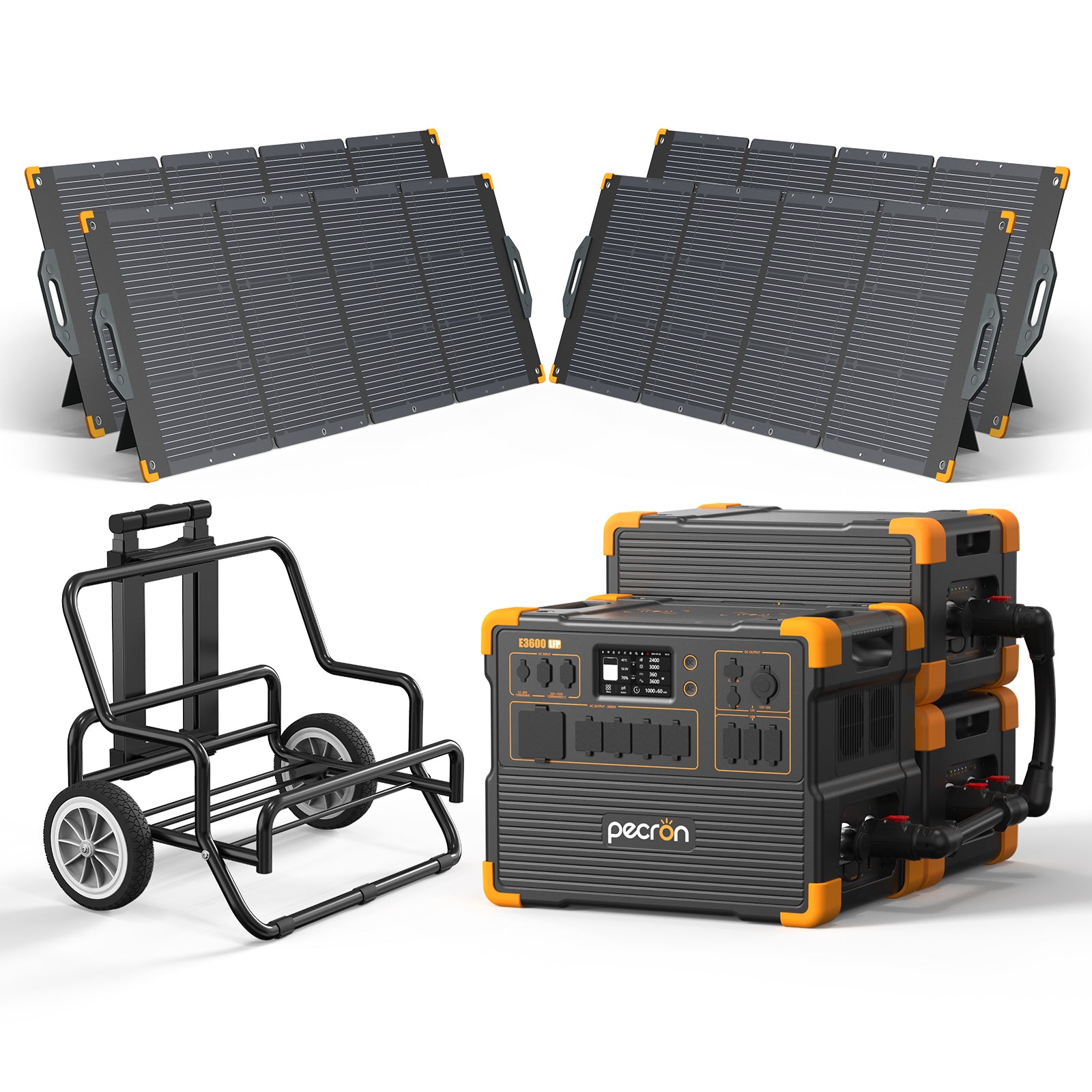
Four panels, two listed packs and a trolley
This exact E3600LFP selection includes four PV300-named 300 W panels, two EP3800-48V packs and a trolley. The trolley is the practical distinction from the otherwise similar no-trolley selection; it may make a bulky setup easier to shift on a suitable surface, but the source provides no load rating, terrain limit, dimensions or total kit weight. The station itself is about 79 lb, before considering the panel and battery pieces. The pictured arrangement is a manufacturer rendering, not evidence that the complete bundle can be moved assembled or loaded in a particular way.
On the station side, the published plan is straightforward: one 120 V E3600LFP, rated at 3,600 W AC, with a 3,072 Wh battery nameplate. Its solar-input ceiling is 2,400 W. Four listed 300 W panels sum to 1,200 W of panel nameplate, which is only a potential rating. A panel-nameplate sum cannot be converted into an expected charge time without the exact electrical configuration and conditions. The manufacturer’s option title uses PV300, while related panel paperwork identifies an S300 family; the exact revision is still uncertain. Confirm the voltage, current, connectors and lead arrangement for this four-panel setup before connecting anything.
The listing also identifies two EP3800-48V packs. Those component names do not settle whether these packs can be used with the exact E3600 revision, nor whether the bundle includes the required cables. The E3600’s manual does not substantiate the exact expansion path. I would budget around the station’s own 3,072 Wh and would not advertise this as a larger-capacity system until Pecron confirms compatibility and supported capacity for this particular SKU. If the additional packs are the reason you are considering this option, get that answer before purchase.
Best case for this package
The bundle is for someone who wants a single large 120 V station, a four-panel kit, the named expansion packs and a way to roll equipment around a prepared site. A home workshop or cabin with a level storage route is a more credible fit than a compact camping setup. Panels need a clear, stable deployment area; the station should remain in a dry, ventilated spot. With no published cart specifications, do not plan on transporting a powered system over stairs, gravel or sloped ground. The cart is a listed box item, not a guarantee of safe transport under every condition.
Build the load plan in two passes. First, total the simultaneous wattage and check motor starts against the E3600’s continuous output and short surge rating. Second, estimate how much energy the appliances use over the outage period. The station’s nameplate is not the same as delivered AC energy, and solar performance is weather- and setup-dependent. A four-panel bundle may shorten recharge time in favorable conditions only if its array is confirmed to fit the input window and the stations’ approved cabling.
For many buyers, the E3600’s base rating is already the key. A person who does not need the trolley could compare the matching four-panel no-trolley choice; someone focused on ordinary backup may save complexity with the two-panel E3600 bundle or the standalone station. A buyer needing a second inverter or 240 V should compare a verified multi-station system, not infer one from this single station plus expansion packs. The option includes no confirmed 240 V operating plan.
Questionnaire fit and limitations
The finder can recognize four panels in the selected package, the trolley and the E3600’s own 120 V output. It will not count the EP3800 units as compatible included expansion batteries, and an all-panels-together requirement will not pass until the exact array plan is documented. This is a more useful result than quietly accepting a large bundle on the strength of its title alone. The selected option was unavailable in the archived U.S. capture. Check for the exact variant and obtain the current included-parts list before ordering.
Key details at a glance
| Nameplate battery capacity | 3072 Wh |
|---|---|
| Rated AC output | 3600 W |
| Manufacturer surge rating | 7000 W |
| Maximum solar input | 2400 W |
| Included panels, combined nameplate | 1200 W |
| Maximum USB-C output per port | 100 W |
More specifications and setup details
| Listed weight | 79 lb |
|---|---|
| Compatible extra-battery expansion | Yes |
| 12 V DC output | 360 W |
| Maximum AC recharge input | 3200 W |
| AC outlet output | Yes |
| USB-C ports | 2 |
| USB-A ports | 4 |
| Solar input ports | 2 |
| 12 V car-style output | 120 W |
| Vehicle charge input | 150 W |
| Battery chemistry | LiFePO4 |
| Home Power Panel in this package | No |
| Separate station units in offer | 1 |
| Smart Transfer Switch in this package | No |
| Solar panels in exact offer | 4 |
Use the exact model’s instructions for operating limits, supplied equipment and version differences.
Sources for this assessment

A useful match starts with the loads that matter.
Use the finder for hard electrical requirements, then check appliance starting behavior, actual run time and the exact package in the full assessment.