
On this page
Your needs, this model
Does it fit your priorities?
Does the documented E3600LFP (U.S. standalone SKU E3600LFP, without trolley) station plan meet 3,072 Wh and 3,600 W at 120 V without counting any unverified package additions?
The E3600LFP (U.S. standalone SKU E3600LFP, without trolley) station itself is listed at 3,072 Wh and 3,600 W at 120 V. Any listed EP3800 modules or second-station arrangement is not added to a confirmed package capacity here.
Explore this need in the finder →Do you need 4 listed 300 W panel(s), 1200 W nameplate total, as part of the exact offer?
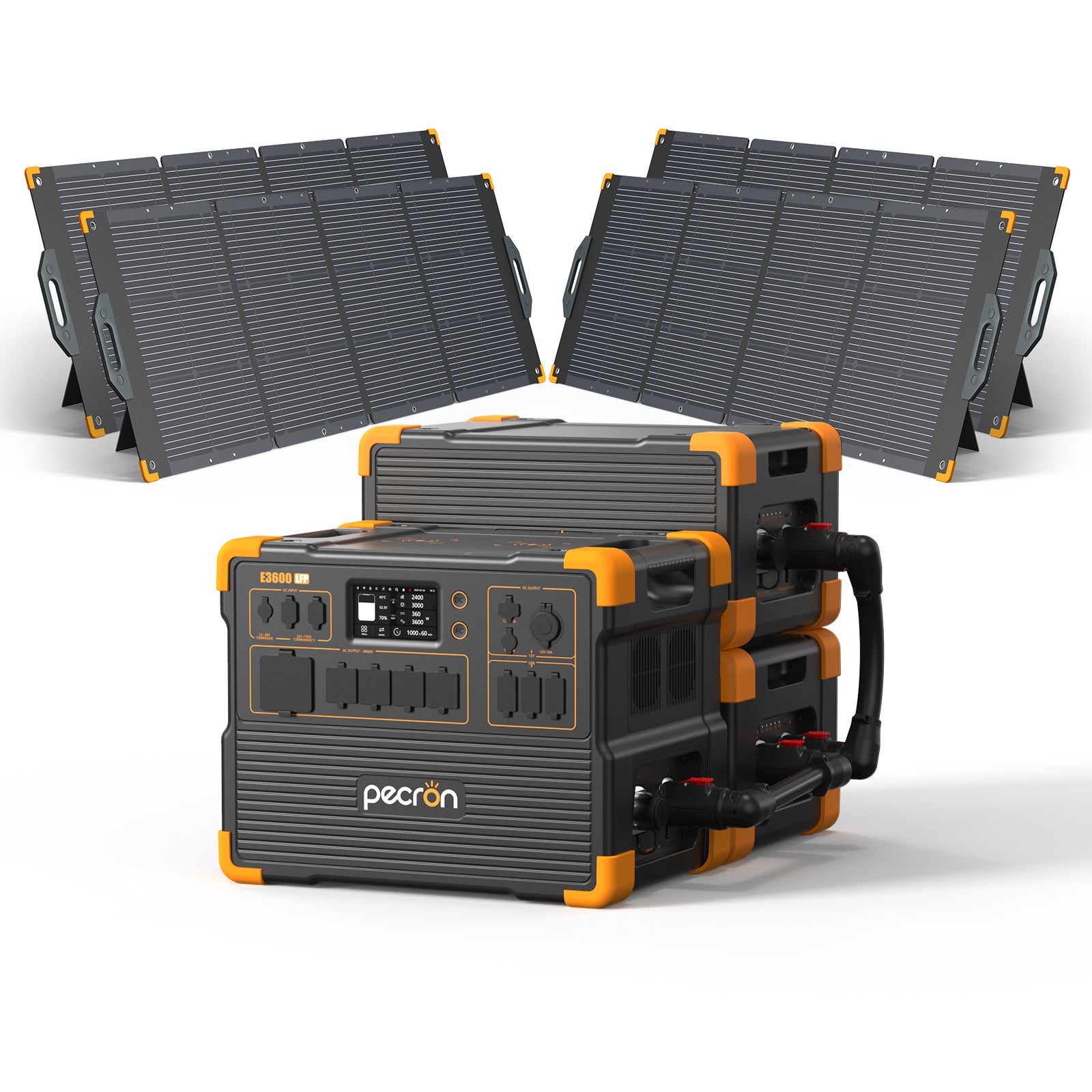
The exact variant title and SKU list 4 PV300-named 300 W panels (1200 W nameplate sum). That confirms package quantity and rating only; exact panel revision and approved combined wiring remain unknown.
Explore this need in the finder →Can the listed EP3800-48V pack(s) be counted as compatible included expansion capacity?
The selected option lists 2 EP3800-48V pack(s), but the exact E3600LFP (U.S. standalone SKU E3600LFP, without trolley) compatibility and cable path remain unresolved. Use the station-only plan unless Pecron confirms this specific revision and supported capacity.
Explore this need in the finder →Pecron · E3600LFP · four PV300-named panels · no trolley
A broad bundle with one proven station plan
The selected U.S. option lists one E3600LFP, two EP3800-48V packs and four PV300-named 300 W panels, without the trolley. Its clearest confirmed use is still the E3600 as one 120 V station: 3,072 Wh nameplate, 3,600 W continuous AC output and a 2,400 W maximum solar-input rating. The storefront bundle is more elaborate than that base plan, but the extra equipment does not automatically become verified capacity or a working household system. The E3600 is not a 240 V unit, and its 7,000 W surge statement is brief rather than continuous output.
Four panels at 300 W each make 1,200 W of listed nameplate. That arithmetic tells you the panels are not above the station’s 2,400 W solar ceiling on wattage alone; it does not prove how they may be wired. Pecron’s selected title identifies a PV300 package, but a model-number conflict remains between the sales label and related S300 manual. The image shows a large panel arrangement, yet a rendering cannot establish panel voltage, current, connectors, adapters, cable count or simultaneous use. Before building a plan around four panels, request the exact panel codes and a station-specific wiring diagram.
The two expansion packs create a second, more consequential unknown. Each EP3800-48V is a named component in the selected option, but the reviewed E3600 instructions do not confirm this exact pack/revision combination. Do not calculate a larger total capacity by adding their label values to the E3600. Ask whether these packs are compatible with the exact E3600 model, what connection lead is required and what total capacity the manufacturer supports in that arrangement. Until that answer is available, the safe recommendation is the base station-only plan.
Fit depends on how you will set it up
This option is most plausible for a stationary cabin, workshop or outage-preparation area where the owner has room to stage several panels and can keep the station near the loads. It is less suitable for casual RV use or a small campsite: the E3600 alone is heavy, there is no trolley in this exact selection, and the panel setup needs open ground or another secure surface. The actual mass and packed size of this bundle are not established, so do not assume one trip or one person can move it all.
Think through the work before buying. Measure the route from storage to use, allow space around the station for ventilation, and make a load list with both running and startup demand. A 3,600 W rating is the limit for the inverter’s continuous AC output, not a promise that any appliance will start. For energy, estimate the daily watt-hours of each load and keep a reserve; the 3,072 Wh station nameplate is not the same as AC energy delivered. Sun availability and conversion losses make panel ratings unsuitable as a guaranteed recharge schedule.
Because four panels are listed, the buyer may be tempted to treat this as a high-yield solar system. It should be treated instead as four included panel units awaiting a confirmed electrical plan. A larger nameplate array is useful only if the panel voltage and current remain inside the station’s input window and the intended grouping is allowed. The source snapshot does not establish that complete package-to-station path.
When a simpler option is better
If your actual need is a large 120 V backup source and one or two modest loads, a standalone E3600 or a two-panel E3600 kit removes more questions. If you need cart-based movement, choose the related four-panel trolley option only if its own cart details meet your handling needs. If you need guaranteed additional energy, compare a configuration whose host manual explicitly names the compatible expansion battery rather than counting the two EP3800s here. If you need 240 V, this single-station package does not meet that requirement.
Questionnaire matching can confirm the base 120 V output, station rating and four listed panels. It will not accept this option for a verified all-panels-together requirement or a minimum of compatible included expansion batteries. That boundary is intentional: the option’s identity and listed contents are clear, while the panel wiring and E3600/EP3800 bridge are not. This selected variant was out of stock in the saved U.S. source snapshot; availability can change and is not a reason to erase the configuration.
Key details at a glance
| Nameplate battery capacity | 3072 Wh |
|---|---|
| Rated AC output | 3600 W |
| Manufacturer surge rating | 7000 W |
| Maximum solar input | 2400 W |
| Included panels, combined nameplate | 1200 W |
| Maximum USB-C output per port | 100 W |
More specifications and setup details
| Listed weight | 79 lb |
|---|---|
| Compatible extra-battery expansion | Yes |
| 12 V DC output | 360 W |
| Maximum AC recharge input | 3200 W |
| AC outlet output | Yes |
| USB-C ports | 2 |
| USB-A ports | 4 |
| Solar input ports | 2 |
| 12 V car-style output | 120 W |
| Vehicle charge input | 150 W |
| Battery chemistry | LiFePO4 |
| Home Power Panel in this package | No |
| Separate station units in offer | 1 |
| Smart Transfer Switch in this package | No |
| Solar panels in exact offer | 4 |
Use the exact model’s instructions for operating limits, supplied equipment and version differences.
Sources for this assessment

A useful match starts with the loads that matter.
Use the finder for hard electrical requirements, then check appliance starting behavior, actual run time and the exact package in the full assessment.