
On this page
Your needs, this model
Does it fit your priorities?
Does the E3600LFP station meet a 120 V, 3,600 W output and 3,072 Wh nameplate plan?
One E3600LFP station remains a 120 V unit rated at 3,600 W and 3,072 Wh nameplate; the panel and trolley selection do not change those ratings.
Explore this need in the finder →Does the two-panel package reach 600 W of included panel nameplate?
The selected SKU E3600LFP+2*PV300 identifies two 300 W panels, totaling 600 W of arithmetic nameplate power; it is not a harvest guarantee.
Explore this need in the finder →Must every supplied panel be documented to work together through the exact station leads?
No. This selected offer identifies its panel count and wattage, but the retained sources do not establish its complete array topology or exact array lead contents; do not assume a yes.
Explore this need in the finder →Pecron E3600LFP with two PV300 panels: review
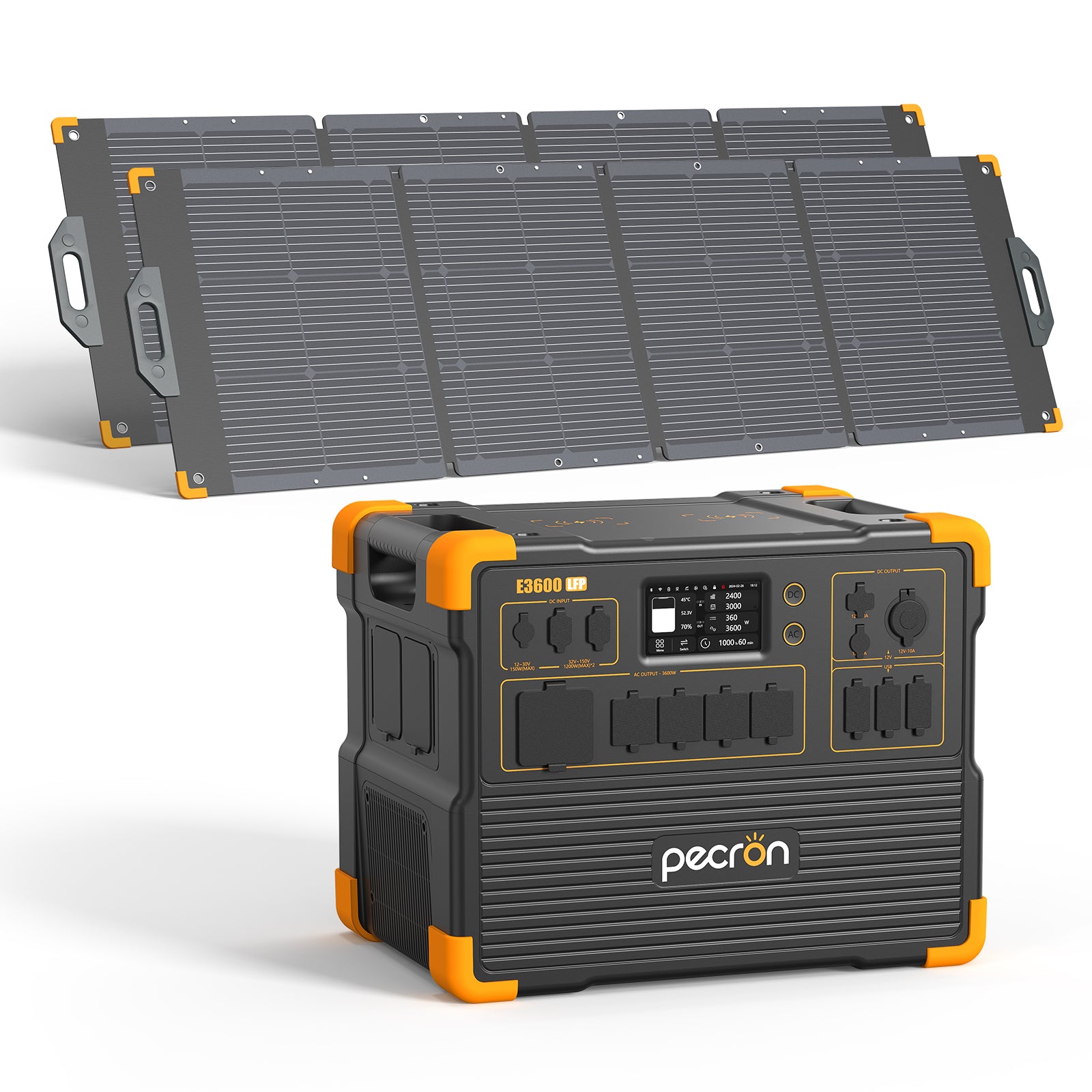
The two-panel E3600LFP bundle adds a second 300 W PV300-named panel to the same large station. The selected SKU specifies one E3600LFP and two panels; it is not a battery expansion or dual-station kit. The station therefore remains a single 120 V, 3,600 W system with 3,072 Wh of nameplate storage. The arithmetic panel nameplate total is 600 W. That package distinction is more useful than the family’s broad “solar generator” wording: the panels affect potential charging, not the AC power ceiling or stored energy.
Two panels improve the starting point, not the guarantees
On paper, 600 W of panels is twice the listed bundle output of the one-panel version. The E3600’s station-side solar limit is 2,400 W across two XT60 inputs, so 600 W remains well below the published maximum. But a nameplate sum does not predict real charging. The retained source set does not verify that the two supplied panels can be joined in a specific series or parallel arrangement, nor does it state which exact leads come with this selected kit. Do not assume both panels can be connected to the station at once without the correct voltage and current checks.
The linked PECRON panel page identifies a PV300 300 W panel, while its manual uses another model label. The selected E3600 variant itself names the PV300 bundle and panel count; that verifies what the offer calls for, but it does not close the manual/revision bridge. Treat electrical details beyond the stated 300 W each as unconfirmed for this exact package until the seller identifies the delivered panel and cable set.
Two fold-out panels also need more setup space than one. The manufacturer image is a product render rather than a record of how the panels deploy at a real site. Keep them in a location with good sun and airflow, protect connectors, and plan for shade and weather without treating the station as weatherproof; no station ingress rating is established here.
Power and capacity: know the separate limits
The E3600LFP is the reason to consider this bundle when a 120 V plan needs high continuous output. It is rated at 3,600 W, with 3,072 Wh of nameplate battery capacity. A high-wattage load may fit the output rating but use the battery quickly; a longer runtime may need a lower average draw or a separately verified expansion plan. The seller’s expansion description and current selectable EP-series options conflict, so do not count a particular extra battery toward an essential capacity target on this evidence alone.
There is no 240 V output from this one-station package. Pecron’s separate 240 V connection-box offering uses two stations; it is a materially different configuration. Likewise, the two solar panels do not add a second inverter, extra battery, or transfer switch. Anyone planning household circuits should check the exact outlet, protection, and transfer arrangement instead of relying on a headline output number.
When the two-panel option is worth choosing
This version suits a fixed backup spot or a cabin user who wants a moderate panel starting package alongside a large 120 V station. It is more balanced than the 300 W kit if the buyer has room to deploy two panels and is prepared to verify wiring. It is not an obvious choice for buyers who need the biggest solar input the station can accept: 600 W leaves considerable input headroom, and the four- or six-panel options provide larger listed panel totals, though the same array questions apply.
Choose the station-only E3600 if compatible panels are already on hand, or consider the lower-capacity E2400 class if 2,400 W output and 2,048 Wh storage are enough. This bundle’s advantage is the specific pair of 300 W panels—not a demonstrated faster recharge time.
Questionnaire fit
A 120 V requirement, at least 3,600 W AC, and at least 3,000 Wh nameplate capacity all fit the one E3600 station. A 600 W included-panel minimum fits this selected option; a 1,200 W minimum points to the four-panel tier. A 2,400 W station-side solar-input requirement also fits, but that describes the station’s ceiling rather than the included 600 W array. If you require verified all-panel wiring, 240 V, or known total system weight, the answer should remain no or unknown rather than being inferred from this product image.
Key details at a glance
| Nameplate battery capacity | 3072 Wh |
|---|---|
| Rated AC output | 3600 W |
| Manufacturer surge rating | 7000 W |
| Maximum solar input | 2400 W |
| Included panels, combined nameplate | 600 W |
| Maximum USB-C output per port | 100 W |
More specifications and setup details
| Listed weight | 79 lb |
|---|---|
| Compatible extra-battery expansion | Yes |
| 12 V DC output | 360 W |
| Maximum AC recharge input | 3200 W |
| AC outlet output | Yes |
| USB-C ports | 2 |
| USB-A ports | 4 |
| Solar input ports | 2 |
| 12 V car-style output | 120 W |
| Vehicle charge input | 150 W |
| Battery chemistry | LiFePO4 |
| Expansion battery in this package | No |
| Home Power Panel in this package | No |
| Separate station units in offer | 1 |
| Smart Transfer Switch in this package | No |
| Solar panels in exact offer | 2 |
| Included expansion batteries | 0 units |
Use the exact model’s instructions for operating limits, supplied equipment and version differences.
Sources for this assessment

A useful match starts with the loads that matter.
Use the finder for hard electrical requirements, then check appliance starting behavior, actual run time and the exact package in the full assessment.