
On this page
Your needs, this model
Does it fit your priorities?
Does the E3600LFP station meet a 120 V, 3,600 W output and 3,072 Wh nameplate plan?
One E3600LFP station remains a 120 V unit rated at 3,600 W and 3,072 Wh nameplate; the panel and trolley selection do not change those ratings.
Explore this need in the finder →Will four included panels meet the panel-nameplate floor?
The selected E3600LFP+4*PV300+CART SKU identifies four 300 W panels (1,200 W arithmetic total); the trolley does not affect that count.
Explore this need in the finder →Must every supplied panel be documented to work together through the exact station leads?
No. This selected offer identifies its panel count and wattage, but the retained sources do not establish its complete array topology or exact array lead contents; do not assume a yes.
Explore this need in the finder →Pecron E3600LFP with four PV300 panels and trolley: review
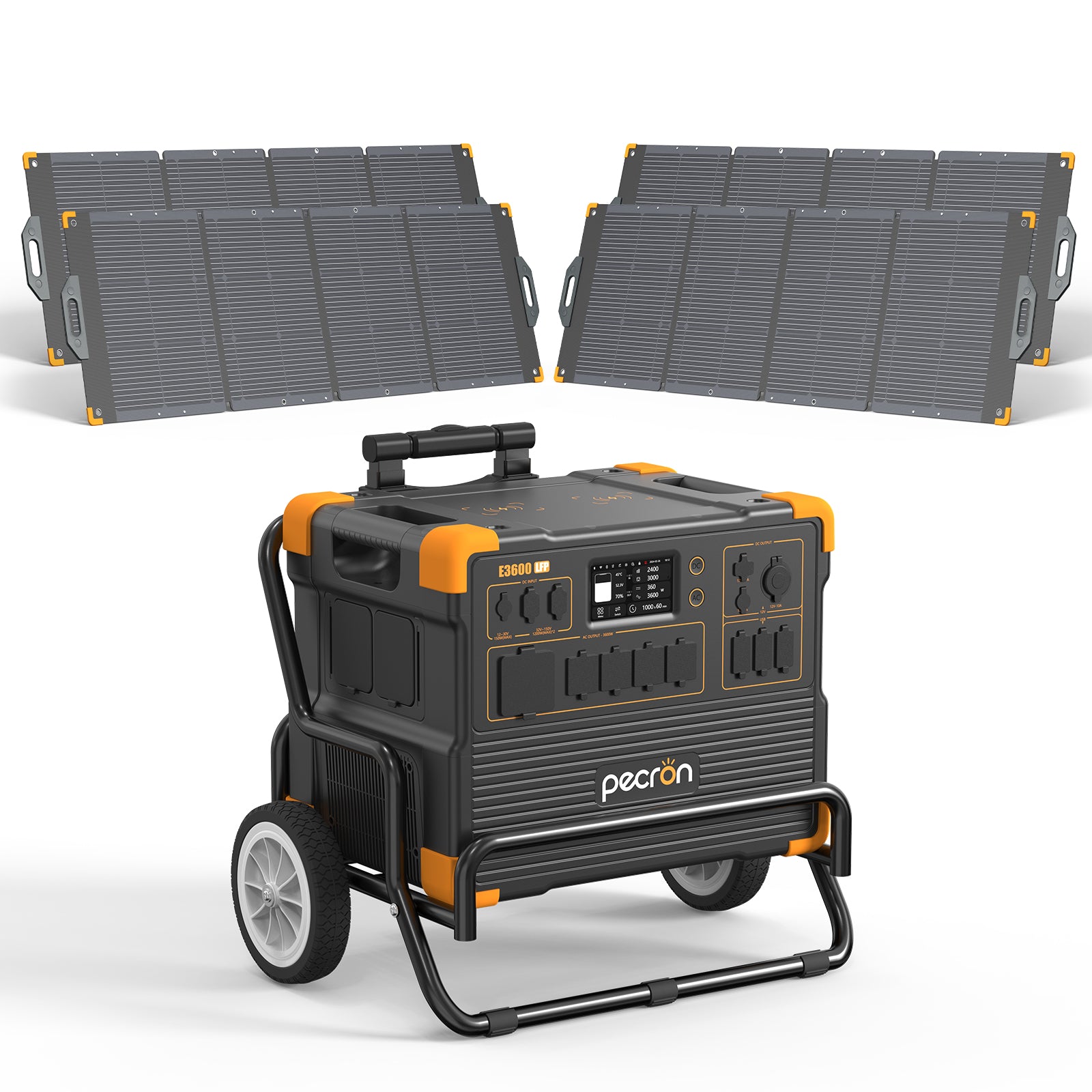
This selected E3600LFP package pairs one 3,600 W, 3,072 Wh station with four 300 W PV300-named panels and a trolley. The option image shows the wheeled frame under the station, but it is an official product-page render, not proof of the exact kit’s full shipment or a real-world setup. The station body is listed at 79 lb; the cart adds an unknown amount, so no complete system-weight figure should be assumed. The panels are separate folding equipment and still require a place to deploy them.
Useful for a base location that must move occasionally
Four panels give the package a 1,200 W arithmetic nameplate total. If the station is stored in one room and rolled to a backup point before a storm, the trolley can make more sense than lifting the 79 lb body. A flat garage, workshop, or paved cabin floor is a more credible use than stairs or loose ground. The selected option establishes a trolley inclusion, not its dimensions, brakes, load rating, or transport behavior. Buyers should verify how the actual unit mounts and whether the cart can safely cover their route.
The cart is for the station; it does not automatically organize, carry, or protect all four panels and their leads. Think through the complete setup: where the battery stays, where panels unfold, how cable runs avoid trip hazards, and how the equipment returns to protected storage. No weather rating for the station is confirmed here. A trolley also does not turn this into a whole-house generator or an automatic transfer system.
Four-panel solar has headroom questions
Pecron specifies a 2,400 W combined solar input for the E3600 through two XT60 ports, with each port rated up to 1,200 W. Four panels carrying 300 W names each total 1,200 W. That leaves the listed array below the station’s stated ceiling, but input headroom alone does not establish that the supplied four panels may be wired together in the required arrangement. Voltage and current at each input matter. The selected SKU does not identify the exact leads, and the linked PV300 page/manual uses a naming relationship that is not fully reconciled.
Use the exact panel labels and an official E3600 wiring guide before treating the four panels as a ready-to-connect array. The render is useful for identifying the four-panel bundle but cannot tell you the electrical topology. Nor should 1,200 W be read as continuous battery charging: sunlight, angle, shade, temperature, cabling, conversion loss, and station load change the actual result. If your backup plan depends on restoring the 3,072 Wh battery in a stated time, the current sources are not enough to promise it.
What it can power
The one E3600 station provides 120 V AC rated at 3,600 W continuous. This can accommodate some substantial single-circuit loads, provided starting surge and concurrent use fit. The battery’s 3,072 Wh is a nameplate capacity, not a guaranteed usable-AC amount or a time estimate. Four panels do not raise that storage figure. A 240 V load needs the separate two-station/connection-box configuration; this single-station solar package is not that product.
Expansion is a potential path but not a settled capacity calculation. Product description text and the selectable offers name different EP-series units. Until the exact compatibility is confirmed for the station revision, treat added battery count and expanded capacity as unresolved. If you need a known capacity today, plan around the single station only.
Who should consider the cart option?
This version makes sense for someone who wants the four-panel bundle and expects to roll the station between a protected storage point and a level operating area. The no-trolley four-panel option suits a fixed installation or a buyer who already has a suitable cart. The six-panel trolley bundle is a step up only when additional panels and their staging space are useful; more panels do not solve wiring uncertainty or make the station easier to lift.
In matching, the package fits ordinary 120 V use, a 3,600 W AC floor, and 3,000 Wh of nameplate capacity. A 1,200 W station solar-input minimum and four 300 W included panels fit the documented figures. A six-panel threshold excludes it. A hard weight limit for the full rolling package cannot be verified, and a requirement that all four panels are confirmed as a compatible array must fail while the wiring fact is unknown. This is a mobile staging option, not a lighter station.
Key details at a glance
| Nameplate battery capacity | 3072 Wh |
|---|---|
| Rated AC output | 3600 W |
| Manufacturer surge rating | 7000 W |
| Maximum solar input | 2400 W |
| Included panels, combined nameplate | 1200 W |
| Maximum USB-C output per port | 100 W |
More specifications and setup details
| Listed weight | 79 lb |
|---|---|
| Compatible extra-battery expansion | Yes |
| 12 V DC output | 360 W |
| Maximum AC recharge input | 3200 W |
| AC outlet output | Yes |
| USB-C ports | 2 |
| USB-A ports | 4 |
| Solar input ports | 2 |
| 12 V car-style output | 120 W |
| Vehicle charge input | 150 W |
| Battery chemistry | LiFePO4 |
| Expansion battery in this package | No |
| Home Power Panel in this package | No |
| Separate station units in offer | 1 |
| Smart Transfer Switch in this package | No |
| Solar panels in exact offer | 4 |
| Included expansion batteries | 0 units |
Use the exact model’s instructions for operating limits, supplied equipment and version differences.
Sources for this assessment

A useful match starts with the loads that matter.
Use the finder for hard electrical requirements, then check appliance starting behavior, actual run time and the exact package in the full assessment.