
On this page
Your needs, this model
Does it fit your priorities?
Does the E3600LFP station meet a 120 V, 3,600 W output and 3,072 Wh nameplate plan?
One E3600LFP station remains a 120 V unit rated at 3,600 W and 3,072 Wh nameplate; the panel and trolley selection do not change those ratings.
Explore this need in the finder →Does this option reach a 1,200 W included-panel threshold?
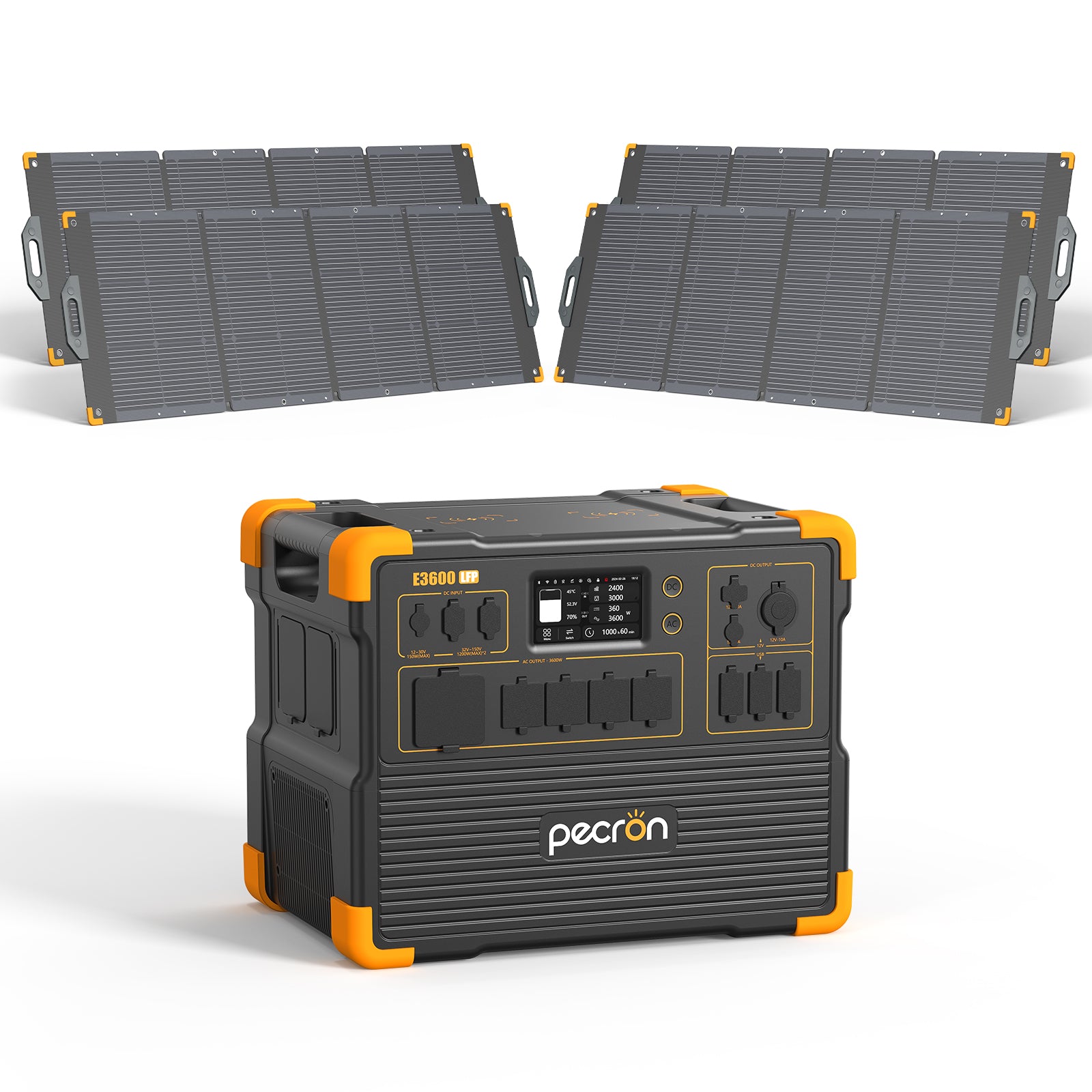
The exact E3600LFP+4*PV300 option names four 300 W panels, totaling 1,200 W of panel nameplate by arithmetic.
Explore this need in the finder →Must every supplied panel be documented to work together through the exact station leads?
No. This selected offer identifies its panel count and wattage, but the retained sources do not establish its complete array topology or exact array lead contents; do not assume a yes.
Explore this need in the finder →Pecron E3600LFP with four PV300 panels: review
Four PV300-named panels make this one of the larger solar bundles offered alongside the E3600LFP. The selected option lists a single station and four 300 W panels, for 1,200 W of combined panel nameplate power. The station itself is unchanged: 120 V output rated at 3,600 W and 3,072 Wh of nameplate storage. This is a solar package choice, not an expansion-battery or paired-station package. The larger panel count makes the kit more plausible for planned off-grid replenishment, but it does not establish a daily harvest or recharge time.
Why 1,200 W is a useful—but incomplete—number
The E3600 manual and product information list two XT60 solar inputs, each up to 1,200 W, with a 2,400 W combined ceiling. Four panels identified at 300 W each add up to half that station-side maximum. This comparison can help screen a package, but it does not prove how four supplied panels should be split between the ports. Series versus parallel wiring changes array voltage and current. The exact cable set and approved arrangement are not established by the option SKU, title, or a product render.
The selection calls the panels PV300 and assigns 300 W each, while the linked panel page/manual do not conclusively resolve the model/revision naming bridge. Treat the 1,200 W sum as arithmetic on the selected offer’s panel labels, not a measured or guaranteed input. Before relying on this setup, confirm the actual panel label and the manufacturer’s permitted four-panel wiring diagram for the E3600 revision. That advice is especially important if this is an outage plan rather than an occasional sunny-day experiment.
Four panels also introduce space and staging requirements. A shaded yard, narrow balcony, or secure indoor storage room may be a poor match even if the wattage looks attractive. Deployment time, tilt supports, cable routing, and how the panels will be protected between uses should be part of the decision. The station’s weather resistance is not confirmed by the source set.
The battery still sets the duration
Solar input and stored energy are different specifications. A 1,200 W panel-nameplate bundle can contribute to charging in suitable conditions, but the battery remains 3,072 Wh nominal. It does not turn into a 4.8 kWh station or guarantee that a refrigerator, pump, or other appliance will run for a particular number of hours. Actual duration depends on load draw, cycling, startup demands, conversion losses, and any ongoing input. Do not convert nameplate watts or watt-hours into an unsupported runtime claim.
The E3600’s 3,600 W rating is a high 120 V continuous-output figure for demanding loads that stay within the published limit. One station is not split phase and does not supply 240 V. The separate two-station connection-box arrangement is another product configuration; four solar panels with one station do not activate that system. Expansion is advertised but the product description and selectable EP-series packages conflict, so a precise expanded capacity should not be part of the purchase case until the exact battery revision is confirmed.
Who should favor this bundle?
The four-panel option suits someone who has already decided that the E3600’s AC output and battery size fit, has a place to deploy four panels, and wants more solar equipment than the one- or two-panel starter bundles. It may be a reasonable middle tier for a cabin or a prepared backup station used near an open staging area. It is not a substitute for a site assessment, electrical transfer plan, or verified panel-wiring instructions.
Buy the station-only version if you already have a compatible array. Choose a lower panel count if storage space and handling matter more than nominal input headroom. The six-panel version raises the arithmetic total further, but cannot exceed the station’s 2,400 W solar ceiling and still needs a supported wiring plan. If the 3,600 W/3,072 Wh station is more than the load requires, the smaller E2400 family is worth comparing rather than buying extra panel hardware around an oversized unit.
How it fares against real requirements
The questionnaire should retain this exact offer for a 120 V plan, a 3,600 W continuous threshold, a 3,000 Wh capacity floor, and a 1,200 W solar-input ceiling if those station specifications are what the visitor means. The exact selected bundle also meets a four-panel, 1,200 W included-panel nameplate requirement. Requiring six panels or a 1,800 W bundle rules it out. Requiring verified wiring for all four panels should rule it out until that fact is established. A 240 V need cannot be satisfied by adding panels.
In short, this package is strongest as a way to buy a substantial amount of panel hardware with a station whose charging ceiling can accept more input than the bundle’s nominal sum. Its limits are the same station’s finite 3,072 Wh storage, the unverified array instructions, and the site space needed to use four panels safely.
Key details at a glance
| Nameplate battery capacity | 3072 Wh |
|---|---|
| Rated AC output | 3600 W |
| Manufacturer surge rating | 7000 W |
| Maximum solar input | 2400 W |
| Included panels, combined nameplate | 1200 W |
| Maximum USB-C output per port | 100 W |
More specifications and setup details
| Listed weight | 79 lb |
|---|---|
| Compatible extra-battery expansion | Yes |
| 12 V DC output | 360 W |
| Maximum AC recharge input | 3200 W |
| AC outlet output | Yes |
| USB-C ports | 2 |
| USB-A ports | 4 |
| Solar input ports | 2 |
| 12 V car-style output | 120 W |
| Vehicle charge input | 150 W |
| Battery chemistry | LiFePO4 |
| Expansion battery in this package | No |
| Home Power Panel in this package | No |
| Separate station units in offer | 1 |
| Smart Transfer Switch in this package | No |
| Solar panels in exact offer | 4 |
| Included expansion batteries | 0 units |
Use the exact model’s instructions for operating limits, supplied equipment and version differences.
Sources for this assessment

A useful match starts with the loads that matter.
Use the finder for hard electrical requirements, then check appliance starting behavior, actual run time and the exact package in the full assessment.