
On this page
Your needs, this model
Does it fit your priorities?
Does the E3600LFP station meet a 120 V, 3,600 W output and 3,072 Wh nameplate plan?
One E3600LFP station remains a 120 V unit rated at 3,600 W and 3,072 Wh nameplate; the panel and trolley selection do not change those ratings.
Explore this need in the finder →Does the six-panel package clear your included panel requirement?
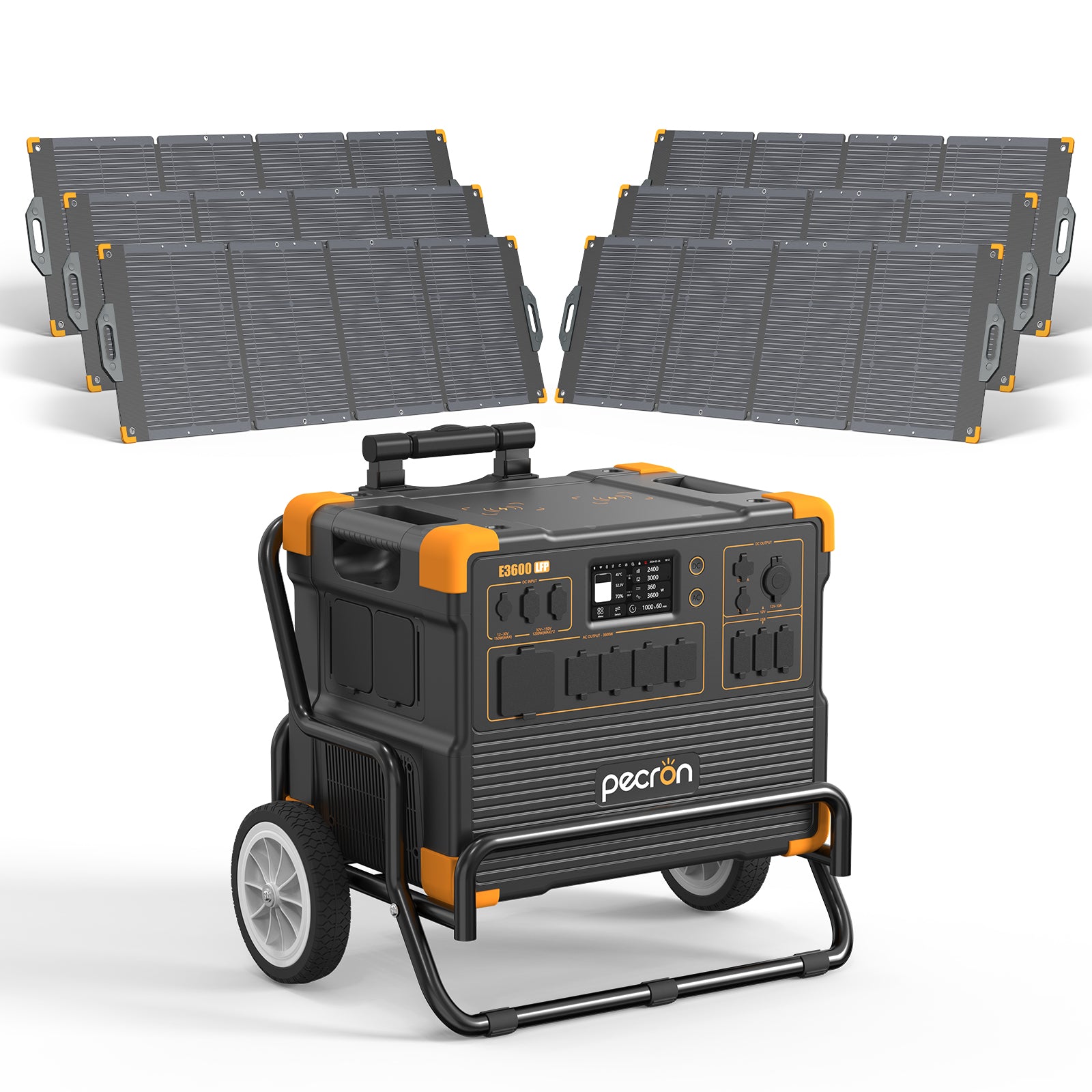
The exact E3600LFP+6*PV300+CART option names six 300 W panels; the trolley is a separate package component and does not change their arithmetic sum.
Explore this need in the finder →Must every supplied panel be documented to work together through the exact station leads?
No. This selected offer identifies its panel count and wattage, but the retained sources do not establish its complete array topology or exact array lead contents; do not assume a yes.
Explore this need in the finder →Pecron E3600LFP with six PV300 panels and trolley: review
This E3600 package combines the one-station power system with six PV300-named 300 W panels and a listed trolley. It has the largest panel count in the single-station PV300 bundle group, plus a cart for moving the heavy station on a level path. The panel count is an offer identity, not an assurance that the entire kit travels as one unit. The station weighs 79 lb before the unspecified cart weight; the panels and cabling require separate handling and storage.
A rolling base and a large deployment footprint
The trolley is most useful when this station is staged in a garage or equipment room and rolled to a nearby prepared location. The official option image shows the selected station and trolley together. It does not establish the cart’s load rating, brakes, installation method, dimensions, or ability to cross uneven terrain. Verify these details and the delivery configuration before expecting the cart to make a 79 lb battery easy to transport. Stairs, soft soil, vehicle loading, and steep ramps still require a separate safe-handling plan.
Six folding panels can be the more demanding part of the setup: they occupy space when stored, need a clear area when deployed, and must be protected from shade and weather. The station’s outdoor ingress protection is unknown in the saved product/manual evidence. The trolley moves the station; it does not anchor the panels, manage their cables, or create an automatic off-grid installation. This is a prepared-site package rather than a grab-and-go camping kit.
What 1,800 W means here
The exact option names six panels at 300 W each. Their 1,800 W combined panel nameplate total is below the E3600’s stated 2,400 W maximum solar input, delivered through two XT60 inputs rated up to 1,200 W apiece. The nominal figures suggest the station has room for the selected panel package, but they do not prove how six panels should be split across the inputs. Array voltage, current, adapters, branch connections, and cable inclusion all matter. Those details are not provided in the selected SKU or established by the render.
The linked panel page calls its product PV300 and the selected option identifies PV300, while the related manual uses a different model label. This source bridge remains unresolved. Confirm the actual panel model and official E3600 wiring directions before relying on a full six-panel setup. Even a verified connection would not guarantee 1,800 W in use or a specific daily energy yield. Sunlight, temperature, orientation, shade, loss, and concurrent loads change the result.
Large charging set, unchanged storage and output
One E3600LFP stays at 3,072 Wh nameplate and 3,600 W continuous at 120 V. The panel bundle does not add battery capacity or let the AC section exceed its rating. If a load’s startup surge or running draw exceeds the station’s limits, six panels do not cure the mismatch. If a long backup duration is the goal, the battery expansion path still needs a revision-specific check because product copy and selectable EP-series names disagree.
Nor is this a 240 V package. A separate two-station connection box is listed for a paired system; its installation method, outlet type, and transfer behavior require distinct evidence. The current option is six panels plus one station, with trolley—not two inverters or a whole-home transfer arrangement.
Who should choose it?
Consider this variant if your use case favors the largest panel set on one E3600, a permanent sunny staging area, and occasional rolling of the station before it is connected. The no-cart six-panel version is appropriate for a fixed installation or an existing cart. The four-panel tier sacrifices 600 W of panel nameplate but may be easier to store and lay out. If you cannot confirm wiring or safely deploy six panels, the largest bundle is not automatically the best value or the most reliable outage plan.
Questionnaire matching should recognize the 120 V, 3,600 W, 3,072 Wh station and six-panel 1,800 W bundle. A requirement for 2,400 W maximum station solar input fits; a requirement above that limit does not. A six-panel count floor matches this option, while a strict all-panels-supported condition remains unknown and should fail. The station’s body weight can be compared separately, but the total trolley/package weight cannot be verified. This is a high-output backup station with a large solar kit and a cart—not a lightweight or fully specified turn-key array.
Key details at a glance
| Nameplate battery capacity | 3072 Wh |
|---|---|
| Rated AC output | 3600 W |
| Manufacturer surge rating | 7000 W |
| Maximum solar input | 2400 W |
| Included panels, combined nameplate | 1800 W |
| Maximum USB-C output per port | 100 W |
More specifications and setup details
| Listed weight | 79 lb |
|---|---|
| Compatible extra-battery expansion | Yes |
| 12 V DC output | 360 W |
| Maximum AC recharge input | 3200 W |
| AC outlet output | Yes |
| USB-C ports | 2 |
| USB-A ports | 4 |
| Solar input ports | 2 |
| 12 V car-style output | 120 W |
| Vehicle charge input | 150 W |
| Battery chemistry | LiFePO4 |
| Expansion battery in this package | No |
| Home Power Panel in this package | No |
| Separate station units in offer | 1 |
| Smart Transfer Switch in this package | No |
| Solar panels in exact offer | 6 |
| Included expansion batteries | 0 units |
Use the exact model’s instructions for operating limits, supplied equipment and version differences.
Sources for this assessment

A useful match starts with the loads that matter.
Use the finder for hard electrical requirements, then check appliance starting behavior, actual run time and the exact package in the full assessment.