
On this page
Your needs, this model
Does it fit your priorities?
Does the E3600LFP station meet a 120 V, 3,600 W output and 3,072 Wh nameplate plan?
One E3600LFP station remains a 120 V unit rated at 3,600 W and 3,072 Wh nameplate; the panel and trolley selection do not change those ratings.
Explore this need in the finder →Does the selected six-panel offer meet an 1,800 W panel-nameplate minimum?
The exact E3600LFP+6*PV300 SKU names six 300 W panels, or 1,800 W of summed panel nameplate—not guaranteed field input.
Explore this need in the finder →Must every supplied panel be documented to work together through the exact station leads?
No. This selected offer identifies its panel count and wattage, but the retained sources do not establish its complete array topology or exact array lead contents; do not assume a yes.
Explore this need in the finder →Pecron E3600LFP with six PV300 panels: review
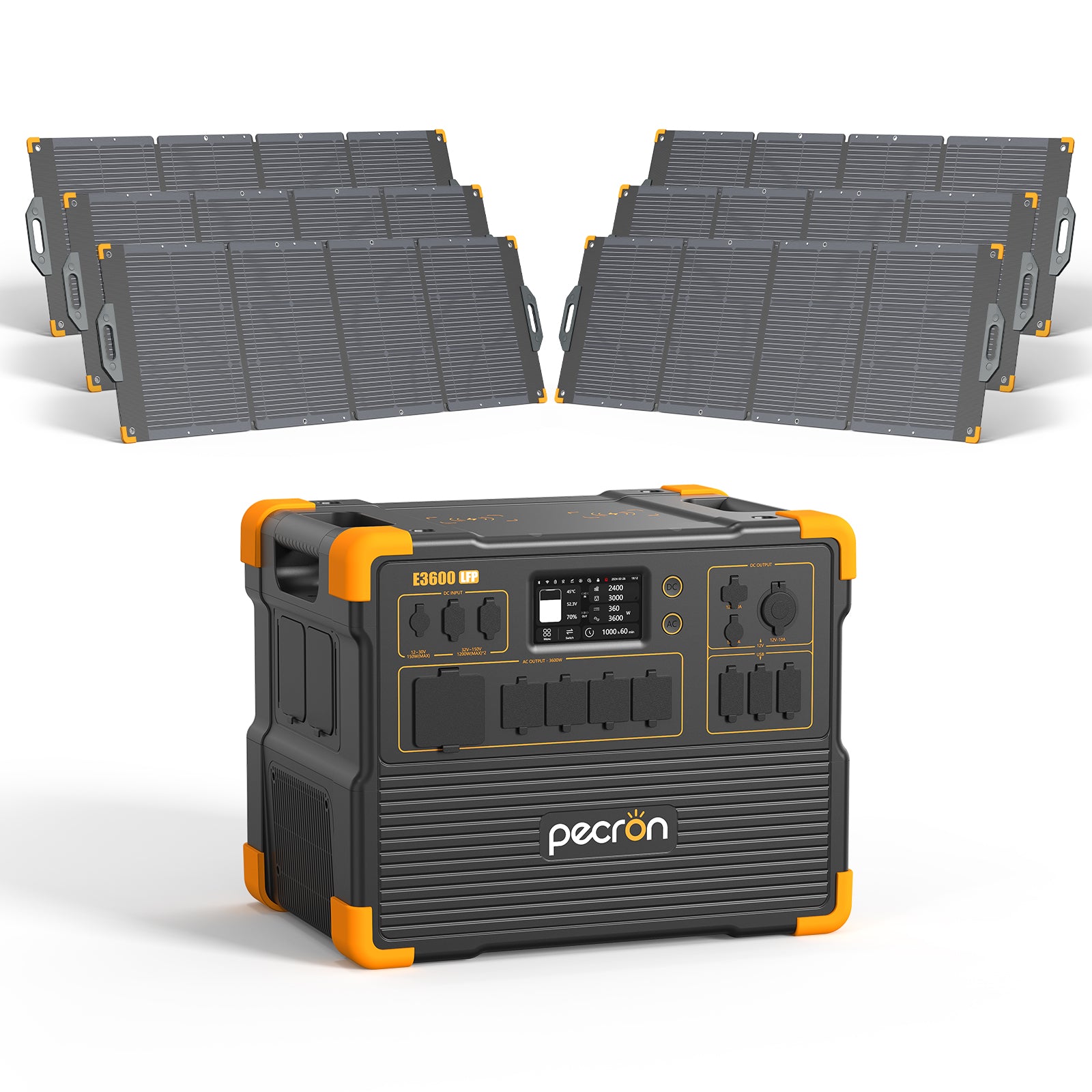
The six-panel E3600LFP package is the highest listed PV300 count in this single-station solar family. Its selected SKU names one E3600LFP and six 300 W panels, totaling 1,800 W of panel nameplate power. The station remains a 120 V unit rated for 3,600 W AC and 3,072 Wh of nameplate storage. This matters because the larger panel count can change a charging plan, but it cannot increase battery capacity, permit a larger load, or turn one station into a 240 V system.
Nearer the solar-input ceiling, but not a verified array
The E3600 lists a 2,400 W combined solar-input maximum through two XT60 inputs, each up to 1,200 W. Six 300 W panels add to 1,800 W by arithmetic, below the station’s published maximum. That is useful as a high-level screen, but the main missing fact is how those six panels may be connected across two inputs while staying within their voltage and current limits. The page option shows the named panel count; it does not provide a complete wiring diagram or establish the exact adapter and extension leads in the box.
There is also a source-label nuance: the exact bundle identifies PV300 panels at 300 W each, while the linked panel material does not fully settle the label/model bridge across page and manual. Do not select this package solely because the arithmetic suggests 1,800 W. Confirm the delivered panel revision and an official six-panel wiring plan for the E3600. Until then, a strict requirement that every included panel must be known to operate together should remain unmet.
Even an approved array does not deliver 1,800 W continuously. Sun intensity and angle, panel temperature, shade, conversion, cable losses, and active station draw all affect input. The panel nameplate is not a daily kWh promise or recharge-time guarantee. Six panels also need substantial open, sunny deployment area and secure storage between uses; the bundle is better suited to a prepared base location than a quick car-camping stop.
Battery and inverter do not grow with the panel count
The E3600 is chosen for its high 3,600 W continuous output at 120 V. Its 3,072 Wh battery is a separate constraint. A large load can still drain it quickly, and nameplate energy is not a measured usable-AC figure. The six-panel option might provide more solar opportunity during suitable conditions, but it cannot be treated as a six-panel expansion battery. For longer storage duration, the advertised expansion route needs exact model confirmation: the product copy and selectable EP-series variants conflict.
A single station does not meet 240 V. Pecron’s paired-station 240 V Connect Box arrangement is distinct and has separate wiring and outlet details that should be reviewed for the actual intended loads. The six-panel bundle should not be mistaken for that package simply because it includes a larger solar array. Likewise, the source does not establish whole-home transfer hardware or installation instructions.
Who has a reason to buy six panels?
This tier is most attractive to a buyer who has already chosen the E3600’s 120 V power limits, wants the largest named panel set in this option family, and can deploy six panels in a suitable location. It is less convincing if you have limited storage space, frequent moves, or no verified plan to connect the array. The four-panel configuration reduces the panel count while retaining 1,200 W of nameplate input; the station-only option avoids buying panels that may not fit an existing setup. A smaller E2400 may be better when output needs are moderate.
For a temporary outage, decide first which loads matter and how long they need to run; then size storage and solar separately. Do not reverse the process by treating six panels as proof that the system can support any particular household circuit for a set duration.
Questionnaire tradeoffs
This offer fits a 120 V requirement, a 3,600 W AC threshold, 3,000 Wh of nameplate storage, and a 1,800 W included-panel requirement if the shopper is asking about panel nameplate. It still has a 2,400 W station-side solar-input ceiling, so a 2,401 W requirement does not fit. A requirement for all six panels to have a verified combined wiring plan should exclude it on current evidence, as should a 240 V requirement. Those are material limits, not reasons to ignore the exact selected bundle.
Key details at a glance
| Nameplate battery capacity | 3072 Wh |
|---|---|
| Rated AC output | 3600 W |
| Manufacturer surge rating | 7000 W |
| Maximum solar input | 2400 W |
| Included panels, combined nameplate | 1800 W |
| Maximum USB-C output per port | 100 W |
More specifications and setup details
| Listed weight | 79 lb |
|---|---|
| Compatible extra-battery expansion | Yes |
| 12 V DC output | 360 W |
| Maximum AC recharge input | 3200 W |
| AC outlet output | Yes |
| USB-C ports | 2 |
| USB-A ports | 4 |
| Solar input ports | 2 |
| 12 V car-style output | 120 W |
| Vehicle charge input | 150 W |
| Battery chemistry | LiFePO4 |
| Expansion battery in this package | No |
| Home Power Panel in this package | No |
| Separate station units in offer | 1 |
| Smart Transfer Switch in this package | No |
| Solar panels in exact offer | 6 |
| Included expansion batteries | 0 units |
Use the exact model’s instructions for operating limits, supplied equipment and version differences.
Sources for this assessment

A useful match starts with the loads that matter.
Use the finder for hard electrical requirements, then check appliance starting behavior, actual run time and the exact package in the full assessment.