
On this page
Your needs, this model
Does it fit your priorities?
Does the documented E3600LFP (U.S. standalone SKU E3600LFP, without trolley) station plan meet 3,072 Wh and 3,600 W at 120 V without counting any unverified package additions?
The E3600LFP (U.S. standalone SKU E3600LFP, without trolley) station itself is listed at 3,072 Wh and 3,600 W at 120 V. Any listed EP3800 modules or second-station arrangement is not added to a confirmed package capacity here.
Explore this need in the finder →Do you need 2 listed 300 W panel(s), 600 W nameplate total, as part of the exact offer?
The exact variant title and SKU list 2 PV300-named 300 W panels (600 W nameplate sum). That confirms package quantity and rating only; exact panel revision and approved combined wiring remain unknown.
Explore this need in the finder →Can the listed EP3800-48V pack(s) be counted as compatible included expansion capacity?
The selected option lists 1 EP3800-48V pack(s), but the exact E3600LFP (U.S. standalone SKU E3600LFP, without trolley) compatibility and cable path remain unresolved. Use the station-only plan unless Pecron confirms this specific revision and supported capacity.
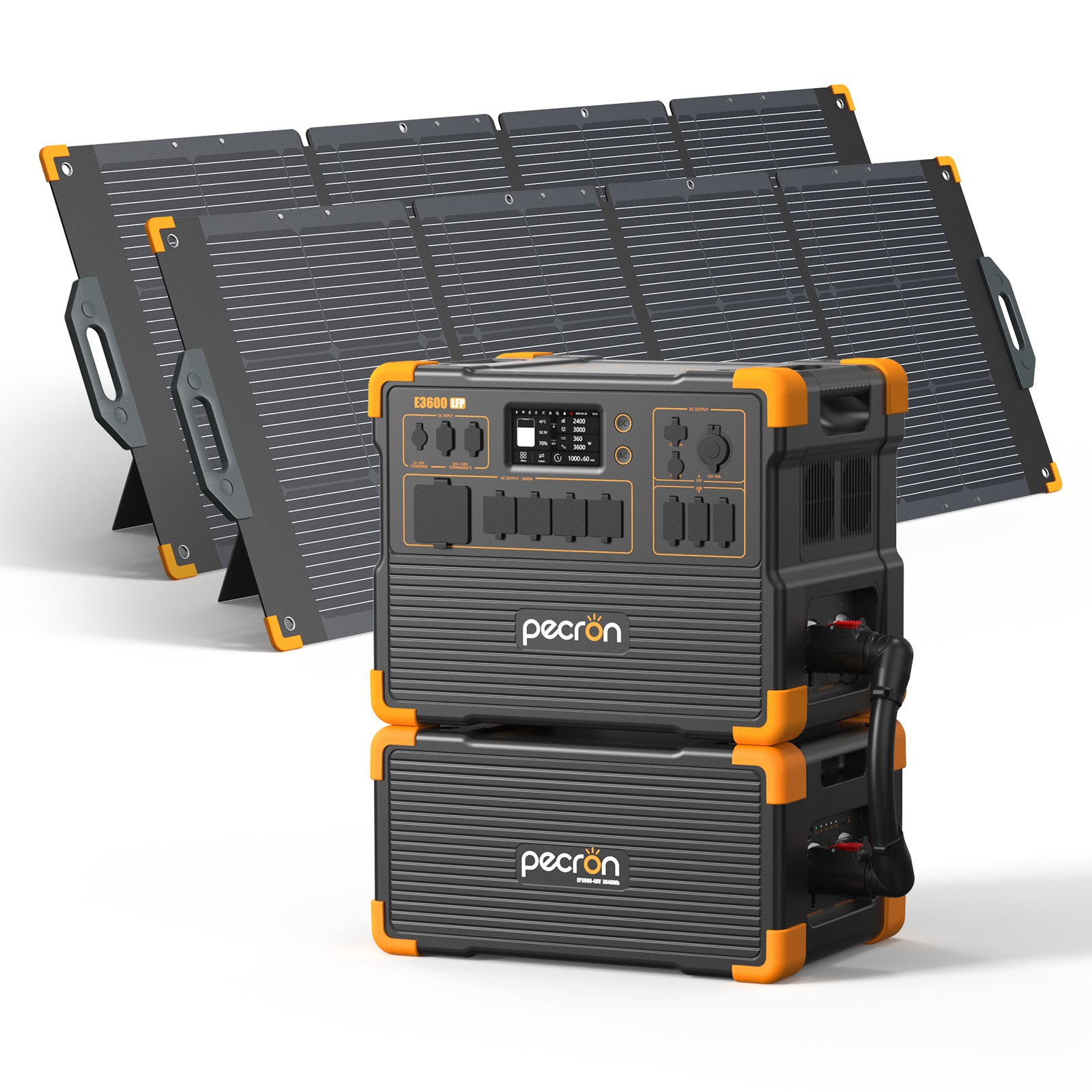
Explore this need in the finder →Pecron · E3600LFP solar and expansion bundle · without trolley
What this selected kit adds
This U.S. option is the E3600LFP with two PV300-named 300 W panels and one EP3800-48V expansion pack, with the trolley option left out. That is a useful distinction from a bare E3600: the listing identifies the extra equipment, but it does not turn the station into a different inverter. The E3600 itself is still the known 3,072 Wh, 3,600 W, 120 V station. Its 7,000 W surge figure is brief, not a continuous-load rating. The included pack is named in the selected SKU, yet the saved E3600 instructions and the separate pack documentation do not bridge this exact revision and connection path. I would not add the pack’s nameplate capacity to a runtime estimate until Pecron confirms the compatible cable and operating steps for this exact bundle.
The two panel labels amount to 600 W of panel nameplate, not 600 W of guaranteed charging. The E3600’s published solar ceiling is 2,400 W across its solar inputs, but that ceiling alone does not prove these particular panel revisions can be combined on the supplied lead. The storefront uses “PV300”; its related manual material has a PV300/S300 naming bridge that remains unresolved. The package title is good evidence of what the seller selected, not enough to plan a series or parallel array. Ask for the panel model codes, open-circuit voltage, connector and the exact connection diagram before counting on the panels for a daily recharge.
Where it makes sense
Choose this package if you want a large 120 V station, two named solar panels and the listed expansion pack, and you can verify the battery connection before the extra storage becomes important. It is a better starting point for a fixed cabin, workshop or prepared home-backup area than for frequent solo trips: the E3600 body alone is substantial, and this option has neither a trolley nor a confirmed combined-package weight. The panels need their own safe, sunny setup area. Treat the E3600 as a heavy station to position near the loads, not as a small battery to carry between rooms.
For a load plan, use the E3600’s own 3,072 Wh nameplate and 3,600 W continuous AC ceiling. The wattage is a limit on simultaneous demand; it does not tell you how long a refrigerator, pump or tool will run. Start from each appliance’s running and starting requirements, then leave room for conversion loss and reserve. A panel’s peak rating also is not a charge-time promise. Shade, season, angle, temperature, battery state and input compatibility all matter. If you cannot get the exact panel wiring answer, buy the station-only or panel-only option whose contents you can verify rather than improvising an array.
Choices and alternatives
This is not a 240 V system. The supported operating plan in this assessment is one E3600 station at 120 V; the included EP3800 label does not make a second station or a split-phase plan. If a 240 V well pump, range or transfer arrangement is essential, this profile should not pass that requirement. A buyer who needs only a clear 3,072 Wh / 3,600 W station and wants fewer unknown parts may prefer the E3600 with two PV300-named panels but no EP3800, or the standalone model. If more verified station output is the priority, compare the E3800LFP, whose individual 120 V rating is 4,200 W, rather than treating extra battery packs as more inverter power.
In the finder, the known 120 V station plan can match a suitable AC load and a two-panel minimum. The exact package is not accepted for a requirement that all supplied panels be proven to work together, or for a minimum number of compatible included expansion batteries. Those limits are deliberate: the seller selected those items, while the technical bridge for the extra pack and this panel revision is still not documented. The listed option was unavailable in the archived U.S. selection snapshot; availability changes, so check the exact SKU before purchase.
Key details at a glance
| Nameplate battery capacity | 3072 Wh |
|---|---|
| Rated AC output | 3600 W |
| Manufacturer surge rating | 7000 W |
| Maximum solar input | 2400 W |
| Included panels, combined nameplate | 600 W |
| Maximum USB-C output per port | 100 W |
More specifications and setup details
| Listed weight | 79 lb |
|---|---|
| Compatible extra-battery expansion | Yes |
| 12 V DC output | 360 W |
| Maximum AC recharge input | 3200 W |
| AC outlet output | Yes |
| USB-C ports | 2 |
| USB-A ports | 4 |
| Solar input ports | 2 |
| 12 V car-style output | 120 W |
| Vehicle charge input | 150 W |
| Battery chemistry | LiFePO4 |
| Home Power Panel in this package | No |
| Separate station units in offer | 1 |
| Smart Transfer Switch in this package | No |
| Solar panels in exact offer | 2 |
Use the exact model’s instructions for operating limits, supplied equipment and version differences.
Sources for this assessment

A useful match starts with the loads that matter.
Use the finder for hard electrical requirements, then check appliance starting behavior, actual run time and the exact package in the full assessment.