
On this page
Your needs, this model
Does it fit your priorities?
Does the E3600LFP station meet a 120 V, 3,600 W output and 3,072 Wh nameplate plan?
One E3600LFP station remains a 120 V unit rated at 3,600 W and 3,072 Wh nameplate; the panel and trolley selection do not change those ratings.
Explore this need in the finder →Does one included 300 W-nameplate panel meet the solar-kit minimum?
The exact SKU E3600LFP+PV300 and selected product title identify one 300 W solar panel; 300 W is the offer nameplate, not a measured harvest.
Explore this need in the finder →Must every supplied panel be documented to work together through the exact station leads?
No. This selected offer identifies its panel count and wattage, but the retained sources do not establish its complete array topology or exact array lead contents; do not assume a yes.
Explore this need in the finder →Pecron E3600LFP with one PV300 panel: review
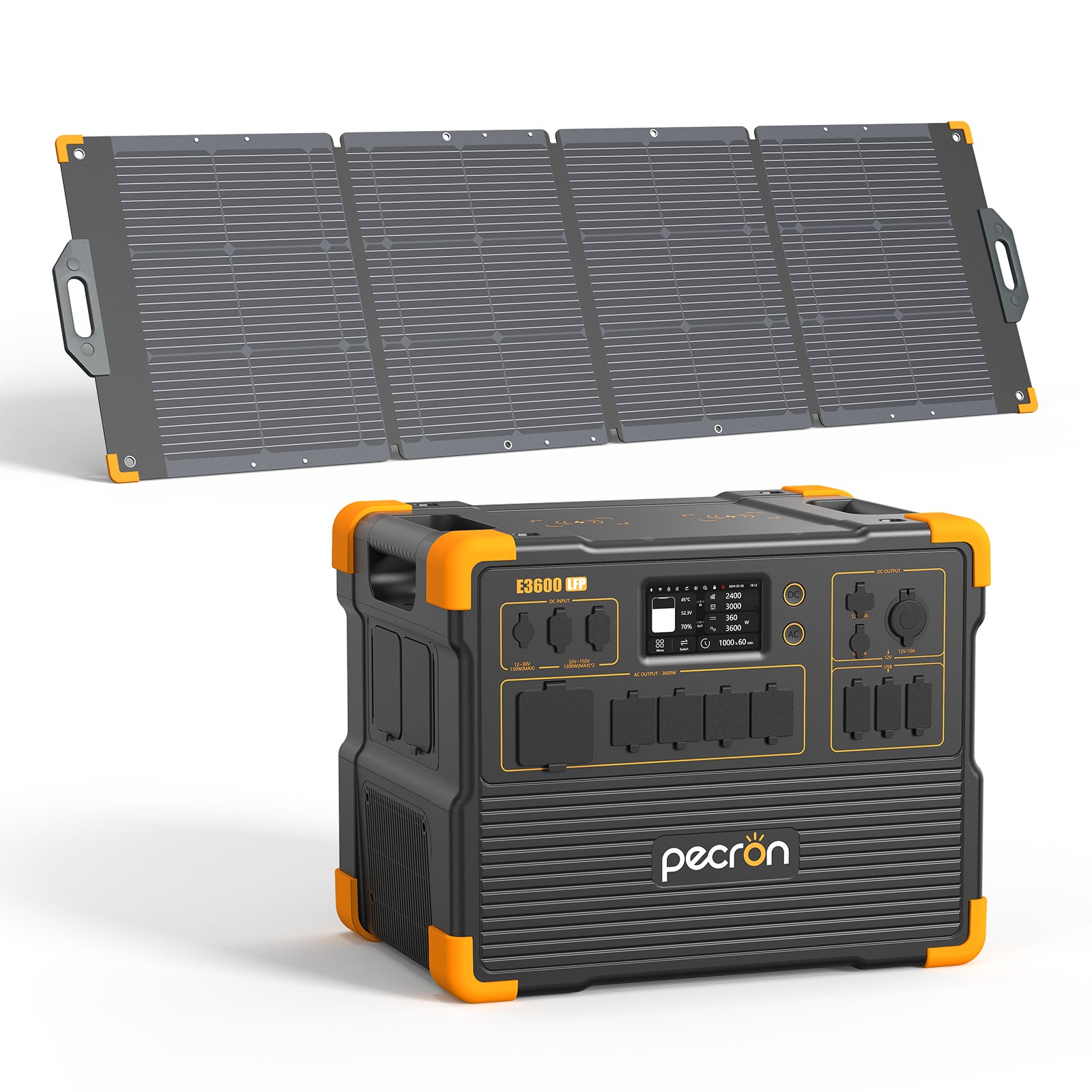
The E3600LFP plus one PV300-named panel is the smallest solar bundle on this product page, not a smaller power station. The single E3600LFP remains a 120 V, 3,600 W unit with 3,072 Wh of nameplate storage. The selected SKU adds one panel listed at 300 W. That distinction matters: the panel changes the amount of solar equipment in the package, not the station’s AC output, battery capacity, or voltage. Choose it only if the panel is useful to your plan and the station itself already fits the load.
Large station, modest solar starting point
Pecron documents two XT60 solar inputs, each rated up to 1,200 W, for a combined 2,400 W station-side ceiling. One 300 W panel is well below that ceiling. The unused input capacity is not a promise of faster charging: adding panels later requires matching their voltage and current to the manual and using an approved connection arrangement. The offer title identifies the panel as PV300, but the linked panel page and manual do not fully settle every naming and wiring detail. Neither this product option nor its image proves that the exact lead needed for every setup is in the carton.
Think of the 300 W figure as panel nameplate power, not energy received by the battery in a day. Sun angle, shade, temperature, clouds, panel placement, conversion losses, and station state all matter. No honest source-backed estimate of daily harvest or recharge time follows from the option name alone. If solar is essential, confirm the delivered panel and cable arrangement before relying on this bundle for a particular outage schedule.
What the station does—and does not—solve
The E3600LFP’s rated 3,600 W continuous output is the more unusual part of this combination. It suits a prepared 120 V load list with appliances whose simultaneous draw fits that limit. The 3,072 Wh nameplate battery is a separate constraint: high-power loads can consume stored energy quickly, and nameplate capacity is not a published usable-AC-energy figure. A 120 V product also does not become a split-phase 240 V source because a solar panel is bundled. Pecron lists a separate two-station connection-box arrangement; that is a different system and needs its own installation and compatibility review.
Battery expansion is advertised, but the station description and current options use different EP-series labels. That mismatch should keep any expanded-capacity promise out of an essential buying decision until the exact revision and compatible battery are confirmed. One included panel does not resolve that issue. The station body is listed at 79 lb, so it is a fixed-place or assisted-movement choice rather than something most people will want to carry routinely.
Who should choose this package?
This option makes sense for someone who has settled on the E3600’s output and storage, wants a starter solar panel in the same order, and is comfortable treating solar wiring as a setup to verify rather than an assumed plug-and-play array. It is less persuasive for a solar-first buyer: a lone 300 W panel may be a slow recovery plan for a 3,072 Wh battery, especially when several days of poor weather are possible. A buyer who already owns compatible panels can compare the station-only SKU instead of paying for a bundle panel they will not use.
It is also a poor fit for anyone who needs 240 V from one box, a verified whole-home transfer arrangement, a guaranteed solar runtime, or a light carry-in unit. For a smaller appliance list, the E2400LFP class may be easier to justify; if the E3600 is the right station but faster solar recovery is the priority, compare the two-, four-, and six-panel options. More panels raise the bundle’s nominal panel wattage but do not raise the E3600’s 2,400 W input limit.
How questionnaire choices change the recommendation
A 120 V requirement, a 3,600 W continuous-output floor, or a 3,000 Wh nameplate-capacity floor can keep this station in the shortlist. Requiring one included panel at 300 W also fits this exact offer. Raising the included-panel minimum to two panels removes it. Requiring documented support for every bundled panel operating together should remove it too: the available materials do not establish an exact array topology and cable package. If your load needs 240 V, a panel bundle cannot compensate for the missing system configuration.
In short, this is a high-output station paired with a small solar starting package. Buy it for the verified station characteristics and the specifically listed one-panel bundle—not for assumed charging speed, expanded battery capacity, or a larger electrical system.
Key details at a glance
| Nameplate battery capacity | 3072 Wh |
|---|---|
| Rated AC output | 3600 W |
| Manufacturer surge rating | 7000 W |
| Maximum solar input | 2400 W |
| Included panels, combined nameplate | 300 W |
| Maximum USB-C output per port | 100 W |
More specifications and setup details
| Listed weight | 79 lb |
|---|---|
| Compatible extra-battery expansion | Yes |
| 12 V DC output | 360 W |
| Maximum AC recharge input | 3200 W |
| AC outlet output | Yes |
| USB-C ports | 2 |
| USB-A ports | 4 |
| Solar input ports | 2 |
| 12 V car-style output | 120 W |
| Vehicle charge input | 150 W |
| Battery chemistry | LiFePO4 |
| Expansion battery in this package | No |
| Home Power Panel in this package | No |
| Separate station units in offer | 1 |
| Smart Transfer Switch in this package | No |
| Solar panels in exact offer | 1 |
| Included expansion batteries | 0 units |
Use the exact model’s instructions for operating limits, supplied equipment and version differences.
Sources for this assessment

A useful match starts with the loads that matter.
Use the finder for hard electrical requirements, then check appliance starting behavior, actual run time and the exact package in the full assessment.