
Your needs, this model
Does it fit your priorities?
Will 3,072 Wh and 3,600 W cover your 120 V plan?
The standalone E3600 is rated for 3,600 W at 120 V; the short surge figure is not continuous output.
Explore this need in the finder →Do you need a two-port solar input with a 2,400 W ceiling?
The page/manual specify two XT60 inputs and a 2,400 W combined station ceiling; panel voltage/current still must fit.
Explore this need in the finder →Is expansion useful if the exact battery model is confirmed first?
The page supports expansion but names different EP battery versions in its summary and current options. Confirm the compatible pack and capacity for the revision.
Explore this need in the finder →Pecron · large single-phase station
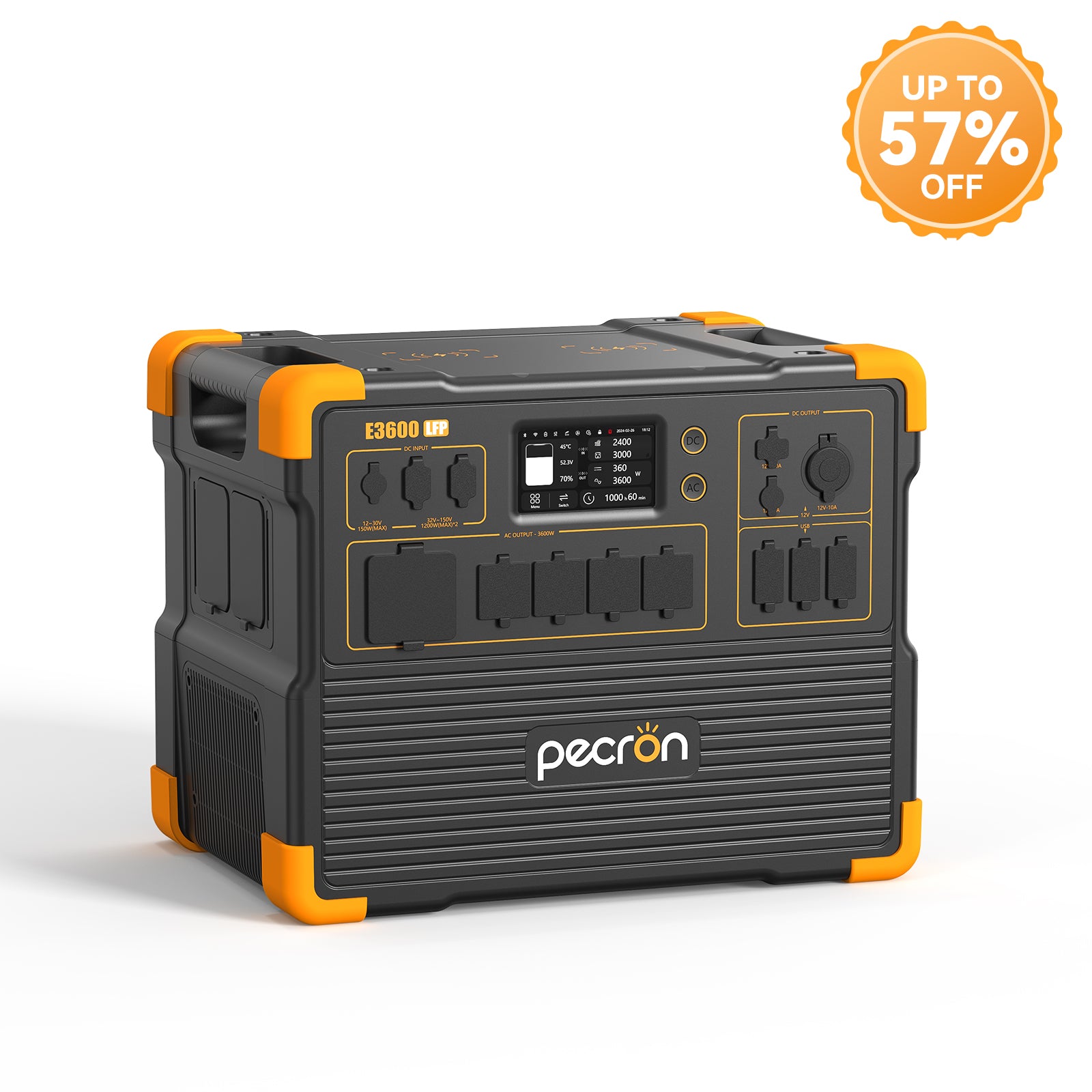
Pecron E3600LFP review
The Pecron E3600LFP is a 3,072 Wh, 3,600 W LiFePO4 station aimed at people who need more than weekend device charging but do not need a 240 V setup from the station alone. Its current U.S. page identifies a 120 V single-station plan. The listed base version weighs about 79 lb; a trolley is a separate selection on the page, and the current standalone SKU was unavailable in the captured U.S. offer. Neither its capacity nor the promotion converts it into a lightweight travel battery.
A high-output 120 V station, not a single-unit 240 V source
Pecron rates one E3600LFP for 3,600 W of 100–120 V pure-sine output and describes a 7,000 W surge figure. Its panel includes a 30 A AC output, 12 V/30 A DC, a car-style socket, a 100 W USB-C output, four USB-A ports and two 15 W wireless charging pads. The exact connector and combined-output limits matter more than the headline list: the 30 A AC lead and port are not ordinary 15 A receptacles, and each attached device must stay within its own outlet and station limits.
Pecron advertises 240 V only with two E3600LFP stations and a compatible 240 V connection box, for up to 7,200 W in that paired configuration. A buyer with one E3600 should plan on 120 V, not assume a split-phase output from the model name or the paired-system marketing. The 240 V box and second station are separate components and require their own compatibility and installation checks.
Solar input is a notable advantage, but kits vary
The exact station page lists up to 2,400 W across two XT60 solar inputs, with each port specified for 32–150 V and up to 20 A. It also lists a 150 W DC5521 solar input; the stated station-level maximum remains 2,400 W rather than a sum of every port's independent ceiling. Use the voltage and current window for the specific input and follow the manual's cable diagram. A solar charging input does not mean the base SKU includes panels. The product selector separately lists PV300 bundles, expansion-battery packages, and with- or without-trolley options.
Wall charging is listed at 3,200 W with the 30 A cable and 1,800 W on the 15 A cable. The page's package list names the station, 15 A lead, MC4 solar charging leads, screwdriver, pouch and instructions, and says a 30 A cable may be included during the sale but is usually sold separately. Do not count a panel, trolley or promotional AC cable without checking the exact option at purchase. Pecron's [E3600LFP manual](https://cdn.shopify.com/s/files/1/0509/5263/4556/files/PECRON_E3600LFP_user_manual_100V_120V_-20251016.pdf?v=1765511954) is the better place to verify input connections before building an array.
Expansion and charging claims need a revision check
Pecron describes the E3600LFP as expandable and its current option selector exposes packages with EP3800-48V batteries. The same product page's descriptive copy still names EP3000-48V packs and a different combined-capacity figure. Those battery models have different stated capacities, so this review does not carry a maximum expanded watt-hour number into matching. If expansion is essential, use the exact station revision, the corresponding manual and the current manufacturer confirmation to identify the compatible pack before ordering; the standalone station does not include an expansion battery.
The manufacturer also claims UPS operation, app control, 15 W wireless charging and 3,500-plus cycles to 80%. Its recharge-time claims depend on the AC lead and solar conditions; they are not an independent speed test. As with other inverter stations, check the actual load's startup draw. A 3,600 W continuous rating does not show how long a large load will run from 3,072 Wh of stored energy, and Pecron's warranty language is a published offer claim whose registration terms should be checked separately.
Who is better served by another model?
Choose the E3600LFP when high 120 V output, a large but still sub-4 kWh battery and substantial solar input all matter. The E3800LFP adds 768 Wh of nameplate storage and a higher inverter rating, though its listed weight rises to about 87 lb. The F3000LFP has the same 3,072 Wh and 3,600 W headline ratings but a 1,600 W solar ceiling and a different 24 V car input; its product copy also needs careful expansion-pack matching. The F5000LFP is the more direct choice if a single station must supply 240 V, but it is a much heavier system with separate electrical and neutral considerations.
At roughly 79 lb, the E3600 is best moved on a cart or kept where it will be used. It suits a fixed backup shelf, workshop or large RV-oriented setup better than frequent lifting. It is not a home transfer switch, and the regular SKU should not be wired into a home panel without the right transfer equipment and a qualified installer. If all you need is a laptop, router and a few hours of modest AC, a smaller station is easier to carry and may be simpler to keep charged. If 240 V or an exact expansion-battery maximum is essential, do not let an option menu substitute for a matched, documented configuration.
Key details at a glance
| Nameplate battery capacity | 3072 Wh |
|---|---|
| Rated AC output | 3600 W |
| Manufacturer surge rating | 7000 W |
| Maximum solar input | 2400 W |
| Included panels, combined nameplate | 0 W |
| Maximum USB-C output per port | 100 W |
| Listed weight | 79 lb |
| Compatible extra-battery expansion | Yes |
| 12 V DC output | 360 W |
| Maximum AC recharge input | 3200 W |
| AC outlet output | Yes |
| USB-C ports | 2 |
| USB-A ports | 4 |
| Solar input ports | 2 |
| 12 V car-style output | 120 W |
| Vehicle charge input | 150 W |
| Battery chemistry | LiFePO4 |
| Expansion battery in this package | No |
| Home Power Panel in this package | No |
| Separate station units in offer | 1 |
| Smart Transfer Switch in this package | No |
| Solar panels in exact offer | 0 |
Use the exact model’s instructions for operating limits, supplied equipment and version differences.
Sources for this assessment

A useful match starts with the loads that matter.
Use the finder for hard electrical requirements, then check appliance starting behavior, actual run time and the exact package in the full assessment.