
On this page
Your needs, this model
Does it fit your priorities?
Will one 120 V E3800LFP with 4,200 W AC and 3,840 Wh nameplate storage suit the required load plan?
The exact selected option retains one E3800LFP host rated for 4,200 W at 120 V and 3,840 Wh nameplate capacity; the panel package does not change either station rating.
Explore this need in the finder →Must the selected offer include at least 2 PV300 panels (600 W combined nominal panel nameplate)?
The exact selected SKU E3800LFP-2*PV300 names 2 PV300 panels; 300 W × 2 = 600 W combined manufacturer nameplate. This is not a promised harvest.
Explore this need in the finder →Must all 2 supplied panels be confirmed as a supported array with the exact connecting leads?
No. The station and panel manuals establish separate input/connector facts, but the saved selected-option evidence does not establish a supported full-array topology or exact cable contents; unknown cannot satisfy that essential condition.
Explore this need in the finder →Pecron · two-panel E3800LFP option
Pecron E3800LFP with two PV300 panels review
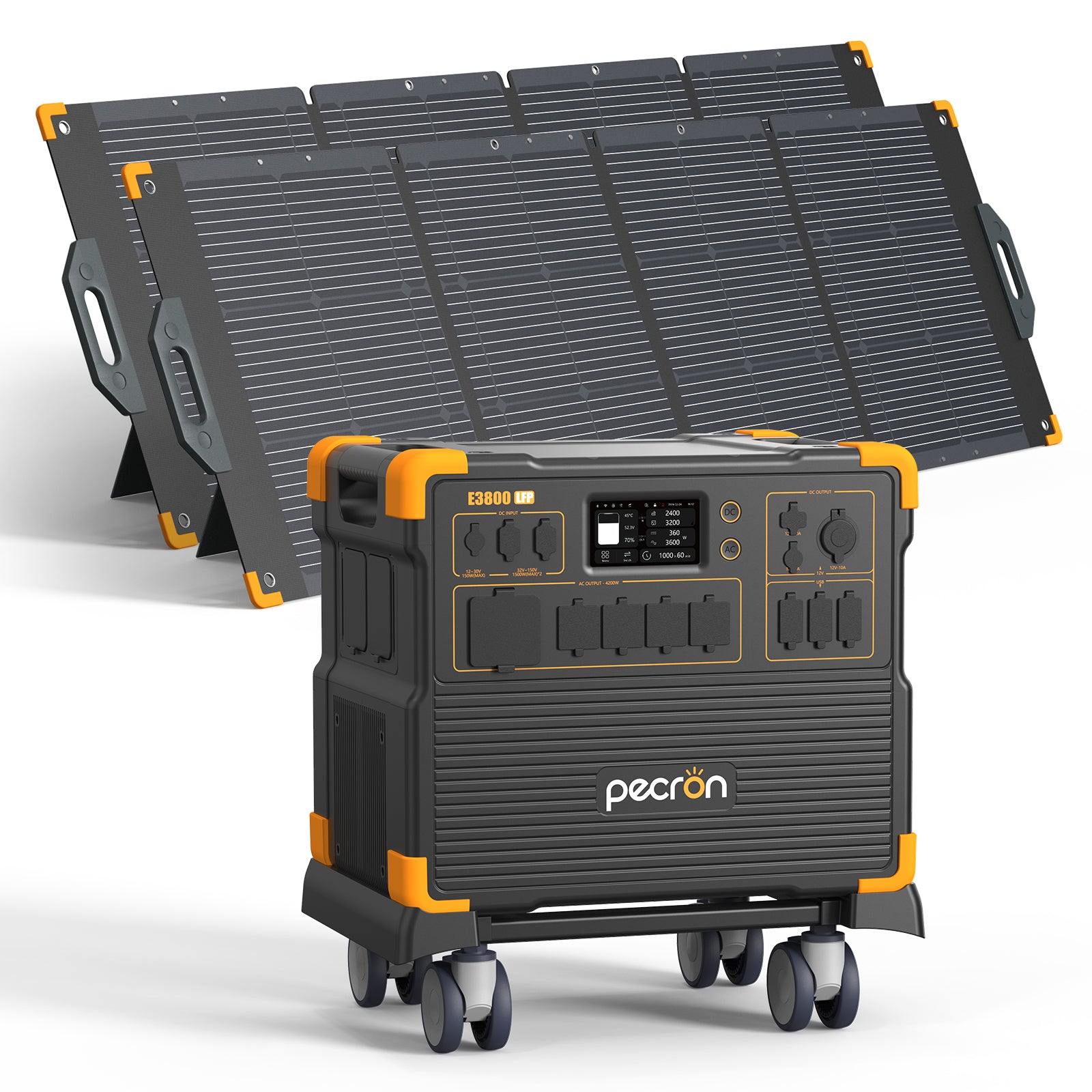
The U.S. page’s exact selected variant is 45804485148860, SKU E3800LFP-2*PV300. It specifies one E3800LFP station and two named PV300 panels. Using the panel’s 300 W nominal rating, that is 600 W of combined panel nameplate. The host remains the same 3,840 Wh, 4,200 W, 120 V machine as the station-only option. This is a panel-count choice, not a battery-expansion upgrade.
Why two panels can be more useful than one
Two fold-out panels offer a meaningful step over the single-panel package if daylight replenishment matters during an extended outage or a stationary off-grid stay. At rated conditions, 600 W is twice the panel nameplate of the one-panel bundle, so it can collect more energy when both surfaces are well exposed. It does not guarantee twice the real-world harvest: the panels may face different directions, one may be shaded, and nominal output is measured under standard conditions. Pecron’s own panel manual cautions that sunlight, temperature, soiling, orientation, and partial shade lower output. The actual charging rate is not measured in this review.
That distinction matters because the E3800’s battery is 3,840 Wh. The offer does not give a manufacturer-published usable AC energy figure for the selected plan, and a 600 W array is not a reliable way to promise a particular recovery time. If the backup plan is to run high-draw loads overnight and recharge fully each day, work from measured appliance energy and a conservative solar plan; do not divide nameplate capacity by a single panel rating and present the result as a field runtime.
The station’s input ceiling is not the package’s panel output
Pecron’s E3800 manual lists two XT60 solar inputs with 1,500 W maximum per input, 3,000 W combined, a 32–150 V range, and 20 A maximum current. The panel manual linked from Pecron’s PV300 page identifies “S300” as its model number and lists 300 W nominal, 36 V operating voltage, 8.3 A operating current, 41.4 V open-circuit voltage, and an MC4 connector. The sales page and this selected bundle call the panel PV300; the manual’s different model label is retained as a source caveat, not silently reconciled. Panel IP67 is not a rating for the station itself.
Two panels give more nameplate than one, yet the exact selected-option evidence does not specify whether or how both are wired together, the precise adapter set, or which station-side cable is boxed. The panel manual tells users to use an MC4 cable supplied with a Pecron machine and to follow the power-station manual’s wiring method. That is general advice, not a verified list of what ships with this SKU. If every supplied panel must work together from day one, get the connection diagram and cable list for this exact package before buying. A compatible panel voltage does not settle the full current, series/parallel, connector, or cable question.
Space, handling, and the role it suits
This bundle makes more sense at a cabin, workshop, parked vehicle, or prepared home-backup site than for someone who wants a compact kit to carry down a trail. The E3800 station alone weighs about 87.3 lb according to its manual. The panel manual’s S300 table lists a per-panel mass of about 12.741 kg, but because that document names S300 rather than PV300, I would not use that number as a definitive total-kit weight without confirming the exact revision. Two panels also require two clear, sun-facing locations; the official option image shows a promotional arrangement, not a guaranteed site layout or box list.
For loads, the fixed 4,200 W AC rating may handle a large single appliance or several smaller household devices within the unit’s output limits, but the station remains 120 V. A 240 V well pump or split-phase transfer setup is not served by this one-host SKU. Two E3800LFP units plus the manufacturer’s 240 V box are a separate selected configuration and should not be conflated with buying two panels.
Which questionnaire choices matter
Requiring 120 V, AC output, and at least 3,840 Wh points to the host, while requiring at least 600 W and two included panels distinguishes this offer from the one-panel selection. The advanced “minimum solar input” choice describes the E3800’s intake ceiling, not what the two included panels can produce. A requirement above 600 W of included panel nameplate favors the four- or six-panel option. If “all supplied panels together” or a particular in-box cable is essential, the answer remains unconfirmed, so this offer should not pass that hard requirement on the available evidence. This is the middle solar tier only for a buyer who can solve placement and wiring deliberately.
Key details at a glance
| Nameplate battery capacity | 3840 Wh |
|---|---|
| Rated AC output | 4200 W |
| Maximum solar input | 3000 W |
| Included panels, combined nameplate | 600 W |
| Maximum USB-C output per port | 100 W |
| Listed weight | 87.3 lb |
More specifications and setup details
| Compatible extra-battery expansion | Yes |
|---|---|
| 12 V DC output | 360 W |
| Maximum AC recharge input | 3200 W |
| AC outlet output | Yes |
| USB-C ports | 2 |
| USB-A ports | 4 |
| Solar input ports | 2 |
| 12 V car-style output | 120 W |
| Vehicle charge input | 150 W |
| Battery chemistry | LiFePO4 |
| Expansion battery in this package | No |
| Home Power Panel in this package | No |
| Separate station units in offer | 1 |
| Smart Transfer Switch in this package | No |
| Solar panels in exact offer | 2 |
| Included expansion batteries | 0 units |
Use the exact model’s instructions for operating limits, supplied equipment and version differences.
Sources for this assessment

A useful match starts with the loads that matter.
Use the finder for hard electrical requirements, then check appliance starting behavior, actual run time and the exact package in the full assessment.