
On this page
Your needs, this model
Does it fit your priorities?
Can one E3800 host provide 4,200 W at 120 V with 19,200 Wh nameplate storage?
The selected E3800LFP-4*EP3800-48V lists one 3,840 Wh E3800LFP and 4 3,840 Wh EP3800-48V packs. Their 19,200 Wh total is nameplate arithmetic; host output remains 4,200 W at 120 V.
Explore this need in the finder →Must this exact offer include 4 EP3800-48V expansion batteries?
The selected U.S. SKU E3800LFP-4*EP3800-48V names 4 EP3800-48V battery pack(s); this is separate from a station-only listing. Exact cable inclusion is not confirmed.
Explore this need in the finder →Do you want the E3800’s documented solar-input ceiling while sourcing panels separately?
The E3800 manual lists up to 3,000 W total through two XT60 inputs and a 32–150 V range, but this battery-only option lists no panels.
Explore this need in the finder →Pecron · four-pack E3800LFP configuration
Pecron E3800LFP with four EP3800-48V batteries review
The exact selected SKU, E3800LFP-4*EP3800-48V, pairs one E3800LFP with four EP3800-48V expansion batteries. That makes it a 19,200 Wh nameplate configuration by adding the manufacturer’s 3,840 Wh host rating to four 3,840 Wh pack ratings. It is still a single station with one 4,200 W, 120 V AC output system. The extra capacity can matter for a long-duration plan; it does not increase the size of loads that inverter can start or run.
Why choose four packs instead of three?
The choice is about storage threshold. A three-pack option totals 15,360 Wh, while this four-pack listing moves to 19,200 Wh. If your planned energy budget exceeds the lower tier but fits the next tier on paper, the selected count is a useful way to compare the two. This is nameplate energy, not a published AC-delivered figure, and the sources do not provide an exact run-time table for your appliances. Treat 19.2 kWh as a screening number and include conversion losses, surge behavior, recharge timing and load duty cycle in your own design.
All four added modules share the same E3800 host. The product’s 4,200 W rating does not multiply by four, and the station remains 120 V. If a well pump, workshop tool or other load needs more than the host rating, more batteries do not solve that mismatch. Likewise, a 240 V request needs a different, two-station-plus-box arrangement; this option is not split-phase simply because the storage total is large.
It is a site-planned system
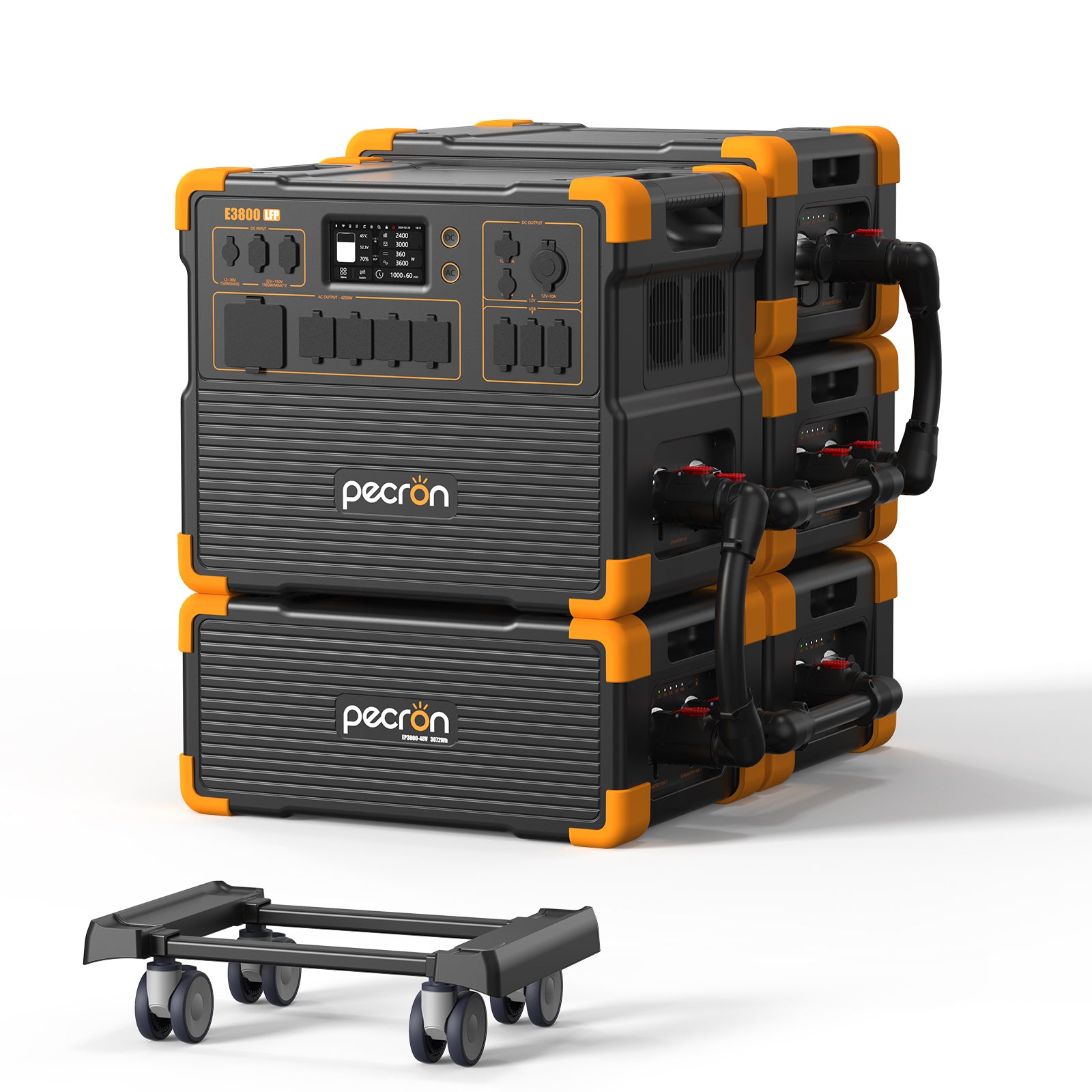
Pecron lists the E3800 station at about 87.3 lb and each EP3800-48V module at about 66.8 lb. Together that is roughly 354.5 lb before the leads, cart or any other accessories. The modules are individually lighter than the entire assembled system, but the package still calls for a defined landing area, cable path and sensible handling plan. The manufacturer’s product image shows a multi-module arrangement and trolley; it is a render, not a guarantee of safe stacking or a list of what arrives in this carton.
The station manual discusses the official MJ32 connection, pack ordering and keeping connected packs in a suitable state-of-charge relationship. Follow the current manual’s connection and handling directions, and confirm the exact cable and any trolley before purchase. The selected SKU establishes four batteries in the offer; it does not establish that the necessary cascade cable is in the box. A buyer who wants a simple battery backup that can be carried out for a weekend is looking at the wrong class of configuration.
Charging needs its own design
The E3800 manual documents two XT60 solar inputs with a combined ceiling of 3,000 W and a 32–150 V range. This selected option is a battery bundle, not a solar-panel kit. Panel voltage, series/parallel wiring, current and the right leads have to be matched to the actual input limits; none should be inferred from the image. Adding packs also does not change the charger’s accepted input ceiling, so a large reserve can take longer to restore than a small one under the same source conditions. No exact recharge time is promised for this four-pack arrangement.
For a location with a verified charging plan and substantial energy demand, four modules can be the middle ground between the three-pack and five-pack options. If the load schedule is modest or the site is hard to access, the extra 66.8 lb beyond the three-pack may not buy a meaningful benefit. A two-pack option is lighter still at 11,520 Wh, while the standalone E3800 is the cleaner choice when its 3,840 Wh rating is enough.
Bottom line
Choose the four-pack E3800 when the specific 19,200 Wh nameplate tier is justified and you have space for about 354.5 lb of station and battery modules. Its advertised advantage is more storage behind a known 4,200 W, 120 V host. The same choice does not add AC output, provide 240 V, include solar panels or confirm the cable/cart contents. The captured U.S. product JSON showed the selected variant available on October 25, 2026; stock and promotional bundle terms can change. Re-check the exact SKU and box list, then compare the 15.36 and 23.04 kWh alternatives against your actual load plan rather than assuming the largest package is automatically better.
Key details at a glance
| Nameplate battery capacity | 19200 Wh |
|---|---|
| Rated AC output | 4200 W |
| Maximum solar input | 3000 W |
| Included panels, combined nameplate | 0 W |
| Maximum USB-C output per port | 100 W |
| Listed weight | 87.3 lb |
More specifications and setup details
| Compatible extra-battery expansion | Yes |
|---|---|
| 12 V DC output | 360 W |
| Maximum AC recharge input | 3200 W |
| AC outlet output | Yes |
| USB-C ports | 2 |
| USB-A ports | 4 |
| Solar input ports | 2 |
| 12 V car-style output | 120 W |
| Vehicle charge input | 150 W |
| Battery chemistry | LiFePO4 |
| Expansion battery in this package | Yes |
| Home Power Panel in this package | No |
| Separate station units in offer | 1 |
| Smart Transfer Switch in this package | No |
| Solar panels in exact offer | 0 |
| Included expansion batteries | 4 units |
Use the exact model’s instructions for operating limits, supplied equipment and version differences.
Sources for this assessment

A useful match starts with the loads that matter.
Use the finder for hard electrical requirements, then check appliance starting behavior, actual run time and the exact package in the full assessment.