
On this page
Your needs, this model
Does it fit your priorities?
Will one 120 V E3800LFP with 4,200 W AC and 3,840 Wh nameplate storage suit the required load plan?
The exact selected option retains one E3800LFP host rated for 4,200 W at 120 V and 3,840 Wh nameplate capacity; the panel package does not change either station rating.
Explore this need in the finder →Must the selected offer include at least 4 PV300 panels (1,200 W combined nominal panel nameplate)?
The exact selected SKU E3800LFP-4*PV300 names 4 PV300 panels; 300 W × 4 = 1,200 W combined manufacturer nameplate. This is not a promised harvest.
Explore this need in the finder →Must all 4 supplied panels be confirmed as a supported array with the exact connecting leads?
No. The station and panel manuals establish separate input/connector facts, but the saved selected-option evidence does not establish a supported full-array topology or exact cable contents; unknown cannot satisfy that essential condition.
Explore this need in the finder →Pecron · four-panel E3800LFP option
Pecron E3800LFP with four PV300 panels review
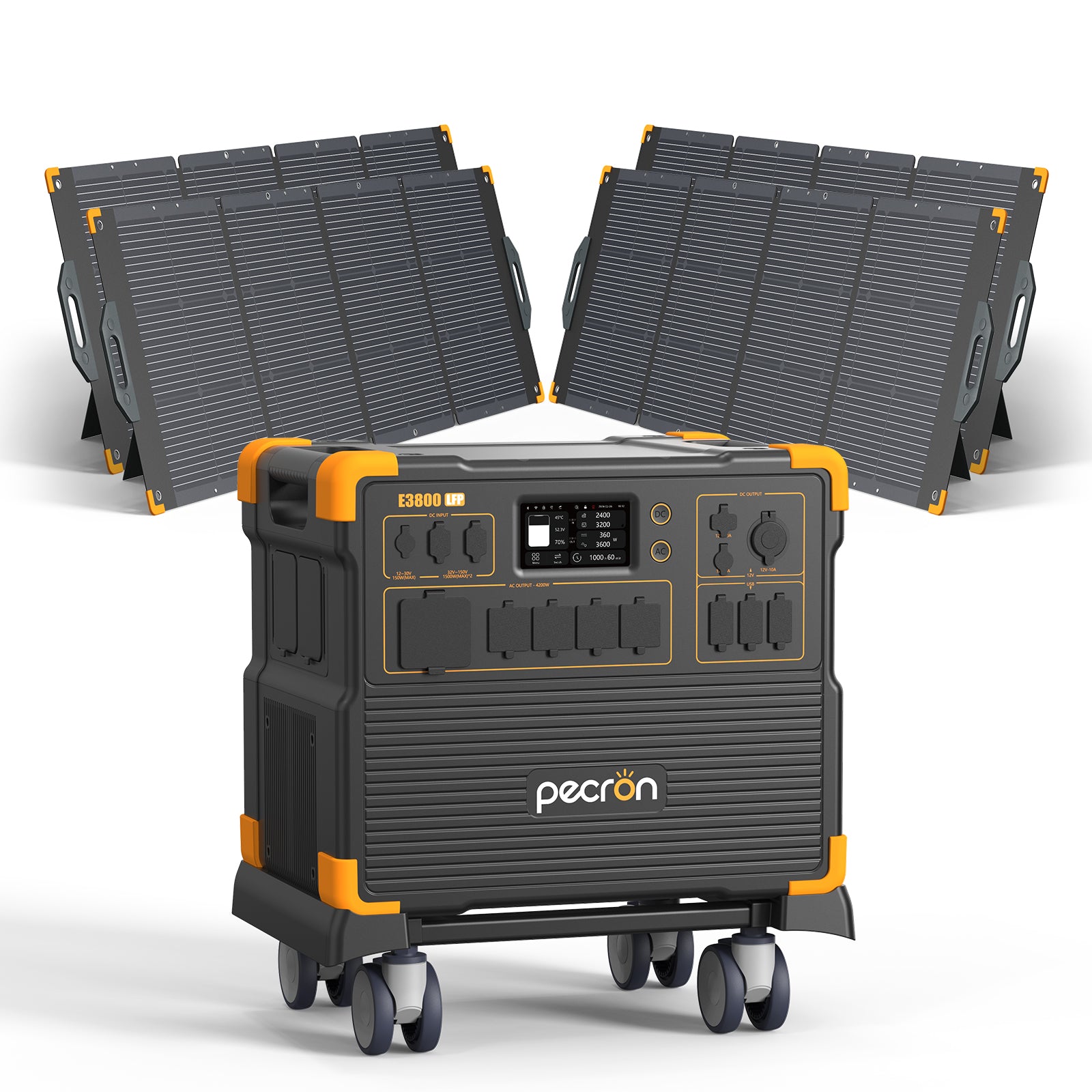
Pecron’s exact option 45804485181628 is SKU E3800LFP-4*PV300: one E3800LFP station and four panels named PV300 on the U.S. product page. At the linked panel listing’s 300 W nominal rating each, the selected bundle totals 1,200 W of panel nameplate. The station is still the same one-host plan: 3,840 Wh nameplate storage, 4,200 W rated AC output, and 120 V household output. The larger solar figure should not be mistaken for extra battery capacity or a second inverter.
A four-panel package is a site-planning decision
Four 300 W panels are a substantial amount of portable array for a consumer bundle. The extra capacity can be useful when a site has enough unshaded area and the owner wants more daylight collection than one or two panels can supply. It is not a measured harvest. Panel ratings assume standard test conditions; the PECRON manual itself notes that cloud cover, heat, dirt, orientation, and partial shading cut output. If the four panels cannot be placed together with similar exposure, the aggregate 1,200 W nameplate will overstate the operating plan. The image linked to this exact variant shows four fold-out panels, but it is a manufacturer CGI/render and not evidence of how quickly they set up or what a real campsite looks like.
The E3800 manual gives a generous 3,000 W solar-input ceiling across two XT60 ports, each at up to 1,500 W. Four PV300 panels total less than that ceiling on nameplate arithmetic, but that comparison does not establish the correct electrical arrangement. The connected array still must stay within each input’s voltage and current limits, and the exact bundle’s lead topology is not identified in the saved manufacturer option data. A lower aggregate watt number does not remove series-voltage or parallel-current constraints.
Read the panel and station sources together
The station manual lists its high-voltage solar input range as 32–150 V, two XT60 inputs, 20 A maximum, and 3,000 W maximum combined. The linked solar-panel manual lists a 300 W nominal panel with 36 V operating voltage and 8.3 A current; its table gives 41.4 V open-circuit voltage and an MC4 connector. That manual’s cover says 300 W / 36 V, but the technical table calls the panel model “S300.” Pecron’s U.S. package selection and separate product-page title call the panel “PV300,” while the page URL has an older “330w” path. I use the SKU and visible product-page identity for the selected package, preserve the manual naming inconsistency, and do not claim a confirmed revision equivalence.
The panel manual’s instruction to use an MC4 cable supplied with a Pecron machine is not the same as a box list for SKU E3800LFP-4*PV300. The E3800’s solar inputs are XT60, so confirm the manufacturer-specified cable/adapter and wiring diagram for all four panels. The option’s pictured station cart is likewise not proof of the selected package’s exact accessories; the page title says “with Free Cart,” but a package-specific contents list was not established here. Keep the purchase decision tied to the exact selected SKU and seller’s current box contents.
Who benefits from 1,200 W of panel nameplate?
This option fits a fixed backup or off-grid setup where the buyer wants a named four-panel bundle, can deploy four panels in good sun, and has a practical plan to carry and stow them. The E3800 itself is heavy at about 87.3 lb. Its 4,200 W output ceiling can be useful for higher-power 120 V loads, while its storage figure governs how much energy is on board. Those are separate limits: stronger sunlight can replenish stored energy, but it does not raise inverter output during a high load, and a larger inverter does not promise a longer runtime.
If your priority is simply one included panel, the one-panel SKU is smaller in scope. The two-panel option provides 600 W nameplate; four panels double that, and the six-panel configuration moves to 1,800 W. The station’s 3,000 W acceptance ceiling remains the same across all of them. Choose four only if the additional deployable panel capacity serves a real recharge plan; avoid buying a bigger pictured array just because the host can accept more solar in theory.
How to judge it for your needs
On the ordinary path, this exact plan can satisfy 120 V, AC, solar-charging capability, and a requirement for at least four included 300 W panels. It cannot satisfy a 240 V requirement; that is a separate two-station/240 V-box configuration. In advanced limits, it clears a 1,200 W included-panel threshold, not 1,201 W; the station’s 3,000 W solar-input rating is independent. If the hard requirement is that all four supplied panels be a manufacturer-verified array with an included cable, keep the answer at “not confirmed.” The four-panel offer is attractive when you are ready to verify the connection plan, not when you need the listing alone to certify a turnkey solar installation.
Key details at a glance
| Nameplate battery capacity | 3840 Wh |
|---|---|
| Rated AC output | 4200 W |
| Maximum solar input | 3000 W |
| Included panels, combined nameplate | 1200 W |
| Maximum USB-C output per port | 100 W |
| Listed weight | 87.3 lb |
More specifications and setup details
| Compatible extra-battery expansion | Yes |
|---|---|
| 12 V DC output | 360 W |
| Maximum AC recharge input | 3200 W |
| AC outlet output | Yes |
| USB-C ports | 2 |
| USB-A ports | 4 |
| Solar input ports | 2 |
| 12 V car-style output | 120 W |
| Vehicle charge input | 150 W |
| Battery chemistry | LiFePO4 |
| Expansion battery in this package | No |
| Home Power Panel in this package | No |
| Separate station units in offer | 1 |
| Smart Transfer Switch in this package | No |
| Solar panels in exact offer | 4 |
| Included expansion batteries | 0 units |
Use the exact model’s instructions for operating limits, supplied equipment and version differences.
Sources for this assessment

A useful match starts with the loads that matter.
Use the finder for hard electrical requirements, then check appliance starting behavior, actual run time and the exact package in the full assessment.