
On this page
Your needs, this model
Does it fit your priorities?
Can one E3800 host provide 4,200 W at 120 V with 23,040 Wh nameplate storage?
The selected E3800LFP-5*EP3800-48V lists one 3,840 Wh E3800LFP and 5 3,840 Wh EP3800-48V packs. Their 23,040 Wh total is nameplate arithmetic; host output remains 4,200 W at 120 V.
Explore this need in the finder →Must this exact offer include 5 EP3800-48V expansion batteries?
The selected U.S. SKU E3800LFP-5*EP3800-48V names 5 EP3800-48V battery pack(s); this is separate from a station-only listing. Exact cable inclusion is not confirmed.
Explore this need in the finder →Do you want the E3800’s documented solar-input ceiling while sourcing panels separately?
The E3800 manual lists up to 3,000 W total through two XT60 inputs and a 32–150 V range, but this battery-only option lists no panels.
Explore this need in the finder →Pecron · high-storage E3800LFP with five EP3800-48V modules
Pecron E3800LFP with five EP3800-48V batteries review
This U.S. selected package is identified by SKU E3800LFP-5*EP3800-48V: one E3800LFP station and five EP3800-48V battery modules. Its 23,040 Wh figure comes from the manufacturer’s 3,840 Wh station nameplate plus five 3,840 Wh battery nameplates. It is a very large stored-energy configuration, but only one station’s inverter is present. The AC rating remains 4,200 W at 120 V.
Capacity is not a substitute for output
This bundle fits a buyer who can name the energy target and wants one station with a large reserve behind it. It does not make a 5,000 W load suitable for a 4,200 W inverter, and it does not convert household 120 V outlets to 240 V. The most important comparison is not simply “five is more than four.” Ask whether a planned load schedule genuinely needs more than the four-pack’s 19,200 Wh nameplate figure. If not, the extra module adds mass and cost exposure without changing the station’s AC ceiling.
No usable AC energy or verified runtime for this exact package is published in the saved manufacturer sources. Nameplate watt-hours are a starting point, not a promise that an appliance will operate for a specific number of hours. Inverter losses, standby consumption, startup loads and the way loads cycle all matter. Treat the 23.04 kWh label as a capacity tier for comparing configurations, then check the individual device requirements against the host’s output rating.
Plan a stationary footprint
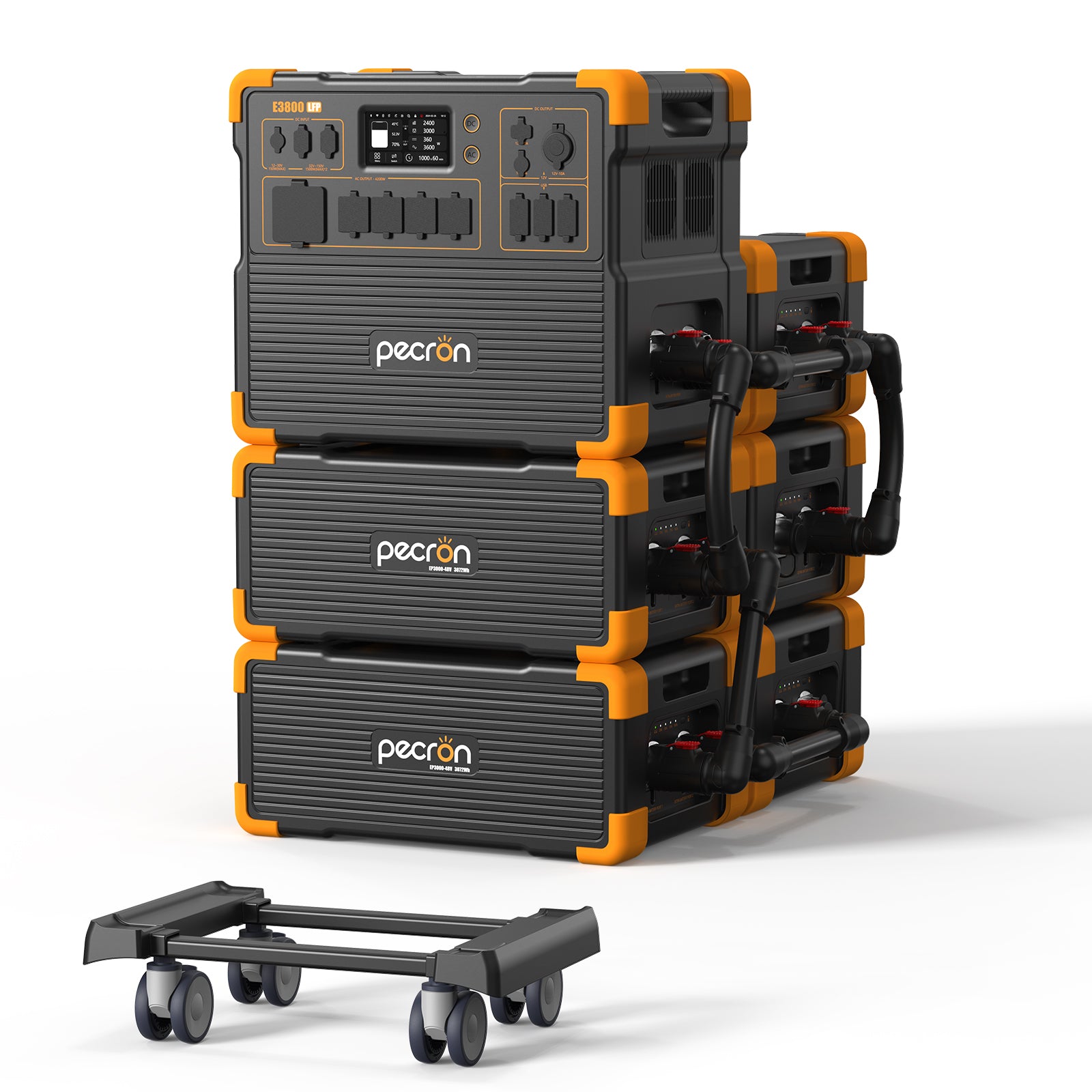
The manufacturer lists the station at about 87.3 lb and each EP3800-48V at about 66.8 lb. A five-pack system is therefore about 421.3 lb of host and batteries before cables or any cart. The pack count is six physical energy units when the station is included. That is not a single portable appliance; decide where the equipment will live and how each module will be moved and connected before selecting this package. The selected-option image is a manufacturer render that shows the stack and trolley; it does not prove that a cart, or the pictured leads, is included in the selected box.
The station manual supports up to six EP3800-48V packs and describes the MJ32 connection procedure, pack numbering and state-of-charge balance. Follow the exact manual rather than improvising a battery order or using an unverified cord. The option title identifies five compatible packs, while the exact cable model and in-box cable list remain unconfirmed. If the offer’s cable contents are essential to you, the current evidence cannot say yes; verify them directly before purchasing.
Solar does not come with the batteries
The E3800 host’s two XT60 solar inputs are listed for up to 3,000 W combined in a 32–150 V window. This five-pack battery option names no panels. A solar system must be selected separately and its electrical values checked against the host’s documented limits. The large battery reserve does not increase the accepted solar-input ceiling, so recharge planning deserves as much attention as storage planning. No specific restoration time should be inferred from the capacity alone.
For comparisons, the three-pack model totals 15,360 Wh and the four-pack is 19,200 Wh; the six-pack listing reaches 26,880 Wh while remaining on the same single 120 V inverter. The five-pack is the choice between them only if the additional 3,840 Wh over a four-pack matters to the plan. If you need more simultaneous AC load, a different high-output system is relevant. If you need split-phase, Pecron’s separate two-station plus connection-box configuration—not this five-battery bundle—is the path to examine.
Bottom line
The five-EP3800 E3800 has a clear role: substantial, modular nameplate storage for a fixed location that can manage over 400 lb of equipment and has a separate charging plan. Its high capacity is real as a sum of named components; its limits are also clear. The station’s output and voltage do not scale with pack count, solar panels are not included by this selection, and cable/cart contents are not proven by the render. The official JSON marked this selected variant available on October 25, 2026, but that dated snapshot is not current stock confirmation. Compare the three-, four- and six-pack tiers against the specific energy and output your setup needs.
Key details at a glance
| Nameplate battery capacity | 23040 Wh |
|---|---|
| Rated AC output | 4200 W |
| Maximum solar input | 3000 W |
| Included panels, combined nameplate | 0 W |
| Maximum USB-C output per port | 100 W |
| Listed weight | 87.3 lb |
More specifications and setup details
| Compatible extra-battery expansion | Yes |
|---|---|
| 12 V DC output | 360 W |
| Maximum AC recharge input | 3200 W |
| AC outlet output | Yes |
| USB-C ports | 2 |
| USB-A ports | 4 |
| Solar input ports | 2 |
| 12 V car-style output | 120 W |
| Vehicle charge input | 150 W |
| Battery chemistry | LiFePO4 |
| Expansion battery in this package | Yes |
| Home Power Panel in this package | No |
| Separate station units in offer | 1 |
| Smart Transfer Switch in this package | No |
| Solar panels in exact offer | 0 |
| Included expansion batteries | 5 units |
Use the exact model’s instructions for operating limits, supplied equipment and version differences.
Sources for this assessment

A useful match starts with the loads that matter.
Use the finder for hard electrical requirements, then check appliance starting behavior, actual run time and the exact package in the full assessment.