
On this page
Your needs, this model
Does it fit your priorities?
Can one E3800 host provide 4,200 W at 120 V with 26,880 Wh nameplate storage?
The selected E3800LFP-6*EP3800-48V lists one 3,840 Wh E3800LFP and 6 3,840 Wh EP3800-48V packs. Their 26,880 Wh total is nameplate arithmetic; host output remains 4,200 W at 120 V.
Explore this need in the finder →Must this exact offer include 6 EP3800-48V expansion batteries?
The selected U.S. SKU E3800LFP-6*EP3800-48V names 6 EP3800-48V battery pack(s); this is separate from a station-only listing. Exact cable inclusion is not confirmed.
Explore this need in the finder →Do you want the E3800’s documented solar-input ceiling while sourcing panels separately?
The E3800 manual lists up to 3,000 W total through two XT60 inputs and a 32–150 V range, but this battery-only option lists no panels.
Explore this need in the finder →Pecron · maximum one-host E3800LFP battery expansion
Pecron E3800LFP with six EP3800-48V batteries review
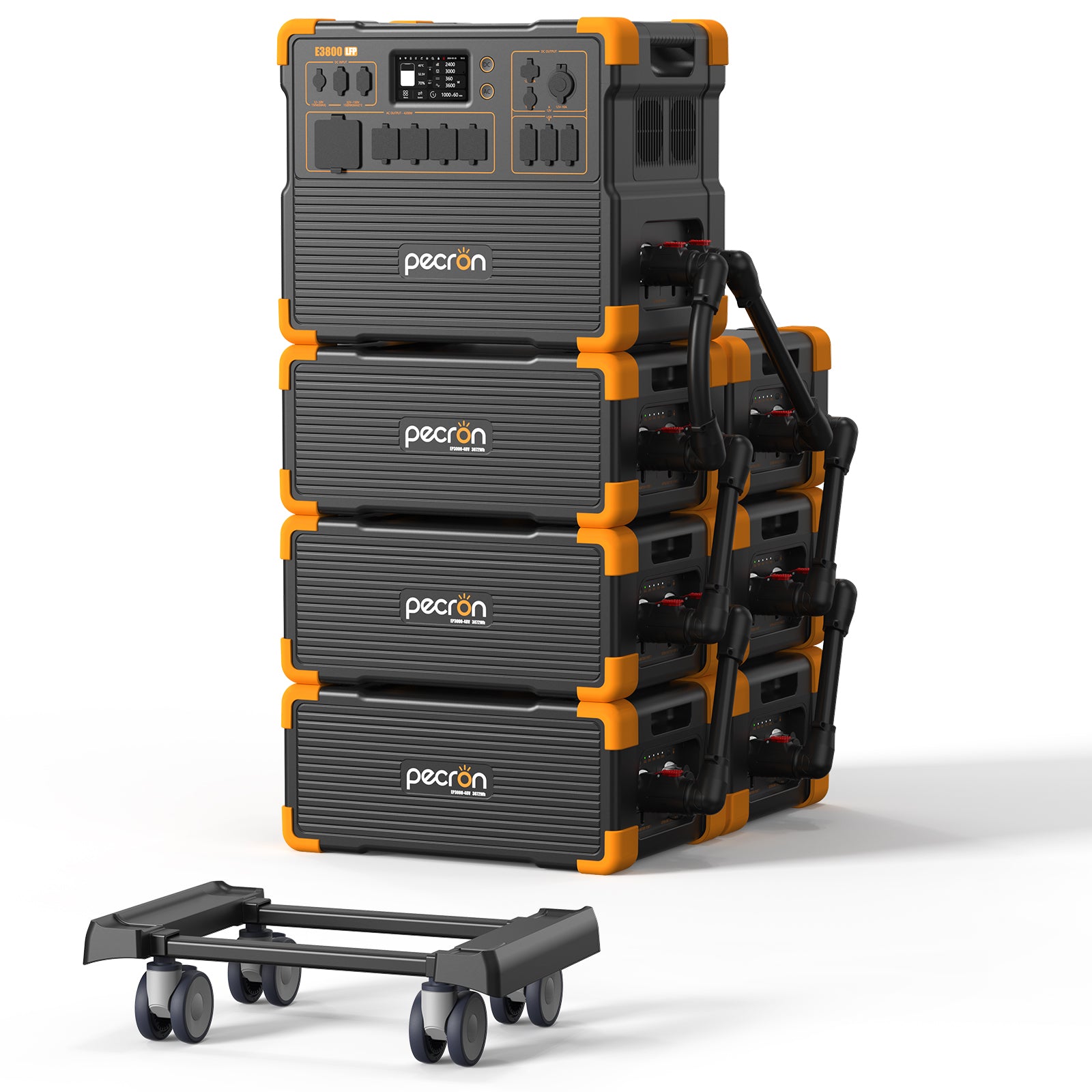
The exact U.S. selected SKU E3800LFP-6*EP3800-48V pairs one E3800LFP station with six EP3800-48V expansion batteries. The combined nameplate total is 26,880 Wh: 3,840 Wh for the host plus six 3,840 Wh packs. Pecron’s E3800 manual identifies six EP3800-48V units as the maximum expansion count for this host. The package is therefore the top documented single-station storage tier—not a multi-inverter or 240 V system.
The limit that matters is still the inverter
More battery modules store more energy, but this package still uses one E3800 inverter rated at 4,200 W AC and 120 V. That rating is the relevant ceiling for simultaneous AC loads; buying the six-pack option will not support an appliance whose required voltage or wattage exceeds the station’s published output. For 240 V or split-phase use, examine the separate configuration built from two E3800 stations and the connection box. Do not mistake a large battery total for a second station.
Its 26.88 kWh capacity is nameplate arithmetic. The saved sources do not state usable AC energy or a run-time result for this exact combination. An estimate for a household or workshop needs the actual load, duty cycle, inverter behavior and recharging schedule. If your plan needs a defined amount of energy rather than the largest available number, compare the five-pack offer at 23,040 Wh and the four-pack at 19,200 Wh first. A smaller system can be easier to site and may already meet the requirement.
A fixed-site system approaching 500 lb
The E3800 station is listed around 87.3 lb and each EP3800-48V around 66.8 lb. Six packs plus the host total approximately 488.1 lb before any connecting leads, cart or other accessory. The listing’s selected-option image shows an E3800 with the battery modules, but it is a manufacturer render and does not establish the cart or cable contents. This system is better approached as fixed-site equipment with a delivery and placement plan than as a portable battery you can move as a whole.
The host manual’s expansion instructions are operational details, not decoration: the cascade connection uses Pecron’s MJ32 cable, the packs are numbered, and the manual discusses balancing state of charge before connecting. The exact six-pack offer does not confirm the required cable’s package inclusion or its retail item code in the archived option data. If those parts must arrive in the same box, that condition remains unverified and should not be assumed from the image.
Charging six batteries is a separate decision
The station manual lists two XT60 solar ports, up to 1,500 W each and 3,000 W combined, with 32–150 V input. The six-pack selected option is battery-only; no panel is included. A large storage reserve can be useful only if the source and schedule to restore it make sense for the intended site. Confirm the array’s voltage and current against Pecron’s limits, the proper leads, and the available AC charging source. The stored-energy figure does not increase the host’s charging ceiling, and no exact charge time is claimed here.
This option suits a narrow type of buyer: someone who can justify the maximum documented one-host capacity, accepts one 120 V/4,200 W output section, and has space for several separate heavy modules. It is not the straightforward choice for travel, quick relocation, 240 V appliances, or a package that must include solar. A four- or five-pack option offers less stored capacity but also less hardware to place, while a two-station configuration addresses a different output requirement altogether.
Bottom line
The six-pack E3800 is the largest documented expansion configuration around a single host. Its 26,880 Wh nameplate total is supported by the manufacturer’s stated component capacities and six-pack compatibility; its inverter remains one 4,200 W, 120 V unit. The combined equipment is about 488.1 lb before accessories, and the saved offer does not prove cable or cart inclusion. The product JSON recorded this U.S. selected variant as available on October 25, 2026, but stock can change. Choose it only when the capacity tier and fixed-site scale both match the plan, then confirm current SKU and box contents.
Key details at a glance
| Nameplate battery capacity | 26880 Wh |
|---|---|
| Rated AC output | 4200 W |
| Maximum solar input | 3000 W |
| Included panels, combined nameplate | 0 W |
| Maximum USB-C output per port | 100 W |
| Listed weight | 87.3 lb |
More specifications and setup details
| Compatible extra-battery expansion | Yes |
|---|---|
| 12 V DC output | 360 W |
| Maximum AC recharge input | 3200 W |
| AC outlet output | Yes |
| USB-C ports | 2 |
| USB-A ports | 4 |
| Solar input ports | 2 |
| 12 V car-style output | 120 W |
| Vehicle charge input | 150 W |
| Battery chemistry | LiFePO4 |
| Expansion battery in this package | Yes |
| Home Power Panel in this package | No |
| Separate station units in offer | 1 |
| Smart Transfer Switch in this package | No |
| Solar panels in exact offer | 0 |
| Included expansion batteries | 6 units |
Use the exact model’s instructions for operating limits, supplied equipment and version differences.
Sources for this assessment

A useful match starts with the loads that matter.
Use the finder for hard electrical requirements, then check appliance starting behavior, actual run time and the exact package in the full assessment.