
On this page
Your needs, this model
Does it fit your priorities?
Will one 120 V E3800LFP with 4,200 W AC and 3,840 Wh nameplate storage suit the required load plan?
The exact selected option retains one E3800LFP host rated for 4,200 W at 120 V and 3,840 Wh nameplate capacity; the panel package does not change either station rating.
Explore this need in the finder →Must the selected offer include at least 6 PV300 panels (1,800 W combined nominal panel nameplate)?
The exact selected SKU E3800LFP-6*PV300 names 6 PV300 panels; 300 W × 6 = 1,800 W combined manufacturer nameplate. This is not a promised harvest.
Explore this need in the finder →Must all 6 supplied panels be confirmed as a supported array with the exact connecting leads?
No. The station and panel manuals establish separate input/connector facts, but the saved selected-option evidence does not establish a supported full-array topology or exact cable contents; unknown cannot satisfy that essential condition.
Explore this need in the finder →Pecron · six-panel E3800LFP option
Pecron E3800LFP with six PV300 panels review
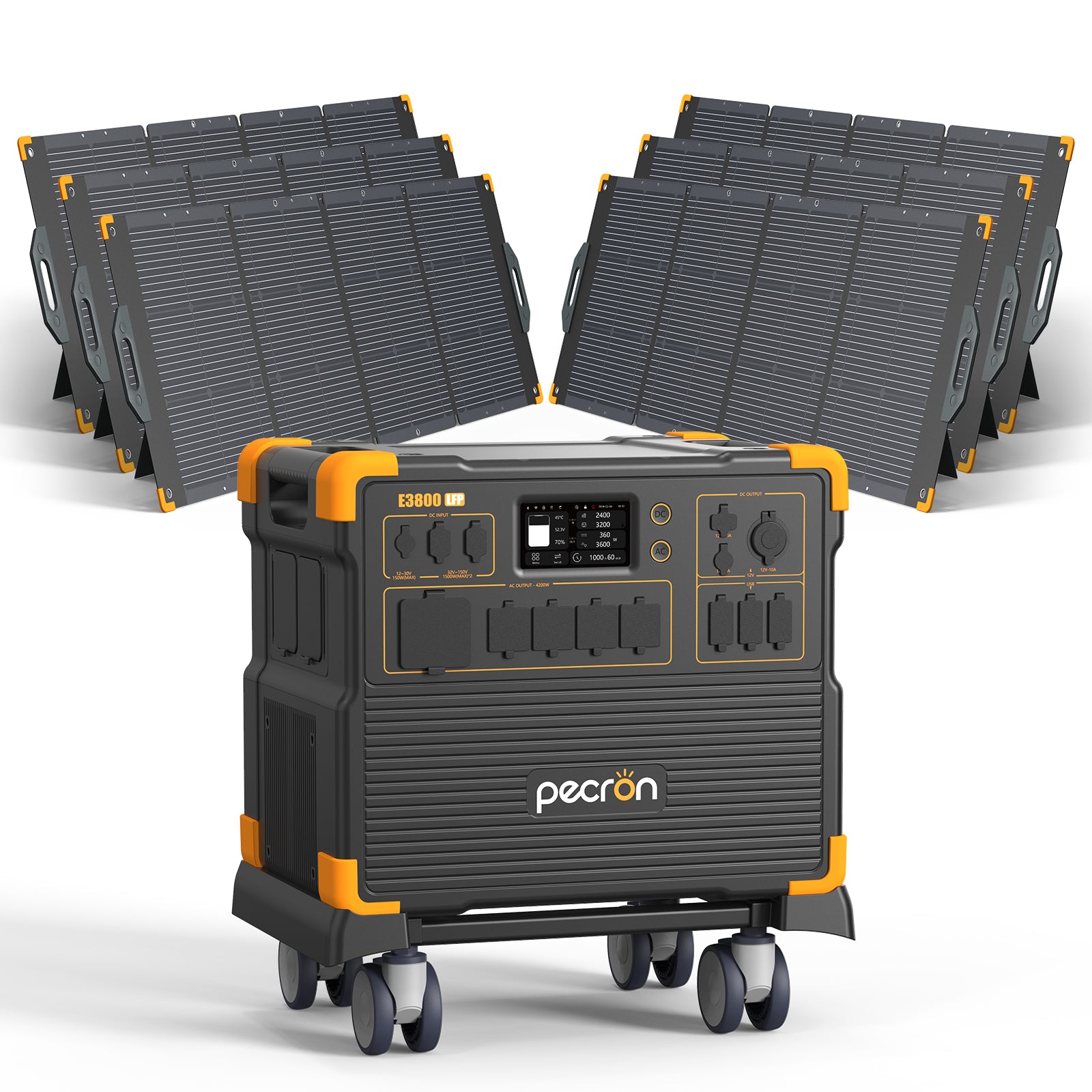
The six-panel selected option on Pecron’s U.S. E3800LFP page is variant 45804485214396, SKU E3800LFP-6*PV300. It is one E3800LFP host with six manufacturer-named PV300 panels. Using the linked panel page’s nominal 300 W rating, the panel nameplate totals 1,800 W. The system is not six stations: its battery stays at 3,840 Wh, and its single inverter is rated 4,200 W at 120 V. This is the largest panel-count option in the captured one-station PV300 group, not the largest possible output or storage arrangement for every E3800 offer.
Six panels only help if the site can use six panels
A six-panel bundle is aimed at a prepared, relatively stationary site with enough clear area to deploy several fold-out surfaces at once and a reason to replenish a large battery in daylight. It may be relevant for an extended outage or a cabin with substantial daytime sun; it is excessive for a buyer who only wants occasional trickle charging. The manufacturer’s exact-option render depicts six panels, but it does not demonstrate panel placement, simultaneous charging, daily energy yield, or the package’s actual accessory list. Four panels total 1,200 W on nameplate and two total 600 W; the six-panel option raises that to 1,800 W without changing the E3800 host.
Large panel-nameplate numbers should not be read as guaranteed solar power. Pecron’s panel manual explains that real output is generally lower than the nominal maximum because of conditions such as irradiance, temperature, dirt, and partial shade. With six surfaces, one obstructed or poorly aimed panel can reduce the usefulness of the overall layout. A plan that depends on all six panels contributing should account for where they will sit, how cables will reach the station without unsafe extension improvisation, and whether the manufacturer approves the proposed array arrangement.
Input capability is not a wiring diagram
The E3800LFP manual lists two XT60 solar inputs, 32–150 V, up to 20 A, and 1,500 W maximum per input, for 3,000 W combined. The PV300 page names the included panel family and calls it 300 W. Its linked manual’s cover calls the unit a 300 W / 36 V panel; the technical table lists model number S300, 36 V operating voltage, 8.3 A current, 41.4 V open-circuit voltage, and an MC4 connector. The exact relation between the page label PV300 and manual model S300 is not proven as a revision-level equivalence. In any case, multiplying panel watts to 1,800 W does not establish how six connectors should be arranged across two station inputs. Series voltage, parallel current, cable selection, and any branch connectors matter.
The manual tells the owner to use an MC4 cable supplied with a Pecron machine and the wiring method from the connected station manual. The captured E3800 selected-option record names a six-panel SKU but is not a package contents list; it does not identify the included MC4-to-XT60 lead or provide a complete six-panel layout. The station’s 3,000 W acceptance ceiling is higher than 1,800 W nameplate, but that alone cannot certify the full array. Ask Pecron for written confirmation of the exact wiring and lead set for variant 45804485214396 before treating this as a complete solar system.
Station limits remain the same
The E3800 manual lists 3,840 Wh, LiFePO4 cells, about 87.3 lb, and the one-host 4,200 W AC rating. It is a substantial backup unit, not a small portable battery; plan placement before delivery and do not assume the pictured cart is included in this selected package. The page heading advertises “with Free Cart,” but no exact variant box list was established for this review. The station remains 120 V. A 240 V requirement calls for a distinct two-station configuration and manufacturer 240 V box, not additional solar panels.
For a 120 V load, first check its continuous draw against 4,200 W and separately plan required watt-hours. The station’s AC usable energy, actual inverter efficiency, and real-world solar recovery are not established by the nameplate figures here. Six panels may improve daylight charging opportunities, but they do not increase the energy already stored when the sun is down and do not make an over-limit load safe.
When this is the right panel tier
If the essential requirement is at least 1,800 W of included panel nameplate, this is the matching exact one-host option in the four-item sequence; the four-panel offer is 1,200 W, while this one adds two more 300 W panels. If you need only the E3800’s 3,000 W input capability and prefer to choose the array yourself, the station-only SKU may be the clearer purchase—but its exact solar lead remains a separate question. If all six supplied panels must be known to work together, or a precise adapter must be in the box, this option does not yet clear that hard condition from the archived evidence. It suits an owner who has the space and is willing to verify electrical compatibility before relying on the full panel count.
Key details at a glance
| Nameplate battery capacity | 3840 Wh |
|---|---|
| Rated AC output | 4200 W |
| Maximum solar input | 3000 W |
| Included panels, combined nameplate | 1800 W |
| Maximum USB-C output per port | 100 W |
| Listed weight | 87.3 lb |
More specifications and setup details
| Compatible extra-battery expansion | Yes |
|---|---|
| 12 V DC output | 360 W |
| Maximum AC recharge input | 3200 W |
| AC outlet output | Yes |
| USB-C ports | 2 |
| USB-A ports | 4 |
| Solar input ports | 2 |
| 12 V car-style output | 120 W |
| Vehicle charge input | 150 W |
| Battery chemistry | LiFePO4 |
| Expansion battery in this package | No |
| Home Power Panel in this package | No |
| Separate station units in offer | 1 |
| Smart Transfer Switch in this package | No |
| Solar panels in exact offer | 6 |
| Included expansion batteries | 0 units |
Use the exact model’s instructions for operating limits, supplied equipment and version differences.
Sources for this assessment

A useful match starts with the loads that matter.
Use the finder for hard electrical requirements, then check appliance starting behavior, actual run time and the exact package in the full assessment.