
On this page
Your needs, this model
Does it fit your priorities?
Will one 120 V E3800LFP with 4,200 W AC and 3,840 Wh nameplate storage suit the required load plan?
The exact selected option retains one E3800LFP host rated for 4,200 W at 120 V and 3,840 Wh nameplate capacity; the panel package does not change either station rating.
Explore this need in the finder →Must the selected offer include at least 1 PV300 panels (300 W combined nominal panel nameplate)?
The exact selected SKU E3800LFP-PV300 names 1 PV300 panels; 300 W × 1 = 300 W combined manufacturer nameplate. This is not a promised harvest.
Explore this need in the finder →Must all 1 supplied panels be confirmed as a supported array with the exact connecting leads?
No. The station and panel manuals establish separate input/connector facts, but the saved selected-option evidence does not establish a supported full-array topology or exact cable contents; unknown cannot satisfy that essential condition.
Explore this need in the finder →Pecron · one-panel E3800LFP option
Pecron E3800LFP with one PV300 panel review
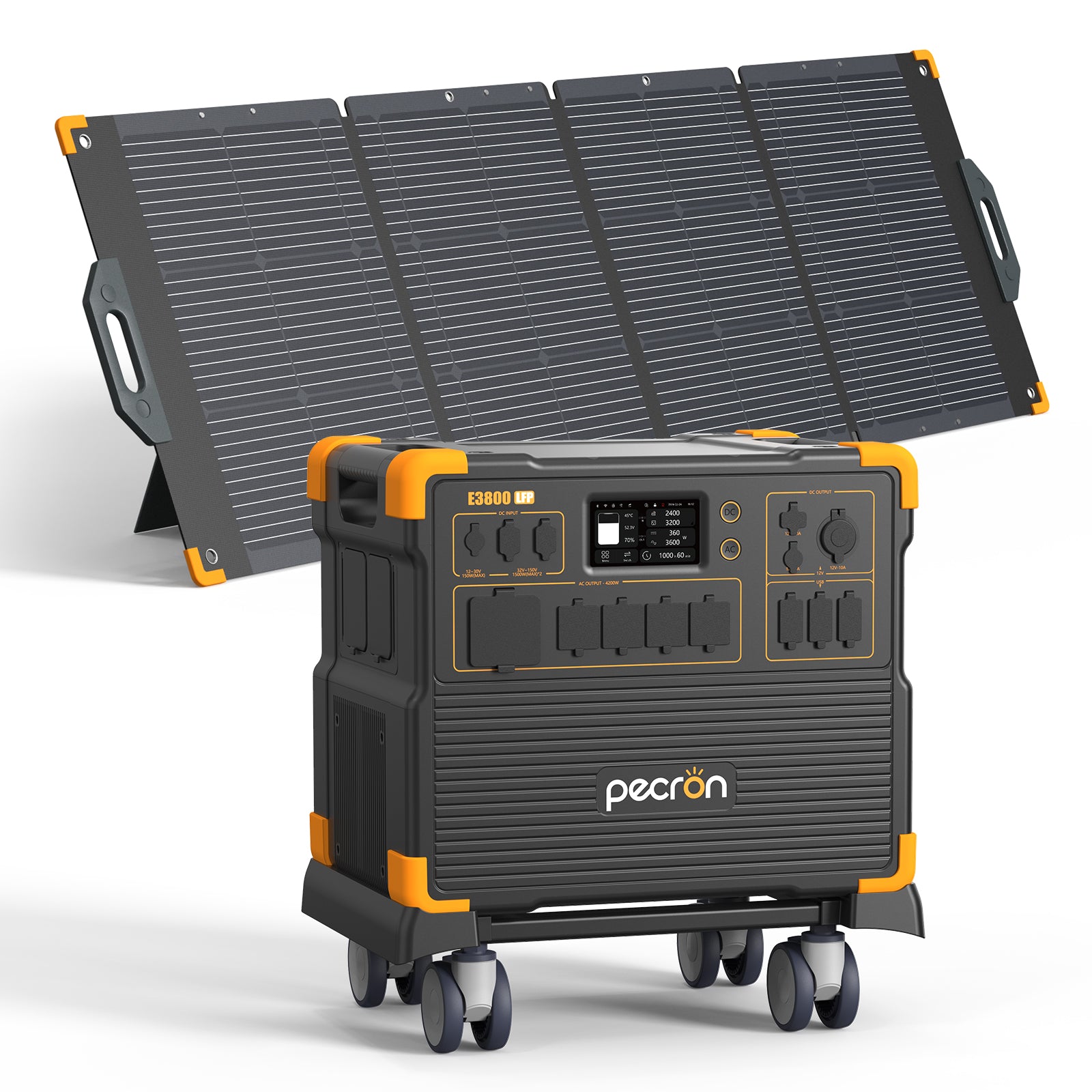
This is the one-panel selection on Pecron’s U.S. E3800LFP page: product 9160921841852, variant 45804485116092, SKU E3800LFP-PV300. The station remains a single E3800LFP, not a second unit or a 240 V system. Its manual lists 3,840 Wh of LiFePO4 nameplate capacity and 4,200 W AC output at 100–120 V. The selected option adds one manufacturer-named PV300 panel, rated 300 W on the linked panel page. Those are separate quantities: a panel does not add stored watt-hours or raise the inverter ceiling.
One panel is a modest addition to a large station
The E3800’s 3,840 Wh battery is large enough to make one 300 W panel feel like a slow replenishment source rather than a promise of rapid recovery. In ideal conditions, solar power arrives only while the panel is producing; household shade, clouds, panel angle, heat, and conversion losses all reduce real output. Pecron’s own panel manual says actual output is generally below the nominal rating. Nothing in this selected option supports a runtime estimate or a guaranteed daily charge total. For a fridge, communications gear, and intermittent small loads, one panel can be a useful daytime contribution. For a deep discharge followed by a quick recharge deadline, this configuration is a poor fit unless the buyer already has another charging plan.
Use the station’s ratings to decide whether the loads fit before focusing on solar. The E3800LFP’s 4,200 W is a rated AC output, not an energy budget, and the 3,840 Wh battery is nameplate capacity rather than measured usable AC energy. A load near the output ceiling can still run the battery down quickly. The unit itself weighs about 87.3 lb and measures 17.5 × 12.1 × 14.7 in in the manual, so it is better treated as a placed backup appliance than as a casual campsite carry.
What the panel evidence does and does not settle
The exact Pecron bundle SKU names PV300, and its product-page title calls the panel a 300 W PV300. The associated manual is linked from that page, but its technical table identifies the panel as “S300.” That manual lists 300 W nominal power, 36 V operating voltage, 8.3 A operating current, 41.4 V open-circuit voltage, and an MC4 connector. I preserve the naming difference instead of claiming a proven revision-level alias. The same source describes IP67 protection for the panel; do not extend that rating to the E3800 station or its connectors.
The E3800 manual describes two XT60 solar inputs, each rated up to 1,500 W, with a 32–150 V range and 20 A maximum current; its separate low-voltage input is capped at 150 W. A single panel’s listed operating voltage is above 32 V, but that fact alone does not prove every adapter, lead, and selected-option box item is present. The panel manual says to use an MC4 cable supplied with a Pecron machine and to follow the power-station manual’s wiring method; the saved option record does not identify the exact E3800 lead or a supported panel-array layout. Confirm the exact cable and manufacturer-approved connection plan before relying on solar as an essential function.
Who should choose this offer
Choose the one-panel option if you want the E3800’s single-host 120 V backup capacity and need at least one panel included, but your solar plan is intentionally modest or you will source a separately documented array later. It is easier to reason about than a larger bundle when the actual requirement is “one known 300 W panel,” not “all the station’s solar input potential.” The captured product JSON marked this option available on October 25, 2026; that archived bit is not live inventory or a price quote.
For more panel nameplate, the same page offers two, four, and six PV300 options at 600, 1,200, and 1,800 W combined, respectively. Choose the two-panel version when 600 W is enough; the four- and six-panel versions buy more rated array capacity at the cost of more panels to unfold, place, and store. Each retains the same 3,840 Wh battery and 4,200 W output. The manufacturer image also shows a cart, while the page title advertises a free cart; because the saved selected-option evidence is not a box-content list, confirm cart and lead contents rather than using the picture as proof.
How priorities change the fit
A 120 V requirement, 4,200 W AC floor, and 3,840 Wh nameplate floor are all consistent with the one-station plan. “Solar input essential” is also met at the station level: the E3800 accepts up to 3,000 W through its high-voltage inputs. But an “included panel essential” choice finds only 300 W here, and a minimum panel-nameplate request above 300 W points to another exact package. If the requirement is a confirmed all-panels-together array or an in-box station-side cable, the sources leave that condition unknown; unknown is not a safe yes. If you need 240 V, select a documented two-station configuration instead. This package is best understood as a large 120 V station with one panel—not as a complete solar system.
Key details at a glance
| Nameplate battery capacity | 3840 Wh |
|---|---|
| Rated AC output | 4200 W |
| Maximum solar input | 3000 W |
| Included panels, combined nameplate | 300 W |
| Maximum USB-C output per port | 100 W |
| Listed weight | 87.3 lb |
More specifications and setup details
| Compatible extra-battery expansion | Yes |
|---|---|
| 12 V DC output | 360 W |
| Maximum AC recharge input | 3200 W |
| AC outlet output | Yes |
| USB-C ports | 2 |
| USB-A ports | 4 |
| Solar input ports | 2 |
| 12 V car-style output | 120 W |
| Vehicle charge input | 150 W |
| Battery chemistry | LiFePO4 |
| Expansion battery in this package | No |
| Home Power Panel in this package | No |
| Separate station units in offer | 1 |
| Smart Transfer Switch in this package | No |
| Solar panels in exact offer | 1 |
| Included expansion batteries | 0 units |
Use the exact model’s instructions for operating limits, supplied equipment and version differences.
Sources for this assessment

A useful match starts with the loads that matter.
Use the finder for hard electrical requirements, then check appliance starting behavior, actual run time and the exact package in the full assessment.