
Your needs, this model
Does it fit your priorities?
Can one station provide 4,200 W at 120 V with 3,840 Wh of storage?
The standalone plan is rated for 4,200 W at 120 V and 3,840 Wh; the output rating is not runtime.
Explore this need in the finder →Is a 3,000 W solar ceiling enough for a two-port array?
Pecron lists two XT60 inputs at up to 1,500 W each and 32–150 V; panels and compatible cabling are separate.
Explore this need in the finder →Do you want to expand later without needing a second station for 240 V?
The product page specifies up to six EP3800-48V batteries. They are separate from the standalone SKU; two stations and a box are a different 240 V configuration.
Explore this need in the finder →Pecron · high-capacity 120 V station
Pecron E3800LFP review
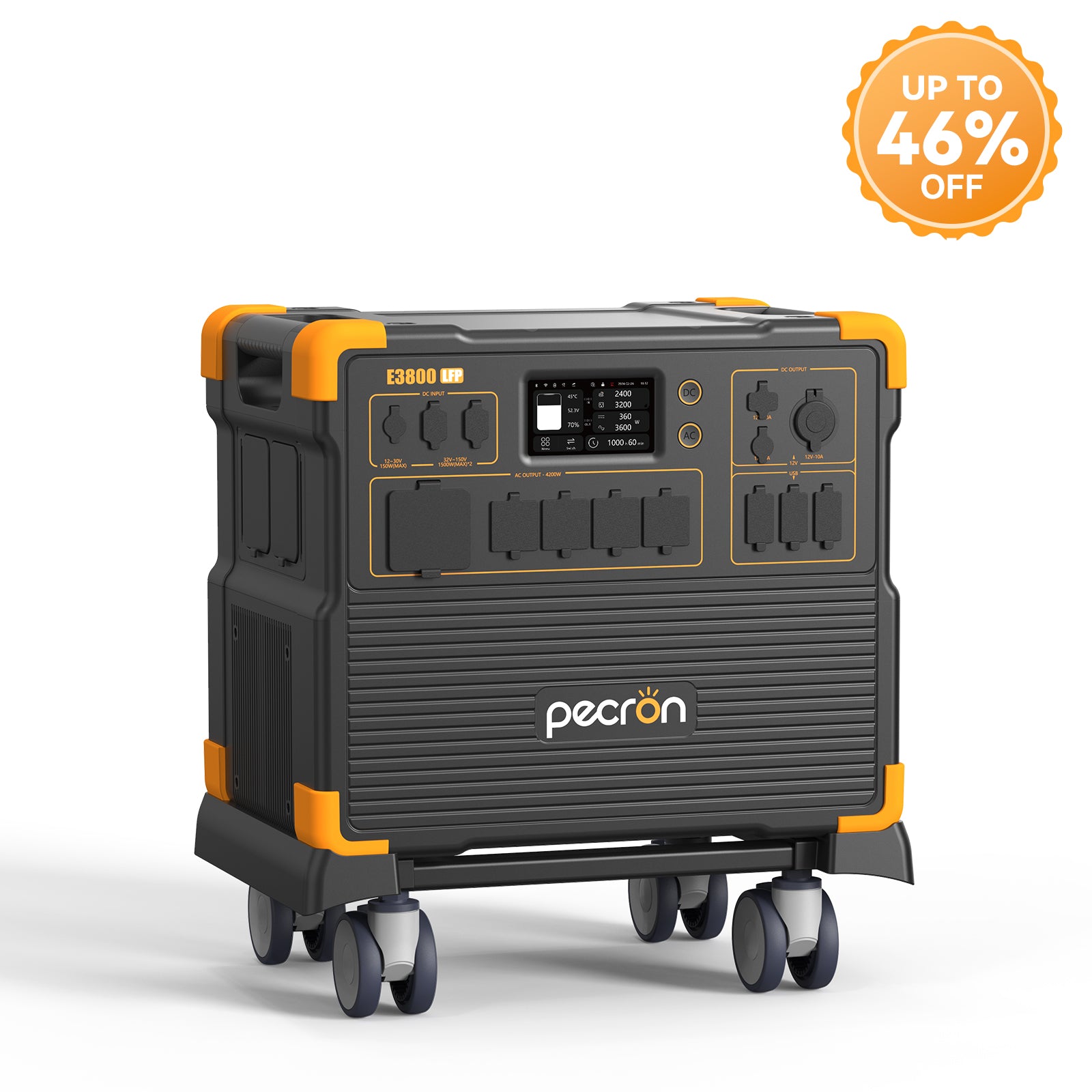
The E3800LFP pairs a 3,840 Wh LiFePO4 battery with a 4,200 W inverter. That is a substantial one-unit 120 V backup source, but this is a stationary-style, heavy machine rather than a pack you casually move between a campsite and the car. The manufacturer lists about 87.3 lb before any separate accessories. Buy it for the output, stored energy and expansion route—not because a large watt figure promises a particular number of hours.
What the single station can and cannot do
Pecron rates one E3800LFP for up to 4,200 W at 120 V and describes its inverter as bidirectional pure sine wave. The manual and product page identify an AC 30 A output, 12 V DC output up to 30 A, a 12 V car-style socket, DC5525, four USB-A ports and USB-C outputs up to 100 W. Do not treat those independent port labels as a guarantee that every port can deliver its maximum at once. Check the exact appliance's starting demand and connector, and leave room for the station's operating limits.
One unit is not a 240 V station. Pecron's product page describes a different plan using two E3800LFP units and its 240 V Connect Box for up to 8,400 W at 240 V. That means two batteries, two station bodies, a connection box, compatible cabling and a different installation plan. The regular E3800LFP option is the single 120 V station; it should not match a buyer whose essential load needs 240 V just because another configuration appears on the same sales page.
High recharge ceiling, with careful component matching
The page lists up to 3,000 W of solar input through two XT60 ports, each accepting up to 1,500 W over its published 32–150 V window. That is a high ceiling for a portable-station class, but a compatible array and the right cabling are separate purchases unless the exact selected solar-kit option says otherwise. A panel's open-circuit voltage must remain in Pecron's allowed range; do not choose panels by adding their printed wattages alone. The product page also lists a 150 W DC5521 input, while its headline solar figure is 3,000 W, so the 3,000 W figure is the conservative total to use for this station profile.
For wall charging, Pecron lists up to 3,200 W on a 30 A lead and 1,800 W with a 15 A lead. It currently advertises a free 30 A lead and cart during the sale, but these are offer-level terms rather than an inherent model capability. The product image shows the station on a trolley; verify the selected package before counting the cart or cable. The official [E3800LFP manual](https://cdn.shopify.com/s/files/1/0509/5263/4556/files/PECRON_E3800LFP_user_manual_100V_120V_-20251201.pdf?v=1769744832) should be consulted before combining charging inputs or using the expansion connector.
Expand only with the documented system
Pecron says the E3800LFP can connect up to six EP3800-48V expansion batteries, reaching a stated total of 26,880 Wh. Those packs are not part of the standalone SKU. At that point the purchase is a multi-piece energy system with a large cumulative footprint, not a simple portable battery. The manual lists a 3840 Wh main pack, 51.2 V/75 Ah LiFePO4 cells and a manufacturer cycle-life claim of 3,500-plus cycles to 80% capacity. These are published specifications, not a measured runtime or independent cycle test.
The station also advertises UPS behavior, app and Bluetooth control and built-in automation. Treat a UPS label as a feature to verify against the actual connected equipment: the product page does not justify a blanket promise that every computer, pump or medical device will ride through a changeover. For critical gear, follow the manual, check the equipment maker's tolerance and test the exact combination. This is not a substitute for a properly designed transfer switch or a licensed electrician when connecting household circuits.
Who should compare it with something else?
The E3800LFP makes the most sense for a user with several demanding 120 V loads, a place to keep an 87 lb unit and a plan to recharge it quickly or expand it. A cabin, workshop or substantial emergency kit is a more natural setting than backpacking. The 3,840 Wh nameplate capacity is still not the same as energy delivered to an AC appliance; conversion losses, the load, temperature and battery state all affect runtime. Size the station from a real load list and desired hours instead of translating 4,200 W into hours.
For a less heavy 3,072 Wh option, compare the E3600LFP: it gives up some capacity and inverter rating but has a dual-input solar ceiling of 2,400 W. The F3000LFP has the same 3,072 Wh and 3,600 W ratings in a different 120 V design, with a lower 1,600 W solar-input limit and an expansion-model conflict to resolve. If you need 240 V from one station rather than the E3800's two-unit system, the F5000LFP is the closer comparison, but it is heavier and its 240 V neutral and installation details deserve careful review. The E3800 is a strong match only when its actual single-unit 120 V plan and the space, weight and selected package fit your use.
Key details at a glance
| Nameplate battery capacity | 3840 Wh |
|---|---|
| Rated AC output | 4200 W |
| Maximum solar input | 3000 W |
| Included panels, combined nameplate | 0 W |
| Maximum USB-C output per port | 100 W |
| Listed weight | 87.3 lb |
| Compatible extra-battery expansion | Yes |
| 12 V DC output | 360 W |
| Maximum AC recharge input | 3200 W |
| AC outlet output | Yes |
| USB-C ports | 2 |
| USB-A ports | 4 |
| Solar input ports | 2 |
| 12 V car-style output | 120 W |
| Vehicle charge input | 150 W |
| Battery chemistry | LiFePO4 |
| Expansion battery in this package | No |
| Home Power Panel in this package | No |
| Separate station units in offer | 1 |
| Smart Transfer Switch in this package | No |
| Solar panels in exact offer | 0 |
Use the exact model’s instructions for operating limits, supplied equipment and version differences.
Sources for this assessment

A useful match starts with the loads that matter.
Use the finder for hard electrical requirements, then check appliance starting behavior, actual run time and the exact package in the full assessment.