
On this page
Your needs, this model
Does it fit your priorities?
Do you need a solar panel to be named in the exact station option?
The selected E500LFP-PV100 option names a 100 W panel and the SKU bridges to PECRON PV100; total kit weight and exact cable contents remain unconfirmed.
Explore this need in the finder →Will the E500LFP’s 576 Wh and 600 W AC ceiling fit the devices you plan to run?
Its 120 V AC plan is rated at 600 W and its station battery is 576 Wh. Capacity is doubled versus E300, but the AC ceiling is not.
Explore this need in the finder →Must the included panel be confirmed to work within the station’s exact published voltage limit?
The selected panel option is known, but Pecron’s station voltage documents conflict and the exact bundle cable/compatibility is not confirmed. If this is essential, verify the exact revision and cable before relying on it.
Explore this need in the finder →Pecron · 576 Wh station and PV100 selection
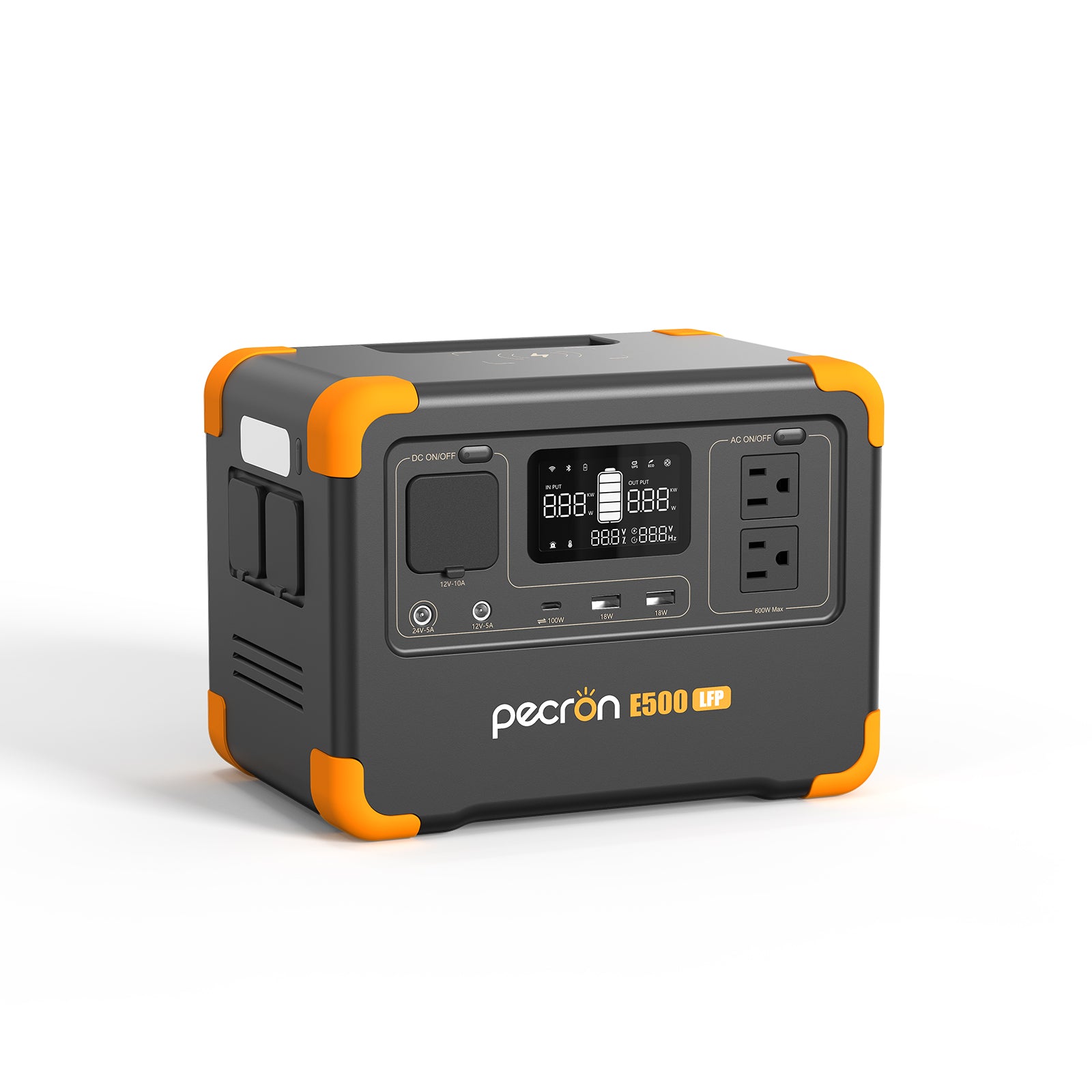
Pecron E500LFP + 100 W Solar Panel review
The U.S. E500LFP page offers a separate “E500LFP-100W Solar Panel” choice. Its selected Shopify variant is 44050347393212, SKU E500LFP-PV100. That SKU is a useful bridge to Pecron’s separate PV100 panel page, so this review treats the station-plus-PV100 offer as a distinct package rather than silently folding it into the station-only E500LFP. The manufacturer’s JSON marked this selected option unavailable on October 25, 2026; it remains relevant for exact-model comparison, but this record does not promise current stock.
Same 600 W AC output, twice the E300’s battery
The E500’s main advantage over the E300LFP is storage: Pecron lists 576 Wh rather than 288 Wh, while both units retain the same 600 W, 100–120 V pure-sine AC ceiling and 100 W solar input limit. That makes the E500 the more sensible of the two for longer light-duty sessions when its added weight and size are acceptable. It does not power a larger AC appliance merely because it has a bigger battery. Actual runtime depends on the connected load, conversion losses and operating conditions; there is no lab runtime measurement or guaranteed usable AC-energy figure here.
The station also provides one USB-C output up to 100 W, two USB-A ports rated up to 18 W each, a 12 V/10 A car-style outlet, 24 V/5 A and 12 V/5 A barrel outputs, and a 15 W wireless charger. Check the input and voltage each device requires, and do not add the individual port peaks as if every output could deliver its maximum simultaneously. There is no documented 240 V/split-phase output, and a compatible expansion battery for this exact U.S. offer is not established.
The named PV100 is a modest, specific panel
Unlike the E300LFP-100W option, the E500 package SKU includes the PV100 model code. Pecron’s U.S. PV100 product page identifies a foldable monocrystalline 100 W panel with a DC5521 output; it publishes 19.4 V at maximum power, 5.4 A at maximum power, and 24.5 V open circuit, each with a ±5% notation. The same page lists IP67 and about 3.5 kg with the adapter cable. Those are manufacturer specifications, not a measured solar yield. A 100 W panel is useful for topping up modest loads when sun and placement cooperate, but it is not a high-input array and cannot remove the E500’s 100 W station-side limit.
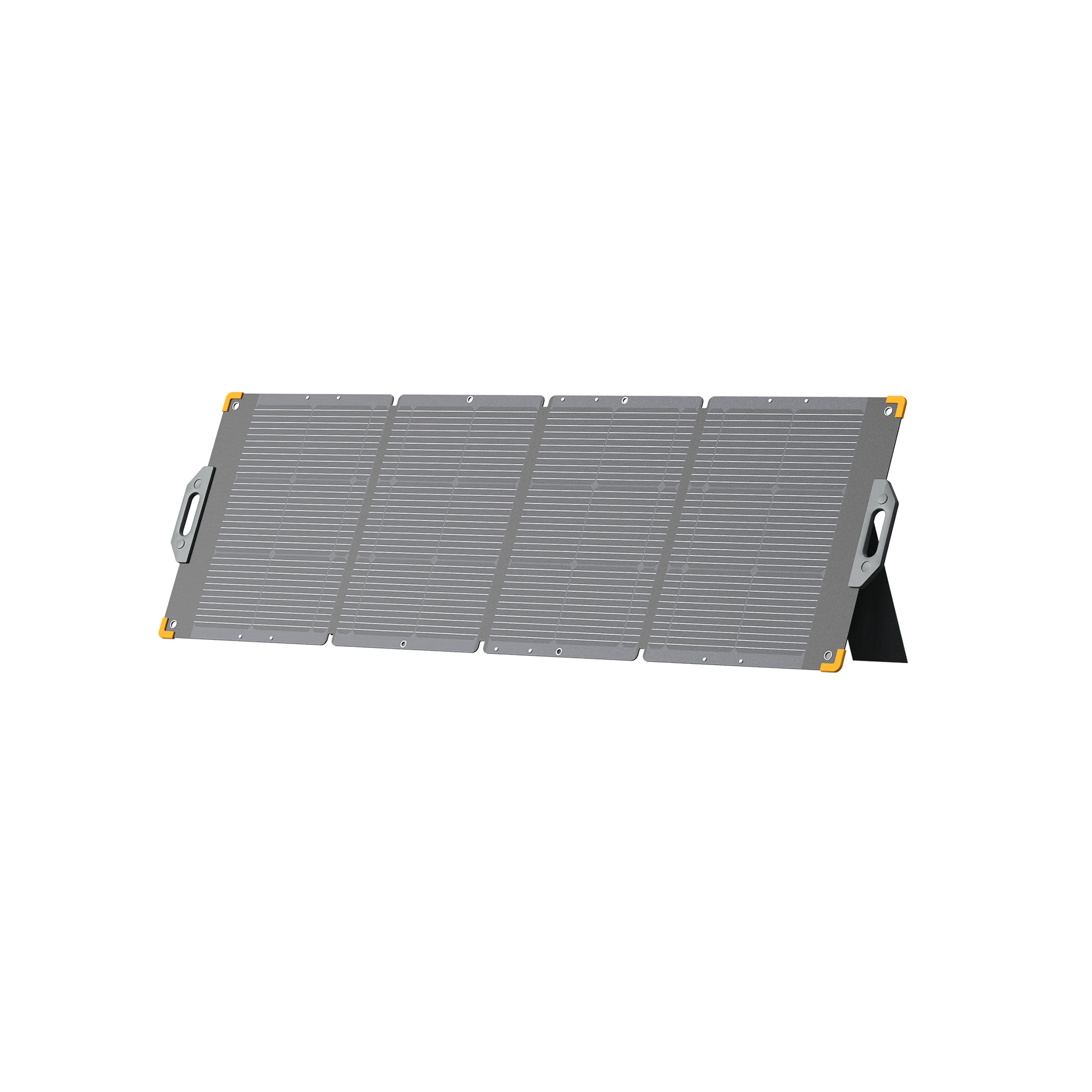
Image source and model notes
The E500 solar input also uses DC5521 and is rated up to 100 W. The published voltage limit needs care: the E500 manual/specification gives 12–28 V, whereas the product-page FAQ says Voc 12–25 V. PV100’s nominal Voc is 24.5 V with a ±5% notation, so it can approach or exceed the lower FAQ ceiling. Although the manufacturer sells this selected bundle and the connectors are named, the conflicting voltage statements keep a strict “all included panels are confirmed inside the station limit” condition from being fully resolved here. Confirm the exact revision’s input ceiling and required cable before relying on a must-work solar setup.
Weight, contents and revision caveats
Do not use this bundle as a hard weight-limit match. The current E500 product page gives the station as 15 lb, while the 2026 manual says around 14 lb; the listed dimensions differ too. PV100’s separate page gives panel weight with adapter cable, but the exact selected package’s total weight and full contents list are not published in the captured option record. The station-only manual says its solar lead is sold separately, which does not establish whether the panel package adds a compatible lead. The main image shows the E500 station; the PV100 appears separately above, not as a photograph of the kit packed together.
There is also an E500 documentation revision difference worth preserving: the current product copy and newer manual-library edition list up to 100 W USB-C charging input, while the older 2024 manual linked from the product page does not list USB-C charging input. Confirm the manual that ships with any specific unit rather than assuming the newer input applies to every revision. The manuals describe UPS changeover in an 8–20 ms range and caution against devices requiring zero interruption. The E500 is not a zero-transfer UPS.
Who should choose this exact package?
Choose it only if a 576 Wh, 600 W station fits the loads and the PV100 option is more useful than buying the station alone. A “panel included” requirement and a 100 W minimum fit the named package; a higher panel minimum does not. If you need the panel and station to be confirmed together at a strict voltage limit, need a specific solar cable in the box, want a hard total-kit weight, or require battery expansion or 240 V, this assessment cannot confirm those needs. The E500 makes more sense than the E300 when extra nameplate storage matters but the 600 W output cap is still sufficient. For a larger appliance ceiling, substantially faster charging or a verified home-backup system, compare a larger station whose operating plan meets the actual requirement rather than stretching this compact unit beyond its documented limits.
Key details at a glance
| Nameplate battery capacity | 576 Wh |
|---|---|
| Rated AC output | 600 W |
| Maximum solar input | 100 W |
| Included panels, combined nameplate | 100 W |
| Maximum USB-C output per port | 100 W |
| 12 V DC output | 120 W |
More specifications and setup details
| Maximum AC recharge input | 500 W |
|---|---|
| Manufacturer UPS transfer figure | 20 ms |
| AC outlet output | Yes |
| USB-C ports | 1 |
| USB-A ports | 2 |
| Solar input ports | 1 |
| 12 V car-style output | 120 W |
| Vehicle charge input | 100 W |
| Battery chemistry | LiFePO4 |
| Solar panels in exact offer | 1 |
Use the exact model’s instructions for operating limits, supplied equipment and version differences.
Sources for this assessment
A useful match starts with the loads that matter.
Use the finder for hard electrical requirements, then check appliance starting behavior, actual run time and the exact package in the full assessment.