
Your needs, this model
Does it fit your priorities?
Does your load need 600 W AC with more than 500 Wh of nameplate storage?
The E500LFP standalone plan lists 576 Wh and two 100–120 V AC outlets rated 600 W. Nameplate capacity is not a guaranteed AC energy measurement or runtime promise.
Explore this need in the finder →Will a solar system capped at 100 W meet your recharge requirement without a panel in the box?
The station supports up to 100 W solar input, but the standalone package has no panel or solar charging lead. The compatible panel voltage range needs confirmation because the official sources conflict.
Explore this need in the finder →Can you accept a documented UPS transfer upper bound of 20 ms?
The exact manual gives an 8–20 ms changeover range and says a zero-millisecond transition is unavailable. The 20 ms value is a conservative upper bound, not a claim of seamless power.
Explore this need in the finder →Pecron · compact AC station
Pecron E500LFP review
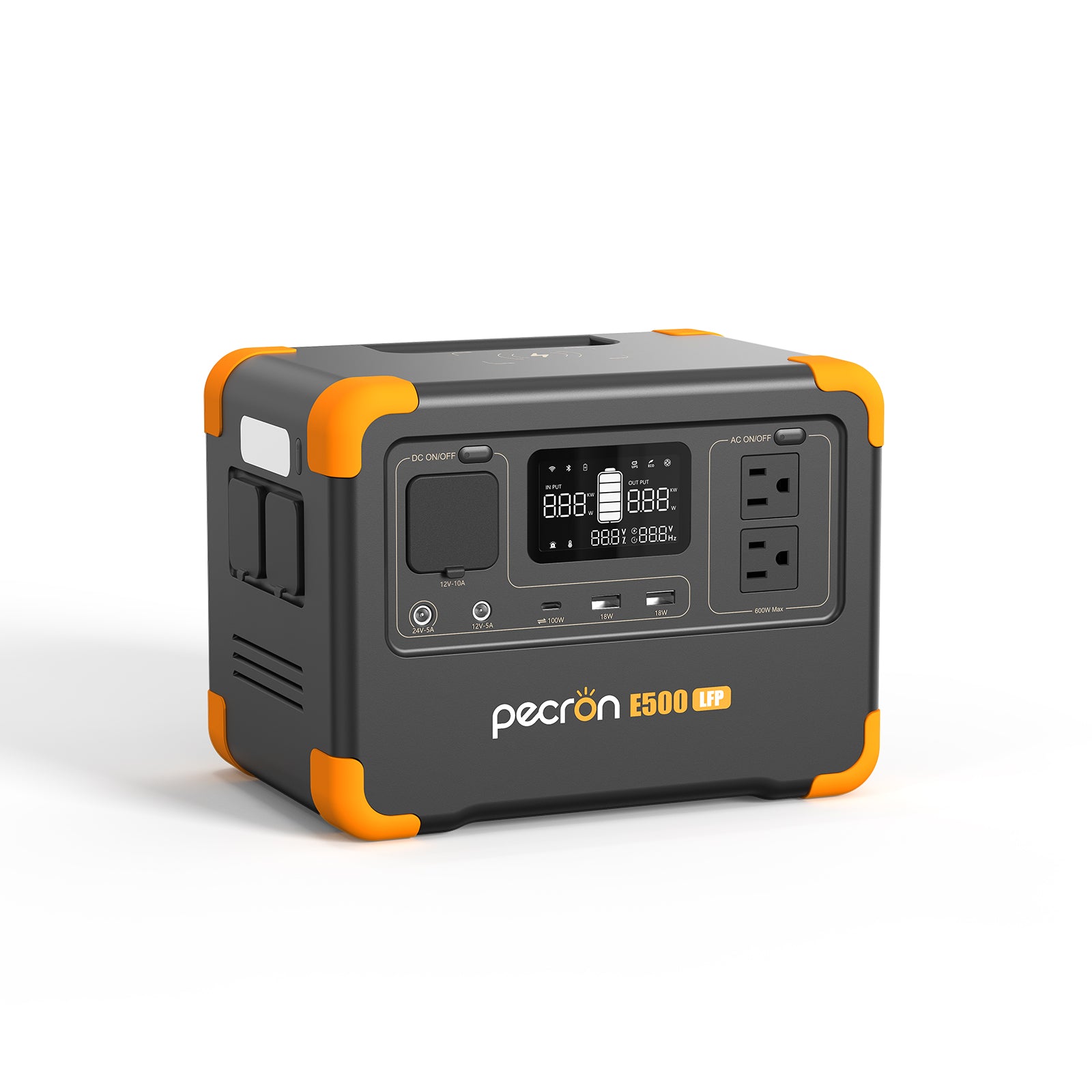
The E500LFP keeps the E300LFP's 600 W pure-sine AC ceiling but doubles its nameplate battery from 288 Wh to 576 Wh. That makes it the more useful of the two when you need longer light-duty sessions, while the inverter rating stays the same. Pecron's product page showed the standalone option out of stock when checked on October 25, 2026. A sold-out listing remains relevant for comparing or revisiting the exact model, but this review does not imply current availability.
More reserve, not a bigger appliance limit
Pecron rates the U.S. E500LFP at 600 W AC, with two 100–120 V pure-sine outlets. The 576 Wh nameplate capacity gives it twice the stored energy of the E300 on paper, but it does not turn a 600 W inverter into a high-draw appliance supply. Runtime depends on the load and conversion losses; there is no independent lab runtime figure here. Check startup draw for compressors and motors, and keep any AC load below the manual's 600 W ceiling. The published AC rating should not be confused with a surge rating.
The unit also has two USB-A ports rated up to 18 W each, one USB-C port with up to 100 W output, a 15 W wireless charger, one 12 V/10 A car-style outlet, and 24 V/5 A and 12 V/5 A barrel outputs. USB-C input is listed at up to 100 W in the current product description and in Pecron's newer manual-library file. That detail needs attention: the current product page still links an older 2024 manual that documents 100 W USB-C output but does not list USB-C charging input. The 2026 manual-library edition adds a 100 W USB-C input. If an individual unit's supplied documentation differs, verify the revision and charging behavior with Pecron instead of assuming all E500LFP units support the newer input specification.
Charging and package choice
The station-only U.S. variant is SKU E500LFP. Its package list names the station, AC charging cable, car charging cable, user manual and accessories bag. It does not list a solar panel or the station-side solar cable. A separate E500LFP-100W Solar Panel option is shown on the product page; the offer name identifies a 100 W panel class but not the exact panel model. The review and matcher therefore describe the standalone configuration only. If a supplied panel is essential, inspect the exact offer and included-items list before choosing that separate package.
AC charging is rated up to 500 W, with Pecron advertising 80% in 60 minutes and full charge in 90 minutes. Solar input is limited to 100 W through the DC5521 connector; vehicle input is listed at up to 100 W. The manual says the solar cable is sold separately and permits combined AC, DC and USB-C charging only within a 500 W total charging ceiling. Voltage documentation is inconsistent: the spec table and current manual say 12–28 V solar Voc, but the FAQ on the product page says 12–25 V. Treat the 100 W ceiling as established, but do not assume a panel close to the upper voltage edge is suitable without manufacturer confirmation.
How your answers affect fit
A 120 V AC requirement and a 600 W continuous-output threshold fit the documented standalone operating plan. A capacity minimum above 576 Wh, a solar-input minimum above 100 W, or a required in-box solar lead will exclude it. The standalone offer does not include a panel, and Pecron's solar lead is separately purchased. Battery chemistry is identified as LiFePO4; the manufacturer claims 3,500 cycles to at least 80% capacity, which is a published claim rather than a promise about any particular unit's lifespan. The manufacturer does not confirm a compatible expansion-battery plan for this exact configuration, so an essential future-expansion requirement should not return this station as a match.
The manual describes UPS use with a transfer interval of 8–20 ms, not zero milliseconds. Pecron says not to connect equipment that needs zero transfer, calls out servers and workstations, and recommends testing compatibility. If a short interruption is unacceptable, use equipment with an independently specified tolerance or a properly specified online UPS system. The station is not a 240 V/split-phase source.
Important size and revision caveats
Do not rely on a numerical weight limit for this listing: the current U.S. product page says 15 lb (6.8 kg), while the latest manual-library manual says around 14 lb (6.75 kg). Their dimensions differ too: the page lists 252 × 170 × 187 mm and the manual lists 254 × 172 × 189 mm. The published records are close, but they are still conflicting, so exact weight and dimensions remain unmatched. The manual also says the station is not waterproof and gives a 32–113°F charging range and −4–113°F discharging range. Keep it dry and leave its ventilation openings clear.
Compared with the E300LFP, the E500's case is straightforward: twice the nameplate capacity and a higher AC recharge ceiling, with the same 600 W output limit and same 100 W solar ceiling. That is attractive for a longer camping or backup session if the load stays modest. If your priority is lower carried weight, the E300 has a manufacturer-stated 10.6 lb mass; if your priority is a guaranteed weight cap, the E500's conflicting listings mean neither a hard weight match nor an exact carry judgment is supported. If your appliances exceed 600 W, your 240 V requirement is firm, or you need high solar charging, look beyond both models and verify a larger station against the actual load. Neither capacity number alone predicts how long your specific devices will run.
Key details at a glance
| Nameplate battery capacity | 576 Wh |
|---|---|
| Rated AC output | 600 W |
| Maximum solar input | 100 W |
| Included panels, combined nameplate | 0 W |
| Maximum USB-C output per port | 100 W |
| 12 V DC output | 120 W |
| Maximum AC recharge input | 500 W |
| Manufacturer UPS transfer figure | 20 ms |
| AC outlet output | Yes |
| USB-C ports | 1 |
| USB-A ports | 2 |
| Solar input ports | 1 |
| 12 V car-style output | 120 W |
| Vehicle charge input | 100 W |
| Battery chemistry | LiFePO4 |
| Solar panels in exact offer | 0 |
Use the exact model’s instructions for operating limits, supplied equipment and version differences.
Sources for this assessment
A useful match starts with the loads that matter.
Use the finder for hard electrical requirements, then check appliance starting behavior, actual run time and the exact package in the full assessment.