
Your needs, this model
Does it fit your priorities?
Will the F1000LFP's fixed 960 Wh and 1,500 W output suit your 120 V load?
This offer retains one 120 V F1000LFP rated at 1,500 W AC and 960 Wh; panel count does not increase the inverter or battery.
Explore this need in the finder →Must the exact box include at least 400 W of panel nameplate?
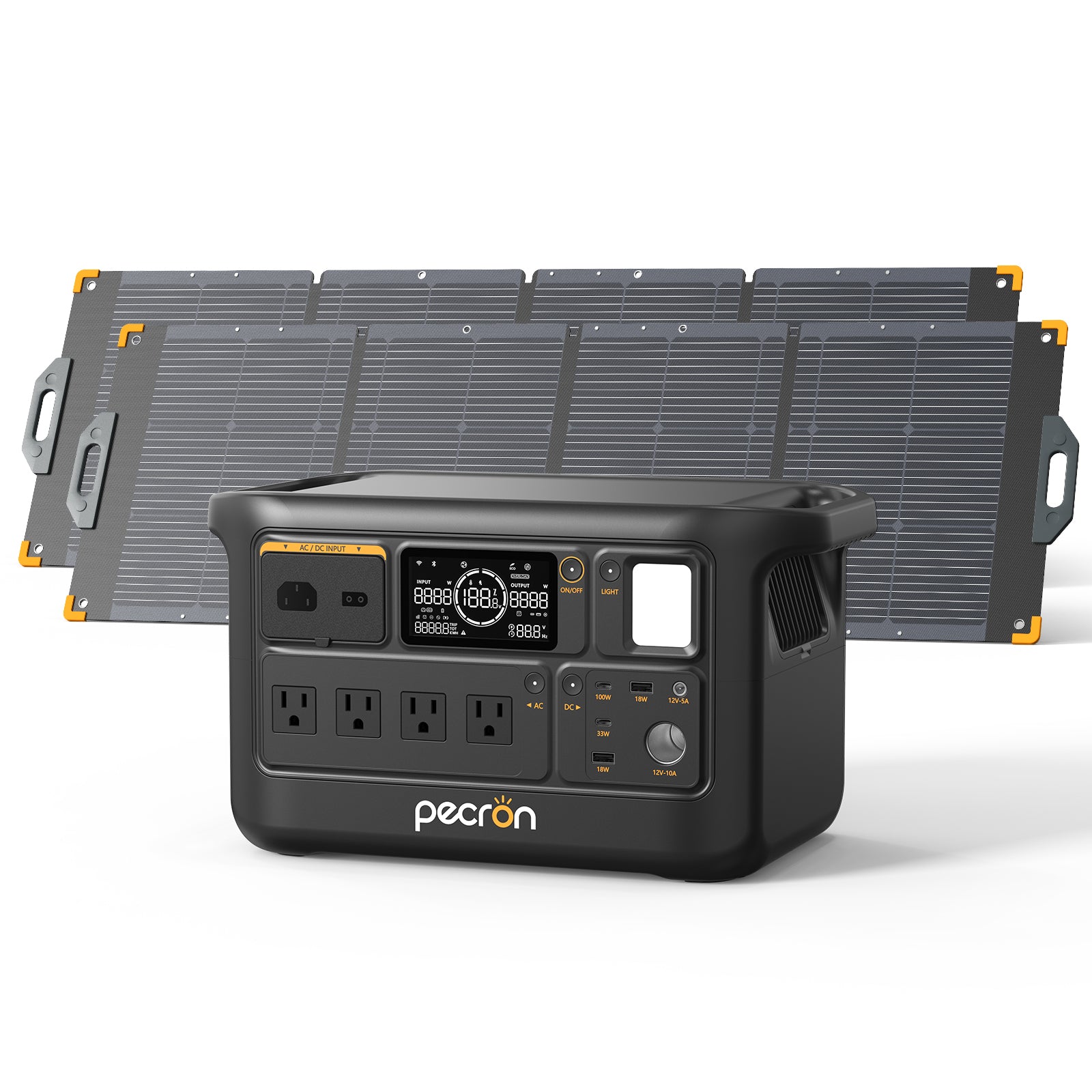
The exact selected offer lists 2 PECRON PV200 panels, 400 W combined nameplate. It does not establish actual solar harvest or the exact connecting cable.
Explore this need in the finder →Must this station support a compatible expansion battery later?
The exact F1000LFP product page and manual reviewed for this assessment do not establish a supported expansion battery; unknown support does not meet an essential expansion requirement.
Explore this need in the finder →Pecron · 960 Wh station with two 200 W panels
Pecron F1000LFP with 2× PV200 review
This F1000LFP option packages the same 960 Wh, 1,500 W station with two PECRON PV200 panels. It is the 400 W combined-nameplate choice in the F1000 panel lineup, not a different battery system. The manufacturer’s captured U.S. product JSON listed the selected option out of stock on October 25, 2026; availability can change, so treat that as a dated observation rather than a permanent status.
400 W of panel rating is not 400 W in every condition
The selected station-page code is F1000LFP+2*PV200. The official PV200 product page identifies each panel as 200 W nominal at 36 V, with about 5.4 A operating current and a 41.4 V open-circuit rating. Two panels therefore represent 400 W of combined nameplate and 10.8 A of summed panel current before tolerances. Pecron specifies the F1000’s single solar input for 11–60 V, 14 A maximum and 600 W maximum. These figures make a 400 W bundle plausible against the station’s published ceiling, but they do not verify that the exact package includes the needed parallel wiring or MC4-to-station cable. The PV200 uses MC4 connectors; the selected-option page does not list each cable or demonstrate the array layout. Check Pecron’s exact wiring direction before connecting the pair.
Two panels in series would add their open-circuit voltages and exceed the station’s 60 V upper solar-input boundary, so do not improvise a series connection. A parallel arrangement keeps panel voltage in the same range while summing current, but the package page does not document that layout or its included adapter. This is an important practical limit: the bundle name confirms the offer includes two panels, while the source set does not confirm a particular F1000 wiring harness. If compatible connection instructions and cables are essential, ask the manufacturer to confirm those exact pieces before buying.
Carrying and placing two panels
Pecron lists each PV200 at roughly 6.9 kg, or about 15.2 lb, and gives folded dimensions around 561 × 595 × 40 mm. Two panels mean roughly 13.8 kg of panel mass alone before cables, plus the station’s published 23.9 lb. The flat deployed area is substantial: each opens to about 2,064 × 595 mm. This is better understood as a vehicle-based charging kit than a small backpack setup. It needs a level place to unfold, clear sun, and frequent adjustment as the sun moves. The panel page suggests a clean surface and angle adjustments; real output falls with shade, clouds, dirty surfaces, and unfavorable orientation.
The 400 W combined panel rating leaves theoretical headroom under the F1000’s 600 W input maximum. It does not promise a particular recharge time, and panel rating should not be translated directly into AC runtime. The station stores 960 Wh, and its input ceiling and battery state constrain charging. Pecron’s recharge claims for wall power are separate from solar performance. If the user expects a fridge or other AC appliance to run overnight, size the load and hours against watt-hours rather than assuming two panels replenish the battery on schedule.
What the bundle does not upgrade
The inverter and port set are unchanged from the station-only profile: 1,500 W rated AC at 120 V, 960 Wh nameplate capacity, USB-C ports and 12 V outputs. The extra panels do not make a 240 V appliance compatible, increase the 1,500 W AC ceiling, or establish battery expansion. A buyer who mainly wants larger outage capacity should compare a larger station or a model with documented expansion rather than automatically choosing more solar hardware. The F1000’s exact U.S. documentation does not establish an expansion battery for this configuration.
For comparison, the one-panel PV200 option reduces the number of items to place and carry but has half the panel nameplate. The three-PV200 option lists 600 W of panels, exactly the station’s published input ceiling, but it raises both deployment burden and the current-layout questions. The two-panel choice is the middle configuration: 400 W is useful only when the panels can be safely connected and the user has space for both. The PV300 alternatives instead trade panel count for heavier individual panels.
Who this option fits
Consider this package if the F1000’s fixed 960 Wh and 1,500 W limits already match your appliances, you have a vehicle or storage area for two foldable panels, and you want a source-listed 400 W panel package. It is a poor match for anyone who needs a verified cable list, a guaranteed daily solar yield, or a weatherproof station. The panel’s IP67 claim applies only to the PV200; keep the power station protected and follow its manual. Before choosing, compare the exact manufacturer option, confirm the available stock and included charging lead, and obtain written array guidance if both panels must run at once.
Key details at a glance
| Nameplate battery capacity | 960 Wh |
|---|---|
| Rated AC output | 1500 W |
| Manufacturer surge rating | 3000 W |
| Maximum solar input | 600 W |
| Included panels, combined nameplate | 400 W |
| Maximum USB-C output per port | 100 W |
| Listed weight | 23.9 lb |
| 12 V DC output | 120 W |
| Maximum AC recharge input | 1000 W |
| AC outlet output | Yes |
| USB-C ports | 2 |
| USB-A ports | 4 |
| Solar input ports | 1 |
| 12 V car-style output | 120 W |
| Vehicle charge input | 120 W |
| Battery chemistry | LiFePO4 |
| Expansion battery in this package | No |
| Home Power Panel in this package | No |
| Separate station units in offer | 1 |
| Smart Transfer Switch in this package | No |
| Solar panels in exact offer | 2 |
Use the exact model’s instructions for operating limits, supplied equipment and version differences.
Sources for this assessment

A useful match starts with the loads that matter.
Use the finder for hard electrical requirements, then check appliance starting behavior, actual run time and the exact package in the full assessment.