
Your needs, this model
Does it fit your priorities?
Will the F1000LFP's fixed 960 Wh and 1,500 W output suit your 120 V load?
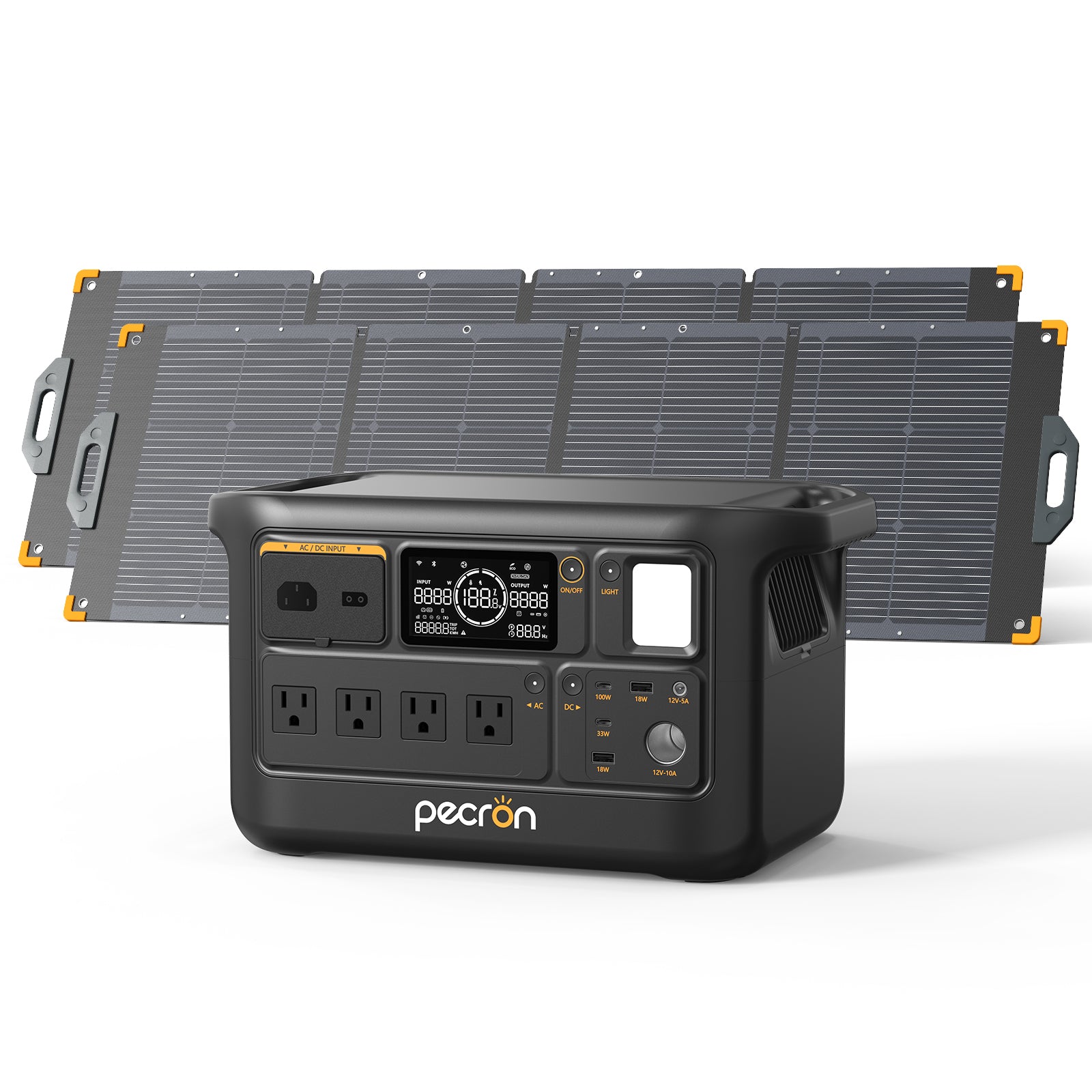
This offer retains one 120 V F1000LFP rated at 1,500 W AC and 960 Wh; panel count does not increase the inverter or battery.
Explore this need in the finder →Must the exact box include at least 600 W of panel nameplate?
The exact selected offer lists 2 PECRON PV300 panels, 600 W combined nameplate. It does not establish actual solar harvest or the exact connecting cable.
Explore this need in the finder →Must this station support a compatible expansion battery later?
The exact F1000LFP product page and manual reviewed for this assessment do not establish a supported expansion battery; unknown support does not meet an essential expansion requirement.
Explore this need in the finder →Pecron · 960 Wh station with two 300 W panels
Pecron F1000LFP with 2× PV300 review
The captured F1000LFP+2*PV300 option lists two PV300 panels with one F1000 station. That is 600 W of combined panel nameplate from the manufacturer’s 300 W panel specification, equal to the station’s stated maximum solar-input wattage. It is not a 600 W AC output station, nor does it store more than the base F1000’s 960 Wh. The selected offer was marked unavailable in Pecron’s U.S. product JSON on October 25, 2026; the dated availability record is not a permanent claim about future stock.
The panel total reaches the station ceiling
Each PV300 page lists 36 V operating voltage, 8.3 A operating current, and an open-circuit voltage near 41.4 V. The F1000 manual lists one solar-input route from 11 to 60 V, 14 A maximum and 600 W maximum. Two panels add to 600 W on nameplate, but the exact way to connect both matters. If arranged in parallel, their nominal currents sum to about 16.6 A, above the F1000’s listed 14 A maximum. If placed in series, their open-circuit voltage would exceed the 60 V limit. The product-page bundle selection and paired-panel rendering do not resolve how the manufacturer intends the pair to connect, whether a combining device is included, or how the station limits input.
This is not proof that the listed bundle is unusable; it is a material unresolved interface question. The PV300 panel page lists MC4 connectors and the linked manual says to use the MC4 cable supplied with a Pecron machine and follow the station’s wiring instructions. But neither source, as captured, supplies a specific F1000 two-panel diagram or exact bundle cable list. A shopper whose essential need is to connect both panels simultaneously should not receive a positive compatibility recommendation from these unknowns. Ask Pecron for the exact F1000+2×PV300 wiring and accessory list before treating it as a complete charging system.
Plan for the real physical kit
Pecron lists each PV300 at around 12.74 kg, so two panels weigh about 25.5 kg (56 lb) before the station and cables. They unfold to roughly 2,362 × 787 mm each. This is a significant outdoor setup, not a single compact panel with a spare hidden in a bag. The F1000 itself weighs about 23.9 lb. The two panels plus station exceed 80 lb of total equipment by a rough arithmetic sum, although carrying that load in separate trips is likely more practical than attempting to lift it as one unit. Consider vehicle access, shade-free space, secure panel placement, and whether two large surfaces can be positioned without obstructing a walkway.
The manufacturer’s panel instructions say actual output depends on solar radiation, cloud cover, dust, angle and orientation; a clean surface and repositioning can help but do not promise a given output. The “600 W” total is an upper nameplate sum, not a daily energy guarantee. It does not establish how quickly the F1000’s 960 Wh battery will recharge in a particular location, and power is affected by the station’s 600 W input cap. The panel’s IP67 statement is for the panel only. Keep the power station dry and follow its own operating limits.
Compare the lighter options first
One PV300 kit has half the panel nameplate and requires only one large panel to deploy. Two PV200 panels are a lower-weight alternative at about 13.8 kg of panel mass together, and their total 400 W rating leaves more headroom under the F1000’s 600 W input ceiling. Three PV200 panels also sum to 600 W, but create their own current and connection question. A buyer should compare not only rated watts but panel count, listed weight, open-circuit voltage, and the actual supported wiring for this station. A larger panel total is not useful if the intended connection is unspecified or the outdoor layout is impractical.
Choose a larger battery if the plan is to run substantial appliances after sunset. The F1000 remains a 120 V, 1,500 W AC station with 960 Wh of storage in this two-panel offer. It does not become expandable because two solar panels are bundled, and its exact documentation does not establish a 240 V output. For longer backup duration, compare Pecron models with a documented expansion path and assess their weight and capacity directly.
Bottom line
The two-PV300 version is the highest-rated F1000 panel set in this captured option group, but its electrical combination needs a manufacturer-confirmed connection plan. It is appropriate to shortlist only for someone who values two PV300 panels, accepts their size and weight, and can verify compatibility and included cables for the exact U.S. offer. It is not a substitute for a larger battery or inverter. The panel manual is linked on the product page under a cover/model label of S300, while the product page calls the retail model PV300; that association is preserved in the evidence rather than converted into an unsupported revision claim.
Key details at a glance
| Nameplate battery capacity | 960 Wh |
|---|---|
| Rated AC output | 1500 W |
| Manufacturer surge rating | 3000 W |
| Maximum solar input | 600 W |
| Included panels, combined nameplate | 600 W |
| Maximum USB-C output per port | 100 W |
| Listed weight | 23.9 lb |
| 12 V DC output | 120 W |
| Maximum AC recharge input | 1000 W |
| AC outlet output | Yes |
| USB-C ports | 2 |
| USB-A ports | 4 |
| Solar input ports | 1 |
| 12 V car-style output | 120 W |
| Vehicle charge input | 120 W |
| Battery chemistry | LiFePO4 |
| Expansion battery in this package | No |
| Home Power Panel in this package | No |
| Separate station units in offer | 1 |
| Smart Transfer Switch in this package | No |
| Solar panels in exact offer | 2 |
Use the exact model’s instructions for operating limits, supplied equipment and version differences.
Sources for this assessment

A useful match starts with the loads that matter.
Use the finder for hard electrical requirements, then check appliance starting behavior, actual run time and the exact package in the full assessment.