
Your needs, this model
Does it fit your priorities?
Will the F1000LFP's fixed 960 Wh and 1,500 W output suit your 120 V load?
This offer retains one 120 V F1000LFP rated at 1,500 W AC and 960 Wh; panel count does not increase the inverter or battery.
Explore this need in the finder →Must the exact box include at least 600 W of panel nameplate?
The exact selected offer lists 3 PECRON PV200 panels, 600 W combined nameplate. It does not establish actual solar harvest or the exact connecting cable.
Explore this need in the finder →Must this station support a compatible expansion battery later?
The exact F1000LFP product page and manual reviewed for this assessment do not establish a supported expansion battery; unknown support does not meet an essential expansion requirement.
Explore this need in the finder →Pecron · 960 Wh station with three 200 W panels
Pecron F1000LFP with 3× PV200 review
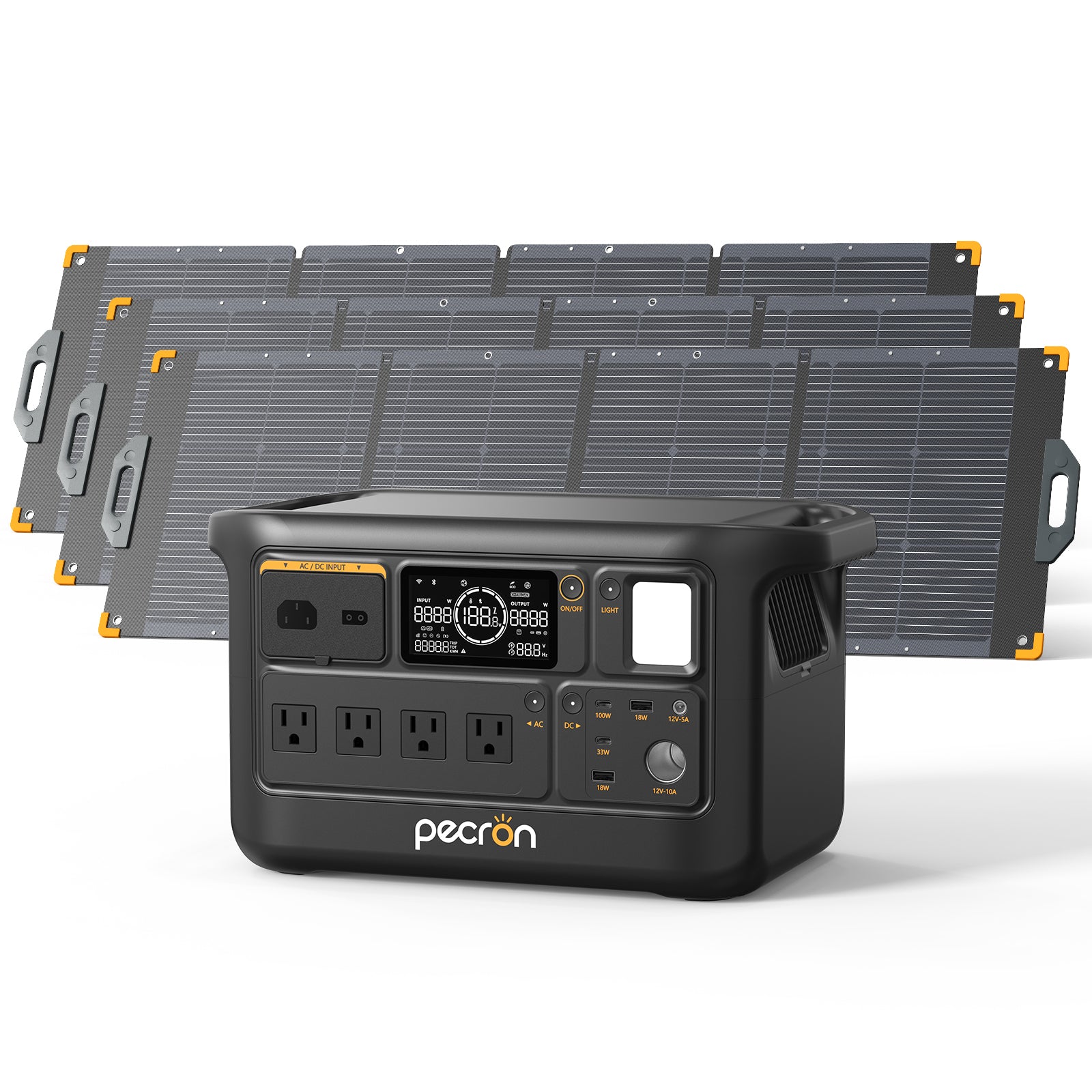
The F1000LFP+3*PV200 selection is the largest panel count shown among the captured F1000 solar options: one 960 Wh station and three PV200 panels. The three-panel composition is visible in the manufacturer’s selected-option image, and Pecron’s PV200 page lists each panel at 200 W nominal. The station is still the same 120 V, 1,500 W F1000. This configuration’s useful distinction is therefore its advertised 600 W of panel nameplate, not extra storage or a higher AC rating. The exact offer was unavailable in the U.S. product data captured October 25, 2026, but out-of-stock does not erase a model option from the reference set.
The difficult part is the array, not the wattage sum
On paper, 3 × 200 W reaches 600 W, equal to the F1000’s published maximum solar input. The station manual gives one solar input with an 11–60 V window and a 14 A maximum. The PV200 page lists roughly 36 V operating voltage, about 5.4 A operating current, and 41.4 V open-circuit voltage per panel. Three panels in parallel would keep the voltage at one panel’s level but add roughly 16.2 A at nominal ratings, above the station’s published 14 A input current. Three in series would stack open-circuit voltage above the 60 V limit. These are conditional calculations from the published individual ratings—not a claim that the manufacturer’s offer cannot be used. They show why the package image and option title alone are not a wiring diagram.
The archived F1000 offer does not state whether a controller, combiner, or other cable arrangement is included for all three panels. The PV200’s separate page lists MC4 connectors; the F1000 station has its own stated solar input limits. The safe recommendation is to ask Pecron for a precise connection diagram and confirm exactly which cables or adapters are in this kit. Until that bridge is documented, the selection is not a positive match for a shopper who needs all three supplied panels connected together in a single supported array. Its exact panel count and nameplate rating can still be recorded, but unknown compatibility cannot pass an essential requirement.
Space, setup, and actual harvest
Each PV200 is four-fold and listed around 6.9 kg; three panels weigh roughly 20.7 kg before any cables, while the station itself is listed at 23.9 lb. Each panel unfolds to about 2,064 × 595 mm. That is a large ground layout, with separate stands and surfaces to manage. This offer belongs in a car-camping or deliberate backup setup with clear outdoor space, not an assumption of a single carry-on unit. Keep the station in a dry, protected location; the panel’s IP67 rating does not confer weather protection on the power station.
Even if the full array is correctly connected, 600 W is a nameplate ceiling, not a forecast of continuous input. Pecron’s PV200 instructions emphasize orientation and clean surfaces, and the manufacturer warns that clouds and other conditions reduce output. Nearby shade on one panel can change the useful contribution of the array. The station can also limit input at its own rated ceiling, and charging behavior depends on battery state. Do not turn a 600 W paper total into a precise recharge-time or refrigerator-runtime promise.
Compare it with the smaller F1000 kits
The single PV200 bundle has fewer panels to place and a lower total nameplate. The two-PV200 option lists 400 W and stays below the F1000’s 600 W ceiling; its array details still need confirmation, but the nominal panel current is less aggressive than a three-panel parallel calculation. A PV300 panel supplies 300 W on its own, but it is much heavier at about 12.74 kg and has its own electrical characteristics. None of these options adds watt-hours to the F1000. If the real problem is overnight energy rather than daytime solar input, compare a higher-capacity station first.
The base F1000 facts also do not establish an expansion-battery path. The larger Pecron E1000LFP or E1500LFP V3 offers more capacity/expansion options in their own manufacturer documentation, although they weigh more. A 240 V load requires a separate plan, not more PV200 panels. The best configuration is the smallest one whose battery, inverter and verified solar operating plan fit the actual load.
Bottom line
This is the correct F1000 offer to consider only if three PV200 panels in the box are valuable and Pecron confirms how they are safely configured with the F1000. Its three panel nameplates total 600 W, but an all-panels-together need remains unverified in the saved product and manual evidence. It is not a reason to assume three panels will deliver 600 W through the station input. Confirm cables, supported array layout, current behavior, and the exact package at purchase time. The model profile preserves the confirmed selected option while refusing to promise an undocumented connection.
Key details at a glance
| Nameplate battery capacity | 960 Wh |
|---|---|
| Rated AC output | 1500 W |
| Manufacturer surge rating | 3000 W |
| Maximum solar input | 600 W |
| Included panels, combined nameplate | 600 W |
| Maximum USB-C output per port | 100 W |
| Listed weight | 23.9 lb |
| 12 V DC output | 120 W |
| Maximum AC recharge input | 1000 W |
| AC outlet output | Yes |
| USB-C ports | 2 |
| USB-A ports | 4 |
| Solar input ports | 1 |
| 12 V car-style output | 120 W |
| Vehicle charge input | 120 W |
| Battery chemistry | LiFePO4 |
| Expansion battery in this package | No |
| Home Power Panel in this package | No |
| Separate station units in offer | 1 |
| Smart Transfer Switch in this package | No |
| Solar panels in exact offer | 3 |
Use the exact model’s instructions for operating limits, supplied equipment and version differences.
Sources for this assessment

A useful match starts with the loads that matter.
Use the finder for hard electrical requirements, then check appliance starting behavior, actual run time and the exact package in the full assessment.