
Your needs, this model
Does it fit your priorities?
Will the F1000LFP's fixed 960 Wh and 1,500 W output suit your 120 V load?
This offer retains one 120 V F1000LFP rated at 1,500 W AC and 960 Wh; panel count does not increase the inverter or battery.
Explore this need in the finder →Must the exact box include at least 300 W of panel nameplate?
The exact selected offer lists 1 PECRON PV300 panels, 300 W combined nameplate. It does not establish actual solar harvest or the exact connecting cable.
Explore this need in the finder →Must this station support a compatible expansion battery later?
The exact F1000LFP product page and manual reviewed for this assessment do not establish a supported expansion battery; unknown support does not meet an essential expansion requirement.
Explore this need in the finder →Pecron · 960 Wh station with one 300 W panel
Pecron F1000LFP with PV300 review
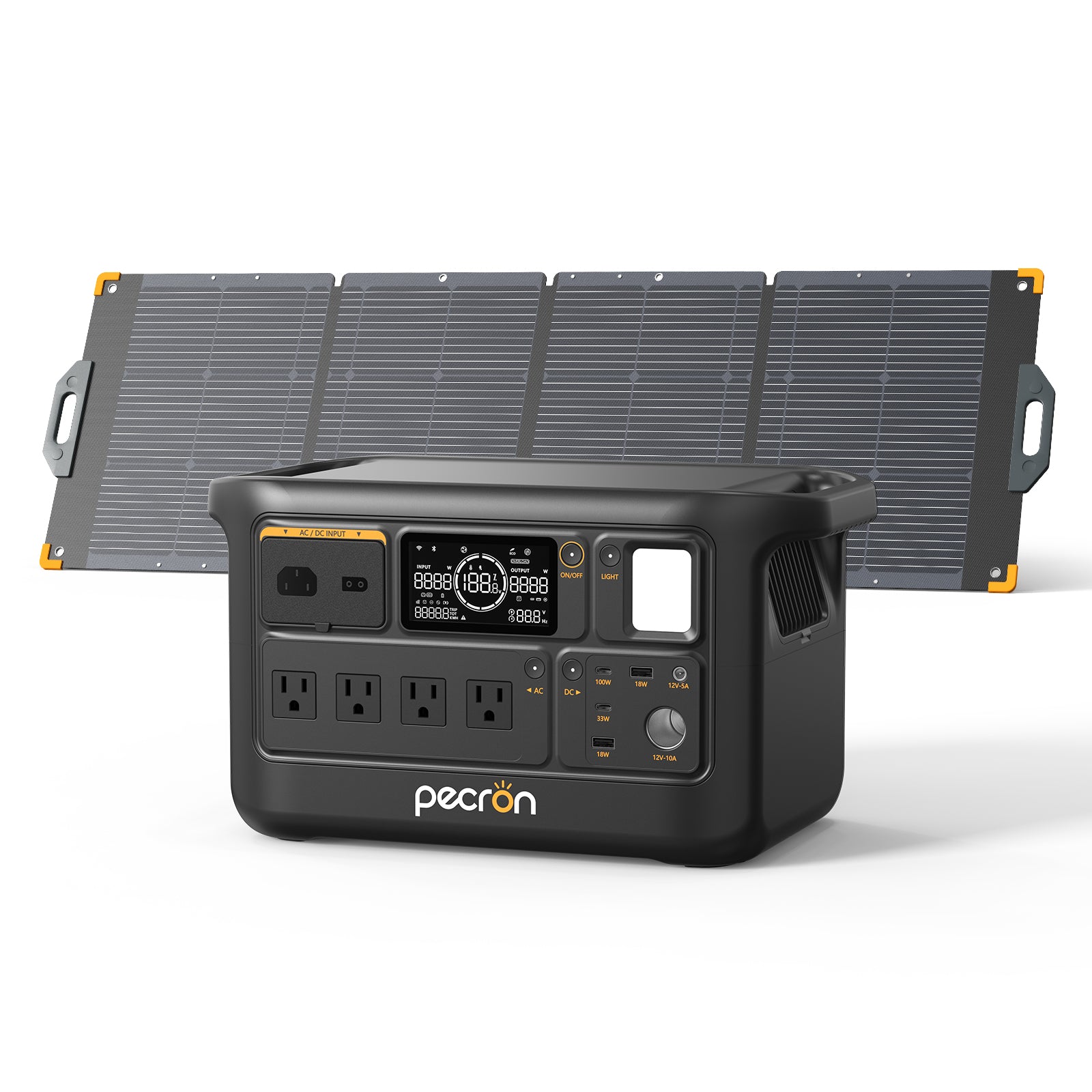
The F1000LFP+PV300 option pairs one F1000 station with one PECRON PV300 panel. It offers a higher-rated individual panel than the PV200 version while leaving the station unchanged: 960 Wh nameplate capacity and 1,500 W rated AC output. Pecron’s captured U.S. option was out of stock on October 25, 2026; this observation is dated, and stock can change. The exact station-page option and image show one panel, while the manufacturer’s panel page supplies the PV300 specifications.
More panel rating, but also much more panel to carry
Pecron describes the PV300 as a four-fold 300 W panel with 36 V operating voltage, 8.3 A operating current and 41.4 V open-circuit voltage. The manufacturer lists about 12.74 kg (28.1 lb), folded dimensions around 636 × 789 × 49 mm, and an unfolded size near 2,362 × 787 mm. By comparison, the PV200 is about 6.9 kg and folds to a smaller footprint. A 300 W panel has 50% more nominal power than one 200 W panel, but the published PV300 weight is nearly double. This matters if the kit is lifted from a vehicle or set up by one person; the station’s own weight, 23.9 lb, is separate.
The F1000’s solar input is rated up to 600 W, 14 A, and 11–60 V. A single PV300’s listed operating and open-circuit voltages fall within that range, and its published operating current is below 14 A. That comparison is a useful nameplate screening check, not a certification of the exact bundle’s adapter lead. The PV300 uses MC4 connectors; the F1000 takes the station-side input described in its manual. The PV300 manual linked on Pecron’s product page instructs users to use the MC4 cable supplied with a Pecron machine and to follow that machine’s own wiring instructions. The F1000 option page does not itemize the exact cable contents, so verify the kit’s actual lead and connector route before relying on plug-and-play setup.
Do not confuse a panel rating with recharge performance
A single 300 W panel remains below the station’s 600 W input ceiling, so it does not fill the entire possible solar-input rating by nameplate. Under favorable conditions it can offer a stronger panel source than one PV200; it still cannot guarantee a particular charge time. Sun angle, cloud cover, shading, dust, temperature and the battery’s current state all affect delivered power. Pecron’s own PV300 manual discusses adjusting the panel angle and keeping its surface clean. Actual solar input can be much lower than the nominal maximum, and the station’s battery remains 960 Wh. A panel does not turn a short battery into a multi-day energy store.
IP67 is the PV300 panel’s published rating, not the station’s. The manual warns against damp storage and placing the panel near fire, and the F1000 should be protected according to its own instructions. Unfold the panel where it can face the sun without blocking a path; keep connectors dry and avoid dragging the panel across sharp edges. The large deployed footprint is part of the decision, not a minor accessory detail.
How it compares with other F1000 selections
One PV200 is lighter and supplies a smaller nameplate, while two PV200 panels reach 400 W across two pieces of gear. One PV300 gives a 300 W nameplate in a single panel but weighs more and opens wider than the PV200. The two-PV300 package raises the combined panel nameplate to 600 W; it is far heavier and requires confirmation of the array’s supported configuration. The F1000LFP+PV300 option is a middle ground only in power rating, not in carry weight: one panel may be less cumbersome than two, yet it is still a nearly 28 lb foldable panel plus the 23.9 lb station.
If you need more stored energy for overnight or high-watt loads, choose a station with greater battery capacity rather than paying attention only to the input source. The F1000 is rated for 1,500 W AC at 120 V, and the battery remains fixed at 960 Wh in the reviewed evidence. The exact manual does not establish a supported expansion battery. It is not a 240 V solution, and solar panel count does not increase the inverter rating.
Who should choose the PV300 bundle?
It may suit a buyer who values one larger panel and can accommodate its weight and deployed size, while the F1000 station itself already fits the device plan. It is a poor fit if the user needs a very light panel, known cable contents, guaranteed real-world harvest, or more energy storage. The PV300 manual calls the panel model S300 while the current U.S. product page names PV300; the manual is linked from the PV300 page, but this wording difference is retained rather than silently treated as a revision-level identity bridge. Check the exact current selected option, confirm the panel and cable contents, and follow the station’s connection limits before use.
Key details at a glance
| Nameplate battery capacity | 960 Wh |
|---|---|
| Rated AC output | 1500 W |
| Manufacturer surge rating | 3000 W |
| Maximum solar input | 600 W |
| Included panels, combined nameplate | 300 W |
| Maximum USB-C output per port | 100 W |
| Listed weight | 23.9 lb |
| 12 V DC output | 120 W |
| Maximum AC recharge input | 1000 W |
| AC outlet output | Yes |
| USB-C ports | 2 |
| USB-A ports | 4 |
| Solar input ports | 1 |
| 12 V car-style output | 120 W |
| Vehicle charge input | 120 W |
| Battery chemistry | LiFePO4 |
| Expansion battery in this package | No |
| Home Power Panel in this package | No |
| Separate station units in offer | 1 |
| Smart Transfer Switch in this package | No |
| Solar panels in exact offer | 1 |
Use the exact model’s instructions for operating limits, supplied equipment and version differences.
Sources for this assessment

A useful match starts with the loads that matter.
Use the finder for hard electrical requirements, then check appliance starting behavior, actual run time and the exact package in the full assessment.