
Your needs, this model
Does it fit your priorities?
Will 960 Wh and 1,500 W cover your 120 V device plan?
The station is rated for 1,500 W at 120 V and holds 960 Wh nameplate energy; watt-hours determine duration.
Explore this need in the finder →Is a 600 W solar ceiling enough when the panel is separate?
The F1000 lists one XT60 input up to 600 W within 11–60 V; no panel is included in the base offer.
Explore this need in the finder →Do 23.9 lb and 100 W USB-C suit your carry kit?
Pecron lists 23.9 lb and up to 100 W from its main USB-C port; expansion support remains unknown.
Explore this need in the finder →Pecron · lighter 960 Wh AC station
Pecron F1000LFP review
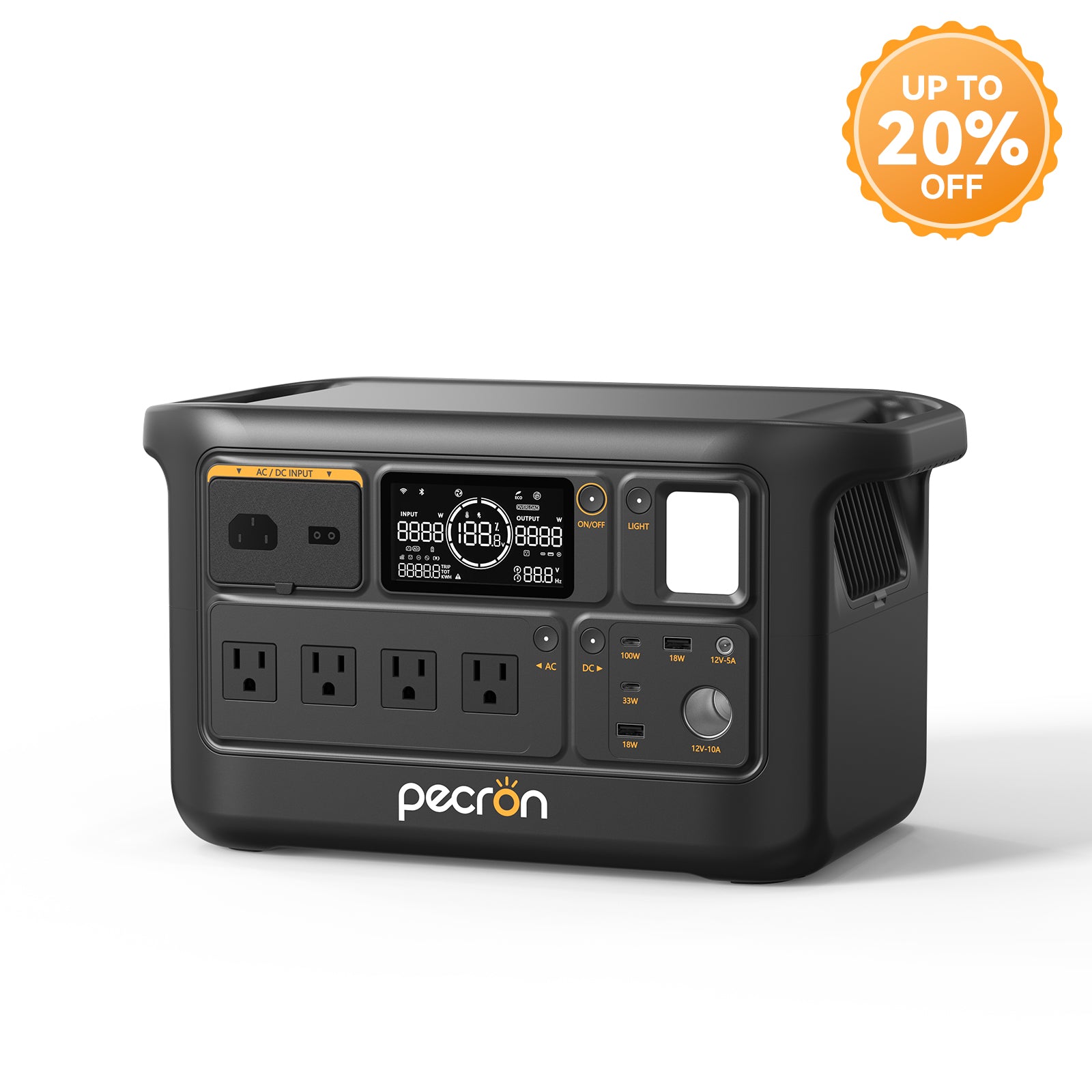
The F1000LFP is a 960 Wh station with a 1,500 W pure-sine inverter, weighing about 23.9 lb. Its attraction is not maximum stored energy; it is a middling-size battery with relatively fast wall charging, a broad set of direct outputs and a quieter operating claim at lower loads. The current U.S. standalone variant was marked unavailable in the captured offer on October 25, 2026. That stock snapshot does not erase the model, and the page offers separate panel-kit choices that should not be confused with the base station.
Size it by watt-hours as well as watts
Pecron lists 1,500 W of 100–120 V AC output and a 3,000 W surge rating, plus 960 Wh of LiFePO4 storage. The AC rating describes the power the inverter can supply within its limits, not how long it can hold that output. A 1,000 W appliance, for example, would consume the battery far faster than a router or laptop; conversion losses and cycling behavior also change real runtime. Treat the manufacturer's 3,500-cycle-to-80% figure as a published claim, not an independent endurance test.
The front panel has a 12 V/10 A DC section, a 100 W USB-C port, an additional USB-C output listed at 33 W, four USB-A ports rated up to 18 W, a car-style socket and a 5 W light. Pecron calls this ten versatile outputs. The separate output ratings do not mean every port can supply its maximum simultaneously, and 12 V/10 A is a 120 W upper bound for that port. The manual's port diagram is useful for matching the supplied lead to a device; do not infer that a socket is interchangeable with a hardwired DC connection.
Recharge speed and a solar ceiling
The F1000LFP accepts up to 600 W through its XT60 solar input, with a listed 11–60 V window and 14 A maximum. Pecron claims up to 1,000 W AC input, reaching 80% in about 50 minutes and a full charge in around 1.1 hours. The times are manufacturer's figures under the stated charging conditions, not a measured guarantee for an arbitrary wall circuit or mixed input. Solar panels are presented as separate F1000LFP+PV200 and PV300 offer options; the station-only selection does not include a panel. Confirm whether the matching XT60 lead is in the exact box before planning a plug-and-play array.
Pecron also advertises a 25 dB noise figure under 500 W of running load. This should be read as a limited manufacturer claim, not a guarantee of silent operation at high output or a value independently measured here. The page also lists UPS behavior, app and Bluetooth control, and two-plus-three-year warranty wording; confirm registration rules and the exact support period with the manufacturer.
Its limits are useful selection facts
The F1000's base page does not establish a compatible expansion battery, so a buyer who must add capacity later should not count the model as expandable from assumption. Its AC ceiling is lower than the E1000LFP's 1,800 W rating, while its stated battery is slightly smaller at 960 Wh versus 1,024 Wh. The E1000 has a published expansion path, but is heavier at about 29 lb. The F1000 may be the more convenient choice when 1,500 W is sufficient and a roughly 24 lb case, fast AC recharge, quiet-low-load claim and USB-C options matter more than the E1000's small capacity advantage.
For a larger solar input and expansion plan, the E1500LFP V3 raises the solar ceiling to 1,000 W and offers a documented expansion route, at the cost of roughly 38 lb and a higher carrying burden. The E2400LFP more than doubles the F1000's nameplate capacity and raises the inverter rating, but it weighs about 45 lb and accepts a different, lower published solar ceiling. No model can be chosen from its watt-hour label alone; check the loads, run time, recharge window and whether the exact panel or cables are included.
Who is likely to be satisfied?
The F1000LFP fits road trips, outdoor work and smaller home backup needs where a 120 V outlet, USB charging and fast wall recovery are more important than multi-day battery storage. Its 23.9 lb listed weight is manageable for occasional lifting but still substantial beside compact device chargers. It is a poor match for a 240 V load or a long-duration high-watt appliance, and it should not be treated as a vehicle jump starter merely because it has car-related inputs and outputs.
Before committing, open the exact U.S. option, confirm availability and included accessories, and read the [F1000LFP manual](https://cdn.shopify.com/s/files/1/0509/5263/4556/files/PECRON_F1000_LFP_user_manual_100V_120V_-960Wh.pdf?v=1778464867). The E1000LFP is the more sensible alternative if an expansion path or 1,800 W inverter matters. The F1000 earns a place when its lower weight, faster published recharge and output mix suit the actual trip or outage plan—and when a fixed 960 Wh battery is enough.
Key details at a glance
| Nameplate battery capacity | 960 Wh |
|---|---|
| Rated AC output | 1500 W |
| Manufacturer surge rating | 3000 W |
| Maximum solar input | 600 W |
| Included panels, combined nameplate | 0 W |
| Maximum USB-C output per port | 100 W |
| Listed weight | 23.9 lb |
| 12 V DC output | 120 W |
| Maximum AC recharge input | 1000 W |
| AC outlet output | Yes |
| USB-C ports | 2 |
| USB-A ports | 4 |
| Solar input ports | 1 |
| 12 V car-style output | 120 W |
| Vehicle charge input | 120 W |
| Battery chemistry | LiFePO4 |
| Expansion battery in this package | No |
| Home Power Panel in this package | No |
| Separate station units in offer | 1 |
| Smart Transfer Switch in this package | No |
| Solar panels in exact offer | 0 |
Use the exact model’s instructions for operating limits, supplied equipment and version differences.
Sources for this assessment

A useful match starts with the loads that matter.
Use the finder for hard electrical requirements, then check appliance starting behavior, actual run time and the exact package in the full assessment.