
On this page
Your needs, this model
Does it fit your priorities?
Does the documented F3000LFP (U.S. standalone SKU F3000LFP, without cart) station plan meet 3,072 Wh and 3,600 W at 120 V without counting any unverified package additions?
The F3000LFP (U.S. standalone SKU F3000LFP, without cart) station itself is listed at 3,072 Wh and 3,600 W at 120 V. Any listed EP3800 modules or second-station arrangement is not added to a confirmed package capacity here.
Explore this need in the finder →Do you need 4 listed 300 W panel(s), 1200 W nameplate total, as part of the exact offer?
The exact variant title and SKU list 4 PV300-named 300 W panels (1200 W nameplate sum). That confirms package quantity and rating only; exact panel revision and approved combined wiring remain unknown.
Explore this need in the finder →Can the listed EP3800-48V pack(s) be counted as compatible included expansion capacity?
The selected option lists 2 EP3800-48V pack(s), but the exact F3000LFP (U.S. standalone SKU F3000LFP, without cart) compatibility and cable path remain unresolved. Use the station-only plan unless Pecron confirms this specific revision and supported capacity.
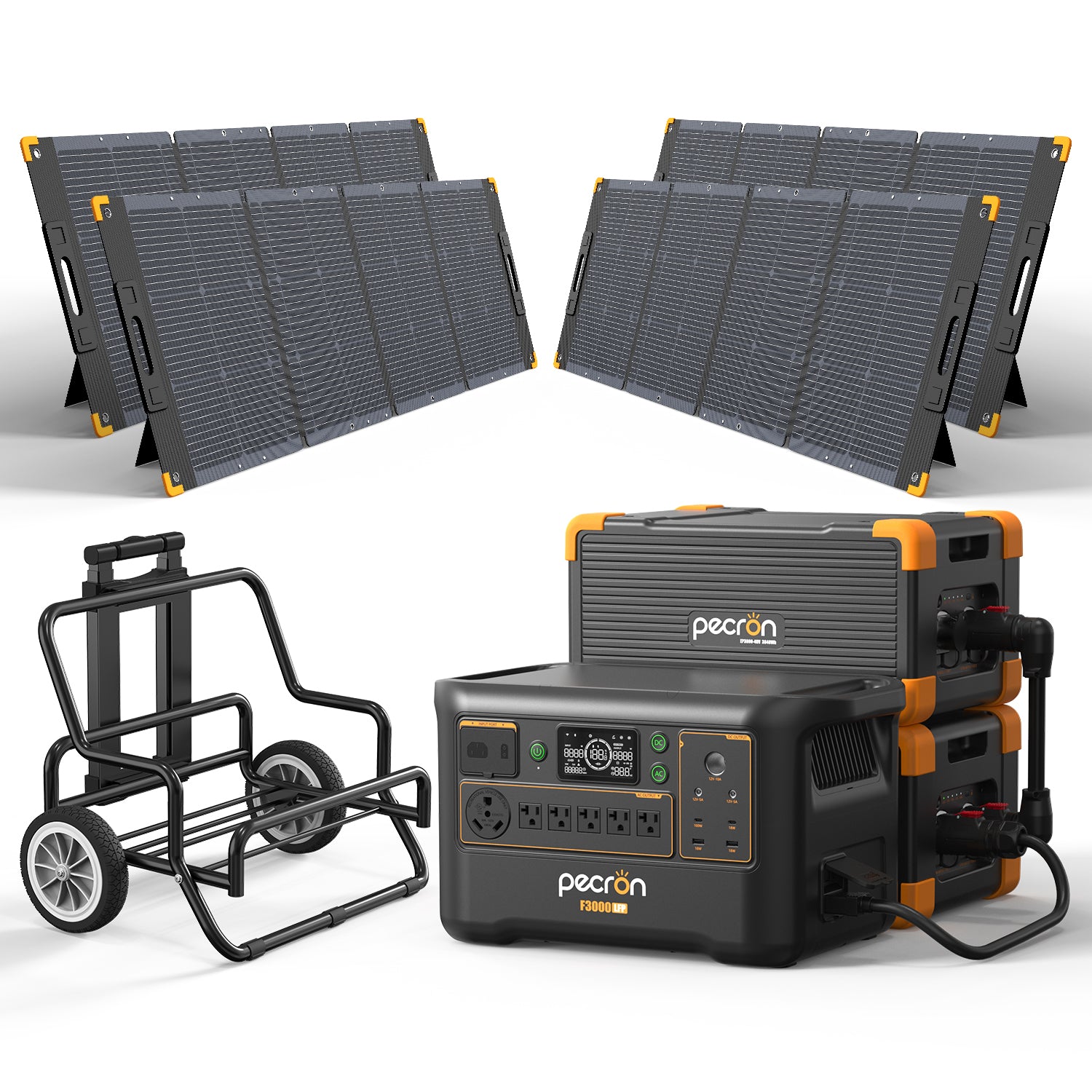
Explore this need in the finder →Pecron · F3000LFP · four panels, two packs and cart
The most complete F3000 option in this group
This exact selected F3000LFP bundle includes four PV300-named panels, two EP3800-48V packs and a cart. It gathers substantial equipment around one station, so it is more appropriate to compare as a site setup than as a single portable power box. The cart is a real included-package distinction, but its payload and terrain ratings are not published in the saved evidence. The F3000 body is around 63 lb on its own; the full package weight and whether the cart can carry the station, panels and battery modules together are not established. Use the cart only according to Pecron’s written limits.
Station specs remain 3,072 Wh, 3,600 W continuous AC at 120 V, and a short 4,500 W surge claim. Four panels at a 300 W nameplate each total 1,200 W, while the F3000’s published solar input maximum is 1,600 W. That arithmetic gives a potentially useful margin, but it does not prove all four supplied panels may feed the station together. The exact panel identity/revision and wiring plan remain open; the sales label PV300 and related S300 manual reference do not yet agree closely enough to authorize a configuration by inference. Confirm panel voltage/current, connectors, leads and the approved array layout before use.
The selected option also lists two EP3800-48V packs. Their presence does not increase the F3000’s inverter output, and the exact compatibility path is still unconfirmed against the F3000 instructions. For runtime, use only the station’s 3,072 Wh base nameplate unless Pecron resolves which pack revision works and how the system is connected. A correct answer should identify the station revision, pack version, cable, pack limit and supported total capacity—not simply repeat the bundle SKU.
Practical setup questions
Four separate panels demand more deployment room than the word “portable” suggests. Think about where the panels will sit, how far they are from the station, how to protect the connection and how you will store them when weather changes. The F3000 should have ventilation and be kept out of exposure. The images are product renderings, not proof of a rainproof installation or included extension leads. The total weight also matters: a cart can simplify rolling but does not solve loading the complete package into a vehicle or moving it up stairs.
For an outage plan, decide whether you need the station for a refrigerator, network equipment, lights, pumps or larger appliances. Check both simultaneous power and daily energy. A compressor’s startup can be more demanding than its normal running draw, and a 3,600 W limit must be respected. The 1,200 W panel label is a maximum nameplate sum, not an expected charge level in ordinary weather. If the pack arrangement is not verified, do not count on it to bridge a multi-day outage.
Alternatives and matching
Consider the four-panel F3000 selection without a cart if you have another safe means of moving it. Choose a two-panel option if storage space and a simpler installation matter more than the largest listed panel count. If a compatible larger battery is essential, compare a package where the exact F3000/EP3800 combination has a complete manufacturer connection plan—or choose the known station-only capacity rather than paying for an unverified expansion label. If 240 V is required, this single F3000 does not satisfy it.
The finder can require the cart, four panels and the F3000’s own 120 V output. It will reject an essential requirement for all four panels to be confirmed working together, or for a minimum of compatible included EP3800 packs. Those are real evidence gaps, not defects in the station’s separately documented output. The exact option was marked available in the saved source JSON, which may not reflect today’s inventory. Verify the exact SKU, current contents and written compatibility before purchasing.
Key details at a glance
| Nameplate battery capacity | 3072 Wh |
|---|---|
| Rated AC output | 3600 W |
| Manufacturer surge rating | 4500 W |
| Maximum solar input | 1600 W |
| Included panels, combined nameplate | 1200 W |
| Maximum USB-C output per port | 100 W |
More specifications and setup details
| Listed weight | 63.3 lb |
|---|---|
| Compatible extra-battery expansion | Yes |
| 12 V DC output | 120 W |
| Maximum AC recharge input | 1800 W |
| AC outlet output | Yes |
| USB-C ports | 1 |
| USB-A ports | 2 |
| Solar input ports | 1 |
| Battery chemistry | LiFePO4 |
| Home Power Panel in this package | No |
| Separate station units in offer | 1 |
| Smart Transfer Switch in this package | No |
| Solar panels in exact offer | 4 |
Use the exact model’s instructions for operating limits, supplied equipment and version differences.
Sources for this assessment

A useful match starts with the loads that matter.
Use the finder for hard electrical requirements, then check appliance starting behavior, actual run time and the exact package in the full assessment.