
On this page
Your needs, this model
Does it fit your priorities?
Does the documented F3000LFP (U.S. standalone SKU F3000LFP, without cart) station plan meet 3,072 Wh and 3,600 W at 120 V without counting any unverified package additions?
The F3000LFP (U.S. standalone SKU F3000LFP, without cart) station itself is listed at 3,072 Wh and 3,600 W at 120 V. Any listed EP3800 modules or second-station arrangement is not added to a confirmed package capacity here.
Explore this need in the finder →Do you need 4 listed 300 W panel(s), 1200 W nameplate total, as part of the exact offer?
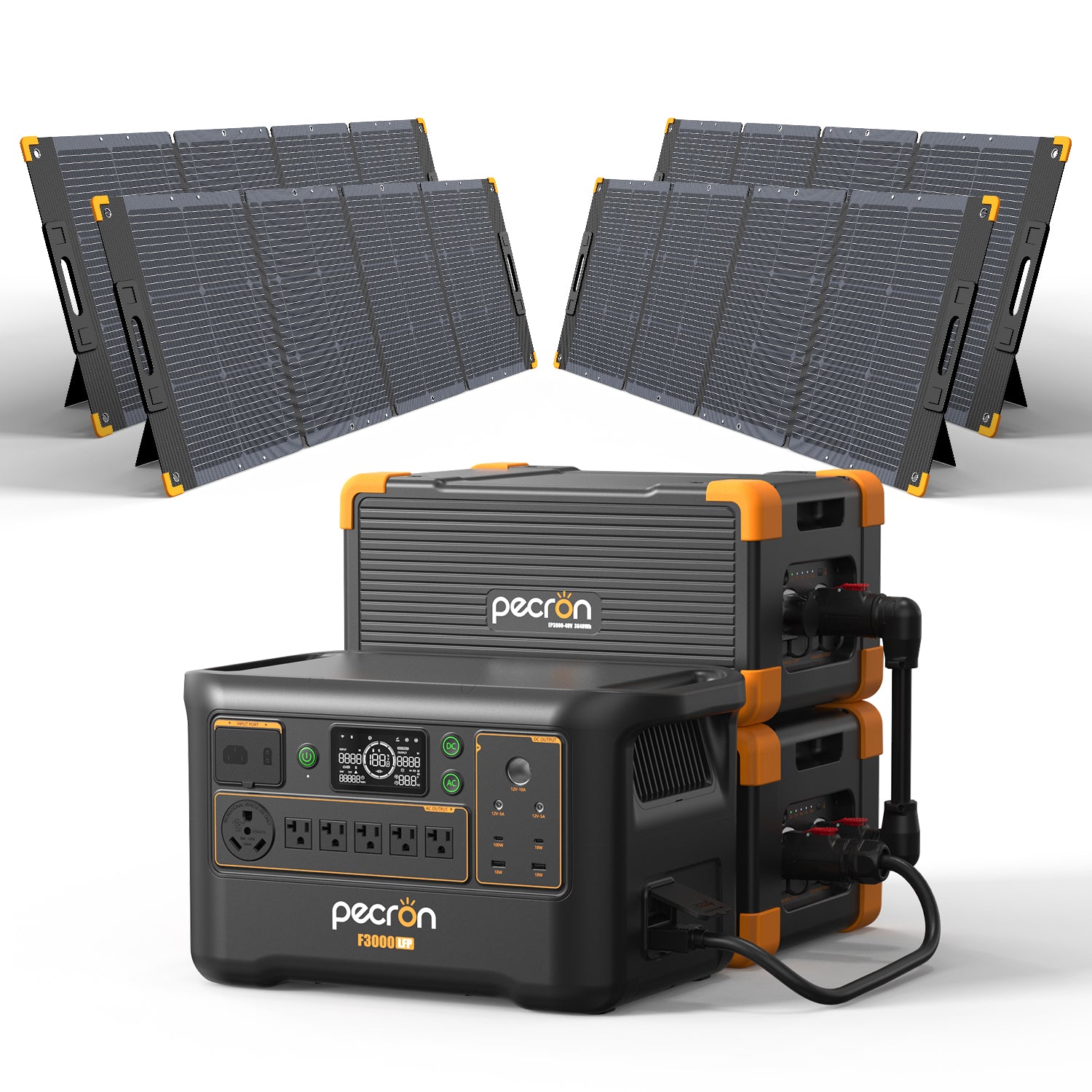
The exact variant title and SKU list 4 PV300-named 300 W panels (1200 W nameplate sum). That confirms package quantity and rating only; exact panel revision and approved combined wiring remain unknown.
Explore this need in the finder →Can the listed EP3800-48V pack(s) be counted as compatible included expansion capacity?
The selected option lists 2 EP3800-48V pack(s), but the exact F3000LFP (U.S. standalone SKU F3000LFP, without cart) compatibility and cable path remain unresolved. Use the station-only plan unless Pecron confirms this specific revision and supported capacity.
Explore this need in the finder →Pecron · F3000LFP · four panels and two listed EP3800 packs
More in the box, but not more verified station output
This selected option lists one F3000LFP, four PV300-named 300 W panels and two EP3800-48V packs. It omits the cart. The F3000 is still the same one-station, 120 V inverter: 3,600 W continuous AC and 3,072 Wh nameplate. Two additional battery packs do not raise its AC rating. The listing identifies the component quantities, but the compatible expansion arrangement for the exact F3000 version remains unconfirmed in the reviewed manual. The safe planning figure remains the station’s own 3,072 Wh until Pecron confirms the proper pack revision, connection lead and supported resulting capacity.
Four 300 W panels sum to 1,200 W of panel nameplate, below the F3000’s published 1,600 W solar-input maximum. The comparison is useful but incomplete: input voltage, current and electrical layout still govern what can actually be connected. The selection’s PV300 label does not resolve the related S300 manual/model-code mismatch. Do not assume four panels may be combined in one string or that the seller includes the correct splitter. Before purchase, request the station-specific arrangement, panel open-circuit and operating values, connector type, cables and any separate-input restrictions.
Even a supported 1,200 W array would not mean a steady 1,200 W charge through the day. Sunlight and panel angle vary, and a station’s input electronics may limit collection. Use the array as a potential recharge source, not a guaranteed runtime extension. A buyer planning a long outage should size the load first, estimate energy use and preserve a backup reserve rather than buying a panel count by headline alone.
Space, lifting and daily use
The F3000 body is about 63 lb, before either pack or any panel. This exact option has no trolley, and total bundle mass and storage footprint are not established. Four panels also need a place to unfold and a plan for cable routing. A home workshop, cabin or stationary emergency kit is a better match than a compact vehicle setup. The station should sit where its vents have room and where it can be protected from rain; panels need a separate clear site and should be secured against wind.
For a backup circuit, compare the 3,600 W continuous limit with the simultaneous load, including the start of motors and compressors. The F3000 advertises a 4,500 W surge for a short period, so do not use that momentary figure as a run rating. For capacity, begin with 3,072 Wh and the actual duration of each load. The value is not the amount of AC energy you will get at the outlets, and the pack labels are not usable storage until compatibility is verified. A 240 V appliance or linked split-phase requirement is outside this single-station operating plan.
Who should compare it
This package is relevant to someone who wants four named panels and two listed expansion packs delivered with the F3000 and does not require a cart. The large panel inventory may be useful if it can be configured to meet the station’s input limits. The pack count may be attractive, but it is not a reason to assume the system reaches a particular total capacity. If you need mobile equipment, a cart-included counterpart is a better starting point. If you only need solar charging and a known 120 V station, compare the standard F3000 plus a simpler panel bundle.
Matching can verify the F3000’s base output, four listed panels and 1,200 W panel nameplate sum. It will not say the four panels work together, because the exact array layout is unresolved, and it will not count the named EP3800 modules as compatible expansion batteries. This keeps an essential solar or runtime requirement from passing on a title alone. The archived U.S. source marked this selected option available at capture; confirm current availability and exact contents before ordering.
Key details at a glance
| Nameplate battery capacity | 3072 Wh |
|---|---|
| Rated AC output | 3600 W |
| Manufacturer surge rating | 4500 W |
| Maximum solar input | 1600 W |
| Included panels, combined nameplate | 1200 W |
| Maximum USB-C output per port | 100 W |
More specifications and setup details
| Listed weight | 63.3 lb |
|---|---|
| Compatible extra-battery expansion | Yes |
| 12 V DC output | 120 W |
| Maximum AC recharge input | 1800 W |
| AC outlet output | Yes |
| USB-C ports | 1 |
| USB-A ports | 2 |
| Solar input ports | 1 |
| Battery chemistry | LiFePO4 |
| Home Power Panel in this package | No |
| Separate station units in offer | 1 |
| Smart Transfer Switch in this package | No |
| Solar panels in exact offer | 4 |
Use the exact model’s instructions for operating limits, supplied equipment and version differences.
Sources for this assessment

A useful match starts with the loads that matter.
Use the finder for hard electrical requirements, then check appliance starting behavior, actual run time and the exact package in the full assessment.