
On this page
Your needs, this model
Does it fit your priorities?
Must the exact package include a cart?
The selected U.S. option is titled “F3000LFP+2*PV300 / With Cart”; cart capacity, weight and terrain limits are not stated.
Explore this need in the finder →Are at least 2 PV300-named panels and 600 W combined panel nameplate listed?
The selected option names 2 panels. 600 W is their nameplate sum, not measured charging power.
Explore this need in the finder →Can all supplied panels be verified as a supported array with this station?
No. The exact panel revision, array topology and cable are unknown. The host input ceiling alone does not establish wiring compatibility.
Explore this need in the finder →Pecron · two-panel F3000LFP option with cart
Pecron F3000LFP with two PV300 panels and cart review
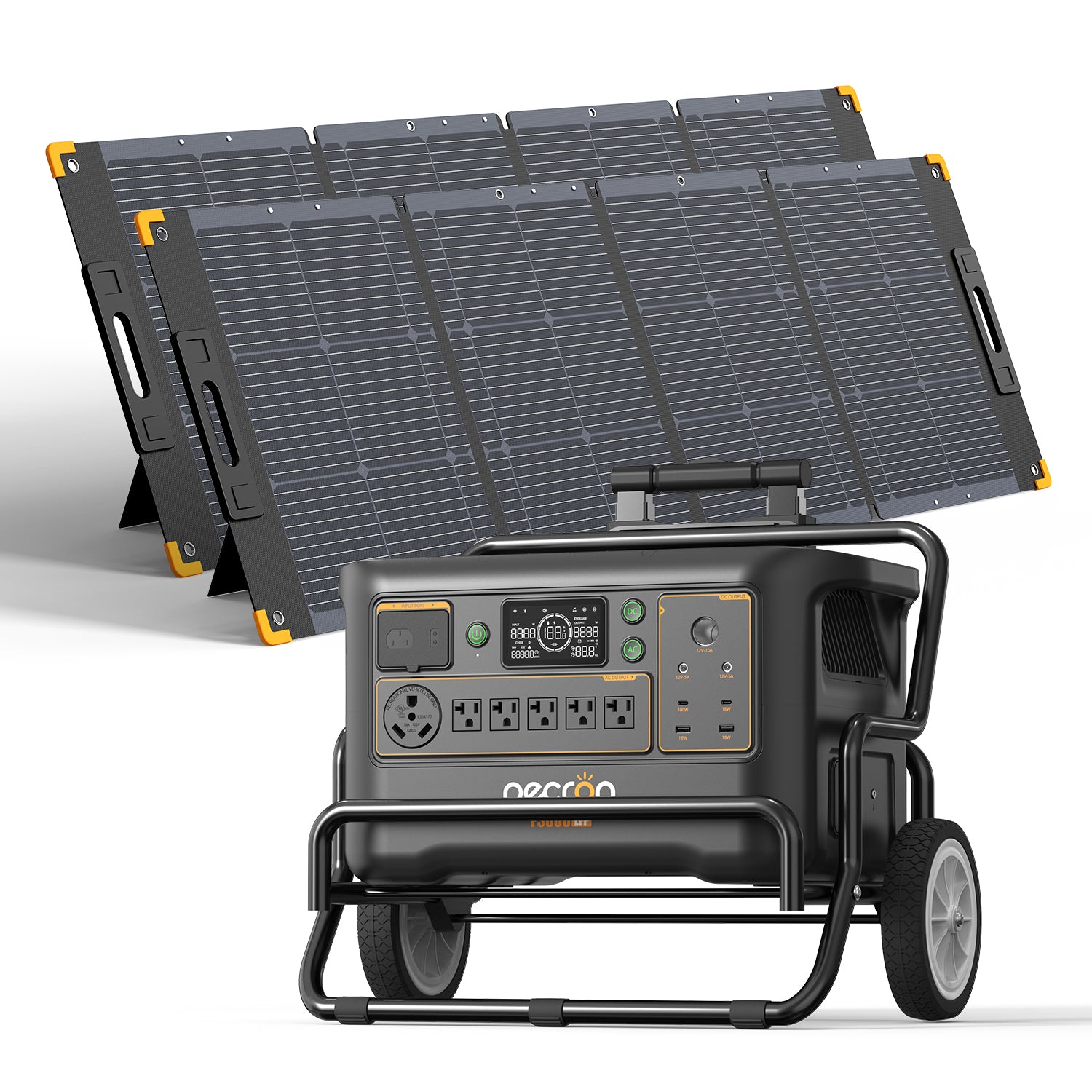
This selected U.S. offer is identified as F3000LFP+2*PV300 / With Cart, SKU F3000LFP+2*PV300+cart. It combines one F3000LFP station, two PV300-named panels and an included transport cart. The cart is the important difference from the separately reviewed no-cart two-panel selection; the panels and power station remain the same described configuration. The official source establishes that the cart is part of this variant, but not its model number, weight, capacity, mounting method, or terrain rating. Buyers should treat the cart as a useful included accessory whose precise limits still need confirmation.
What two panels change
Two 300 W panel nameplates total 600 W on paper. That is more panel equipment than the one-panel version, but it does not raise the F3000LFP’s 3,072 Wh battery capacity or 3,600 W AC output. It also is not a promise of 600 W entering the station in ordinary conditions. Sun angle, shade, temperature, and conversion losses affect harvest. The manufacturer’s F3000 manual gives a 1,600 W maximum solar-input ceiling across its single input and a 25–120 V / 25 A range. The 600 W arithmetic total is below that watt ceiling; it still does not establish the two-panel electrical arrangement or cable path.
That distinction matters because the package listing names PV300, while the separate linked panel manual names S300. The available records do not establish whether the package’s panel revision is the one described by the manual. They also do not verify the exact MC4-to-XT60 cable or whether the two panels should be connected in series, parallel, or by another approved method. Ask Pecron for the exact wiring and supplied-lead instructions before making an all-panels-together plan. Until then, the known package count is not a compatibility guarantee.
Large station, same load limits
The F3000LFP remains a 120 V station rated at 3,600 W AC, with a five-second 4,500 W surge rating and 3,072 Wh nameplate storage. A cart can help when shifting the 63.3 lb station between adjacent areas, especially if repeatedly lifting is undesirable. But the rendering only shows an example of the unit on its cart; it is not a load test or proof that the cart safely handles ramps, steps, rough ground, or a vehicle transfer. The total weight of cart, station, panels, and cables is not published in the selected variant.
Do not use capacity as a substitute for a runtime estimate. AC conversion reduces energy delivered to appliances, and actual load cycling is unknown. The station’s surge rating does not guarantee that a pump, compressor, or other motor will start with other devices connected. This is a substantial 120 V backup or worksite choice, not a compact device for daily carrying.
Questionnaire fit and limits
The ordinary questionnaire’s cart requirement should make this variant different from the no-cart two-panel model. A required 120 V outlet and adequate AC rating fit the station; requiring at least two listed panels also fits the captured selection. A strict 601 W solar-panel floor is one watt above its 600 W panel-nameplate sum and should reject it. A requirement that both supplied panels be confirmed to work together should also reject it for now: the exact array plan remains unknown. The cart does not solve any electrical uncertainty.
Who should buy this package?
This is for someone who wants the F3000’s host output and storage, would make use of two listed panels, and prefers the source-listed cart over a separate accessory purchase. It makes less sense if you cannot store or deploy two panels, need verified solar wiring before selection, require 240 V, or expect the cart to carry the full kit without checking its rating. The cart may ease station movement, but it does not eliminate setup work: panels need their own placement and the station must be connected according to the exact instructions.
For fewer bundled components, the no-cart F3000 with two PV300 panels preserves the same stated panel count and station ratings. The one-panel-with-cart option trades away half the listed panel nameplate while retaining the cart selection. A larger station such as the E3800 changes the host capacity and output but does not automatically provide a verified solar array. Pick by the exact station requirement first, then consider panel count and cart as separate, evidence-bounded package choices.
Key details at a glance
| Nameplate battery capacity | 3072 Wh |
|---|---|
| Rated AC output | 3600 W |
| Manufacturer surge rating | 4500 W |
| Maximum solar input | 1600 W |
| Included panels, combined nameplate | 600 W |
| Maximum USB-C output per port | 100 W |
More specifications and setup details
| Listed weight | 63.3 lb |
|---|---|
| Compatible extra-battery expansion | Yes |
| 12 V DC output | 120 W |
| Maximum AC recharge input | 1800 W |
| AC outlet output | Yes |
| USB-C ports | 1 |
| USB-A ports | 2 |
| Solar input ports | 1 |
| Battery chemistry | LiFePO4 |
| Expansion battery in this package | No |
| Home Power Panel in this package | No |
| Separate station units in offer | 1 |
| Smart Transfer Switch in this package | No |
| Solar panels in exact offer | 2 |
Use the exact model’s instructions for operating limits, supplied equipment and version differences.
Sources for this assessment

A useful match starts with the loads that matter.
Use the finder for hard electrical requirements, then check appliance starting behavior, actual run time and the exact package in the full assessment.